GrayHats secure runner-up finish in Pacific Rim Collegiate Cyber Defense Competition
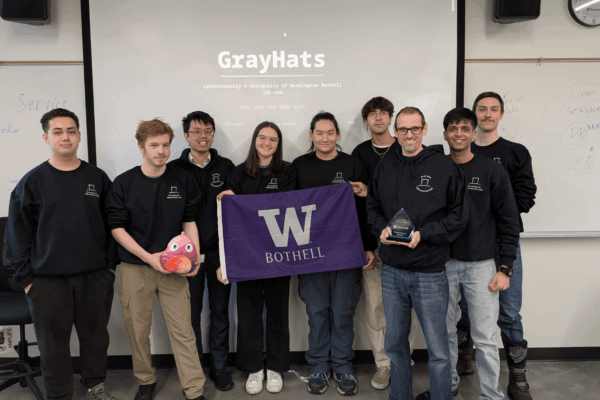
This year, the Collegiate Cyber Defense Competition team from UW Bothell’s GrayHat Cybersecurity Club won second place at the Pacific Rim Collegiate Cyber Defense Competition!
The PRCCDC serves as one of many regional competitions leading to the National Collegiate Cyber Defense Competition which focuses on operational tasks in managing and protecting network infrastructures.
On a regional scale, the PRCCDC brings together student teams from universities in Washington, Idaho and Oregon. GrayHats finished the competition in second place, competing against twelve other schools for the top positions.
Club Adviser Jesse Moore described the competition as a combination of students defending enterprise systems and services (such as workstations, servers, websites, databases, IAM, privacy data on systems, backup services) and responding to hackers, all while responding to business needs.
“The hackers are typically industry Ethical Hackers (from Apple, Microsoft, Boeing, Amazon, PNNL, etc. at PRCCDC), that are trying to access systems and services while also making it fun,” Moore said. “Fun may look like changing a desktop to a background.”
Building a team
The team consisted of eight members: Siddha Mehta (MSCE ‘26); Curtis Gilchrist (intended CSSE); Aidan Messmer (CSSE), Khang Tran (MSCE), Blake Bedford (CSSE: IAC); Kyle Ricks (CSSE: IAC ‘26), Jacob Brown (CSSE and Mathematics) and Melissa Ryan (CSSE).
As vice president of the club and team captain for the PRCCDC, Mehta oversaw the formation of the team, which he determined based not only on their technical skills, but also on their dedication and strong drive to win.
According to Mehta, the best teams are not found; they are built from the ground up.
“You don’t need a flawless roster from day one; you just need the right people with the right mindset to build something great together,” he said.
A learning experience for all
Many of the members had a desire to join an experience like PRCCDC.
Brown dreamed of participating in red-team/blue-team style simulations, where the red team plays an attacking role, and the blue team defends against threats.
“Joining the CCDC team was a way to fulfill that goal while forcing myself to rapidly acquire new skills that you just don’t get in a standard classroom setting,” Brown said.
His biggest challenge was catching up to the Linux proficiency of his teammates. He learned a necessary lesson in triage, focusing on non-vulnerable areas while leaving other ports exposed.
While competing for the first time came with high adrenaline, Brown was able to manage expectations even when facing challenges.
“Despite hearing stories from former club members, I tried not to form preconceived notions,” he said. “This allowed me to take the hits and the wins exactly as they came without comparing them to a ‘perfect’ scenario.”
PRCCDC was also a major learning experience for Gilchrist, a first-time attendee.
As a freshman, he decided to join the GrayHats after performing well in the first meeting’s hands-on challenge. He jumped at the chance to join the competition, wanting a real-world learning experience.
The competition, he said, felt like learning a new language. “But it’s based off a language I’ve used my entire life,” he said. “I knew about programming, not anything about scripting or security tools. Every tool I used, I learned about as I went. What made it challenging was just how much there was to learn, I can only do so much.”
Teamwork makes the dream work
As they recalled their experience at the competition, the team emphasized the importance of communication and cooperation, especially under stress and fatigue. This helped them get stronger as a team and also helped them better their skills.
“I became more confident in figuring things out on my own, especially since my team was relying on me,” Ryan said.
As the newest member of the team with the least experience, she worked closely with teammates who had competed before and had more knowledge.
“It took a lot of courage to ask questions and be okay with not knowing everything. But I stayed motivated, kept learning, and did my best to support the team,” Ryan said. “Looking back, I grew a lot through that process.”
“Seeing everyone focused and working to keep services running was intense. With each competition, we improved our efficiency and communication. I didn’t realize how important communication was until something went wrong and it affected the whole team,” Ryan said.
Tran reiterated teamwork being a vital part of the competition, especially keeping morale high during stressful situations.
“I learned that team communication and energy are the keys to success,” Tran said.
It was important to have a mix of skills offered by members in the team.
“Cybersecurity is a team effort, while you can know a lot about your system and maybe even about the entire environment, you cannot be everywhere and responding to everything at once,” Messmer said. “It’s better if you maintain general ability while specializing in one or two aspects and letting your team handle the rest.”
What’s next for the GrayHats?
With this experience completed, the team members look ahead, both personally and professionally.
For first timers like Ryan, PRCCDC gave her a ‘real look’ into the cybersecurity field.
“It wasn’t something I knew much about before, but I’ve enjoyed it so much that I can now see myself pursuing it as a career,” Ryan said. “I love the constant learning, the people I’ve met, and the impact of helping keep systems secure.”
Messmer also focused on the future with reverence: “I think this competition made me realize just how difficult it could be if you are dealing with stuff like this everyday, and I gained a lot more respect for those who deal with these situations in real-world environments,” he said. “But overall, it made me more excited than ever to learn about cybersecurity and want to do it as a career.”
Even while battling illness during the competition weekend, Bedford made it through and remembers the competition fondly. He was given a challenge coin from Mehta and a sticker from Moore.
“They will make nice drawer trophies that I will be able to look back on,” he said.
Through a stressful, high stakes competition, the GrayHats came out among the top teams in the region, something that marks their hard work and dedication.
Brown is already looking forward to next year: “We are already preparing for next year, and we’re in it to win it!”