CBIT releases case study in NSF report, “Educating for Impact”
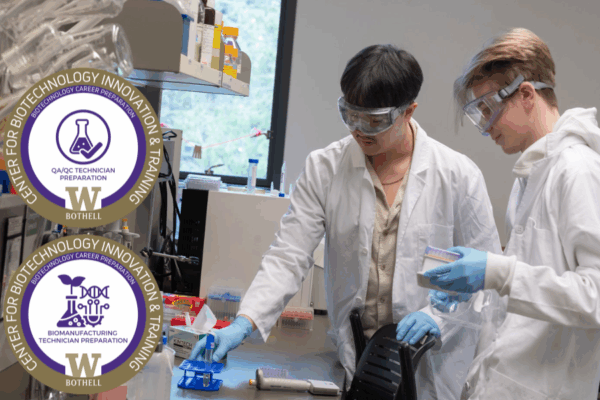
At the end of 2025, CBIT Director Guy Hamilton partnered with consultant John Carrese to author “Educating for Impact: Translating Science Curriculum into Industry-Ready Skills for the Cell and Immunotherapy Technician Workforce.” This report, supported by Shoreline Community College’s Immunotherapy Biohub, is funded by a grant from the National Science Foundation Advanced Technological Education program.
The full report focuses on how colleges can respond to the workforce needs of immunotherapy employers without creating a new career education program. Drawn from the report, this case study highlights how CBIT worked alongside industry and UW Bothell faculty to create digital badges as an academic credential.
Case Study: University of Washington Bothell
The following case study from The University of Washington Bothell (UW Bothell) Center for Biotechnology Innovation and Training (CBIT) is one example of how colleges can respond to the workforce needs of immunotherapy employers without creating a new program. The case study describes how UW Bothell developed short term credentials (i.e. digital badges), in collaboration with industry, by utilizing content from existing UW Bothell courses to teach students the skills needed for entry-level biotechnology positions.
CBIT was established in 2021 with the mission of “creating a sustained, robust workforce pool to support the growing biotechnology industry in Bothell and the greater Puget Sound region.” With a grant from Life Sciences Washington, CBIT formed a faculty task force to develop biotechnology curriculum at UW Bothell. The first phase of this work was to incorporate existing UW Bothell courses that align with skills needed for two specific positions: biomanufacturing technician and quality assurance/quality control associate.
The task force prioritized engagement with industry, with a series of forums to discuss the skills students need to enter the biotechnology industry (listed on the following page). After a series of high-engagement sessions, the team developed learning outcomes for the digital badges and mapped these to existing curriculum.
The task force developed two draft digital badges included in the UW Canvas Credentials system:
Biomanufacturing Technician Preparation
(for STEM majors outside of biology and chemistry)
Quality Assurance/ Quality Control Technician Preparation
(for biology or chemistry majors)
Each badge includes the following components:
- 10 – 20 credits of core coursework
- Introductory biology courses for the biomanufacturing badge
- Biochemistry and analytical chemistry for biology and chemistry majors
- Experiential project-based learning
- Introduction to biotechnology seminar
To earn a digital badge, students must complete a self-paced online course, moderated by faculty and an industry mentor, which guides them through reflections on class work they have previously completed. In the process, students demonstrate how they have met the digital badge learning outcomes and prepare for potential interview questions for entry-level positions.
The faculty task force recognized that students needed to supplement coursework within their major to learn about the biotechnology industry. As one industry representative said, “When I was in college, I had no idea about the industry; I was so lost – I mean, just lost. It was a big gap in my education and made it hard for me to visualize a future career.”
There are currently no required courses within UW Bothell STEM majors that provide an introduction to the biotechnology industry. However, UW Bothell faculty have previously taught a discovery seminar called “Biotechnology: from Lab to Shelf the Business of Health,” as well as a special topics course for biology majors that focused on biotechnology. These courses will be adapted to include those topics most relevant to STEM majors preparing for industry, such as:
- Introduction to the field of biotechnology (sub-disciplines, careers, basic biotech concepts)
- Pharmaceutical product development cycle
- How note-taking and lab notebooks correspond to documentation within the field
This biotechnology course is essential for students to understand how the skills and knowledge they have gained in their four-year degrees have prepared them for jobs in biotechnology. The course will be offered for the first time in Spring 2026.
PRIMARY TAKEAWAYS FROM INDUSTRY/FACULTY FORUMS
CORE STEM LAB SKILLS
Many of the general lab skills students need are part of required courses for almost any STEM major, including scientific method, use of lab protocols, data analysis, instrument calibration, and documentation.
VALUE OF PROFESSIONAL SKILLS
Professional (or “soft”) skills, such as collaboration, communication, and critical thinking were more important to success in entry-level biotechnology technician roles than extensive lab experience or in-depth knowledge of biology and chemistry.
CROSS-DISCIPLINARY KNOWLEDGE GAPS
Students from STEM majors outside of biology and chemistry need some fundamental knowledge of certain concepts such as measuring pH levels, cell culture procedures, protein structure, basic components of viruses, which could be covered in existing introductory courses outside the students’ major.
ADVANCED NEEDS FOR BIO/CHEM MAJORS
Students who have completed two years in biology and/or chemistry majors would benefit from additional course work in bioinformatics, advanced instrumentation, and biochemistry.
INDUSTRY CONTEXT & APPLICATION
All students need to understand the biotechnology industry, not just as an introduction to biotechnology lab procedures, regulated lab environments, and product development, but also to contextualize the general skills they gain within their majors within the actual procedures used within industry labs.