How summer scholarships empower student research
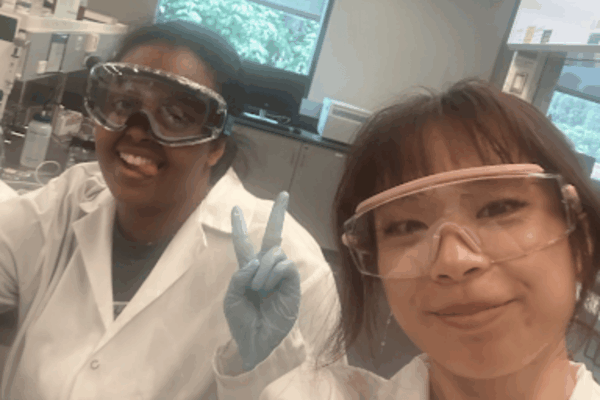
What happens when students are given the time and resources to pursue their curiosity? This summer, School of STEM students investigated how people understand quantum mechanics, explored environmentally friendly water filtration methods and gained firsthand experience conducting research alongside faculty mentors.
Supported by the STEM Undergraduate Summer Research Scholarship and the Department of Physical Sciences’ Chair’s Summer Research Award Scholarship, seven students spent their summer tackling big questions, testing new ideas and developing the skills that will shape their future careers.
Read on to learn about some of their research projects and experiences!
Jaci Chiang, Chemistry major (she/her)
- Research project: “Biochar filtration CURE for aqueous chemistry”
- Mentor: Dr. Charity Lovitt
- Scholarship: STEM Undergraduate Summer Research Scholarship
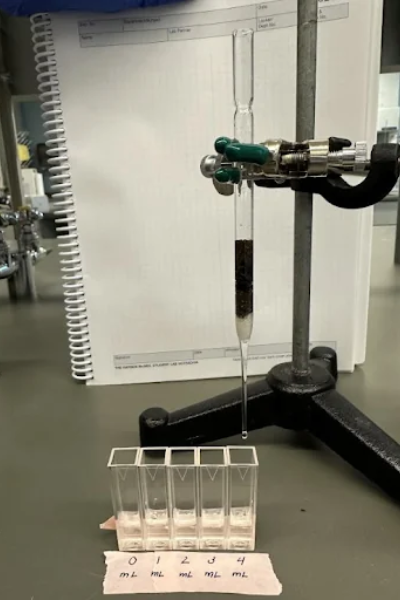
The idea for Chiang’s research project began when she thought about the waste that labs generate. While working with Dr. Charity Lovitt, teaching professor in the Department of Physical Sciences, Lovitt noted that she wanted to incorporate green chemistry to develop sustainable labs for an aqueous chemistry course.
Chiang and her team searched for studies that involved using biochar, a charcoal-like material, to filter water.
“We specifically focused on using biochar because of its adaptability (ability to create different biochars to target specific pollutants to clean out of water) and its eco-friendly features (biochar is made from plant waste and is also non-toxic to the environment/animals),” Chiang said.
The focus on water filtration became important to Chiang.
“Teaching students through a well-known, applicable substance like water helps the concepts be more understandable and memorable,” she said. “Incorporating green chemistry is always an important part of labs as it eliminates toxic substances from the environment.”
Working with faculty
Collaborating with Lovitt on this research taught Chiang about decision-making, independence and laboratory skills.
“I got the opportunity to choose the things that I wanted to test in the lab and how I wanted to approach them with the help and input of my mentor,” Chiang said. “Through this process, I learned that a research lab consists of a lot of trial and error because things don’t always go as smoothly as expected. This also taught me lots of problem-solving skills in order to meet a goal.”
The importance of funding research
The main thing that the scholarship provided Chiang was time.
“Without this scholarship, I am not certain that I would be able to spend as much extra time as I did in the lab to improve my findings in the experiments we were testing,” she said.
The funding also provided the proper equipment that made the research process more efficient.
“Although I do not want to work in a research environment in the future, this heavily contributes to my career goals of working in the biotechnology industry as it allows me access to equipment that I wouldn’t normally be able to operate in a normal class at UW Bothell,” she said.
Mia Longen, Physics major (she/her)
- Research project: “Conceptual resources for quantum interpretation”
- Mentor: Dr. Rachel Scherr
- Scholarship: Chair’s Summer Research Award Scholarship, Department of Physical Sciences
Longen’s research examined how students think about and discuss quantum mechanics. By listening to audio recordings from the Quantum Mechanics I course taught by Dr. Rachel Scherr, associate professor in the Department of Physical Sciences, she investigated how students engage with foundation questions that have long challenged physicists themselves.
“My job is to listen to the students and connect the ways that they approach quantum mechanical concepts to the existing physics education and philosophy of science literature to analyze how their ideas align with existing interpretations of quantum mechanics,” Longen said.
“This research is important to me because this is basically the only quantum mechanics class for undergraduates in the country that discusses quantum interpretations with students,” she said. “Not even expert quantum physicists agree about which interpretation is best, so it’s really interesting and insightful to see how students think about this idea.”
Working with faculty
Dr. Rachel Scherr also served as Longen’s mentor for the project.
“Dr. Scherr is one of the leading physics education researchers in the United States, so I am very grateful to be partnered with her on this project,” Longen said. “It’s like working with a celebrity! She knows everyone, so anytime I have a question about something she is able to point me towards a person who will know the answer or a research paper that discusses what I am wondering.”
Scherr also introduced Longen to the philosophy of science side of physics education research, which Longen had never been exposed to before.
“I basically learned everything that I know about quantum foundations due to Dr. Scherr, so this project would not have been possible without her,” Longen said.
The importance of funding research
The scholarship funding gave Longen the time to focus on conducting her research rather than acquiring a different job to make ends meet.
“I was happy to spend my time working on a research project that I was passionate about in my favorite field of study,” she said. “This summer I was able to dedicate about 100 hours to listening to audio recordings, organizing data, and making scientific claims about student thinking. If not for the scholarship, I would not have been able to present fully fledged ideas during the conference that I attended.”
Longen presented research findings at Foundations and Frontiers of Physics Education Research: Puget Sound 2026, where she received feedback from other physics education researchers and physics faculty from all over the country.
Her work with Dr. Scherr has connected a network of physicists interested in her research, which would not have been possible without Longen’s heavy focus on the project over the summer.
“Physics education research is my ultimate passion, so being able to dedicate my summer to participating in a research project really was fantastic,” Longen said.
The future of quantum mechanics education
As she enters her final year in the Physics program, Longen looks forward to continuing this research for her senior project.
“Learning about how to make quantum mechanics more approachable for undergraduate students is something that I have become passionate about through my work on this project,” she said.
The research project serves as a great example for other physics faculty across the country interested in incorporating discussions of quantum foundations into undergraduate courses. Longen’s work demonstrates that undergraduate students can engage meaningfully with these complex ideas and gain new perspectives on some of physics’ most enduring mysteries.
Support from the I Heart UW Bothell Luncheon and the STEM Advisory Board expanded opportunities for STEM undergraduate research scholars. Their annual contributions increased the number of fully funded summer research scholars from three to four. Learn more about last year’s experiences in 2025 Summer Undergraduate Research Scholarship Experiences.