Early wound healing research inspires future physician-scientist
“I’ve always been a curious person,” said Ian McAnally. “Even as a little kid I was fascinated by science and the ‘why’ behind how things work.”
As a third-year Biochemistry student, McAnally is making an impact with his research on wound healing, an interest sparked by his experience as a certified nursing assistant (CNA) in a memory care unit.
He began working as a CNA the summer before his first quarter at UW Bothell.
“Working as a memory care CNA has been one of the biggest influences in how I think about medicine and research,” he said. “What’s stuck with me the most is how much dementia affects the lives of a person and their family, and how many of our solutions are very limited.”
He also treated many residents with chronic wounds.
“I saw how current treatments weren’t effective for chronic wound healing and the struggle of residents afflicted by them,” he said. “Many residents under my care had wounds that seemed like they should’ve healed, but didn’t, which made me curious about what was happening biologically and why we don’t have a solution.”
McAnally’s experience as a CNA shaped how he views the bridge between research and medicine.
“As an aspiring physician scientist, I want my experiences caring for patients to inform the questions I bring into the lab, and I ultimately want my research in the lab to make its way back to patients.”
He currently works on a research team with Dr. Lori Robins, professor in the Department of Physical Sciences, whose work focuses on how active chlorine compounds act as antimicrobial, odor control and wound healing agents.
During his first year at UW Bothell, he was eager to get involved in biochemistry research. He connected with Robins, who invited him to attend her lab’s weekly group meetings and explore his interest in the field.
“After learning more about the chronic wound project, I knew I wanted to be part of Dr. Robins’ lab,” McAnally said. “Not only was I interested in the project itself, but by joining I saw how I’d be able to use my passion for science to help bring real solutions to people globally, which is my dream.”
“Dr. Robins is also very welcoming and knowledgeable, but also a fun professor to have as a mentor. Her obvious passion for her research and working with students is also why I chose to join.”
Robins highlighted McAnally’s passion for research, too.
“Ian showed up at our weekly meeting ready to learn and participate in the project,” Robins said. “It is clear to me that Ian is highly motivated, passionate and ready to learn. Ian has a bright future ahead of him, and I am excited that he joined my lab early in his undergraduate career.”
Finding solutions for chronic wounds
Robins’ team studies how active chlorine compounds can improve healing in chronic wounds, such as pressure injuries, diabetic foot ulcers, venous ulcers, through novel therapeutics.
As part of the research, McAnally investigates the role of matrix metalloprotease-9 (MMP-9), a protein that helps break down a wound’s damaged tissue during the healing process. While MMP-9 is essential for wound repair, elevated levels can cause the protein to degrade healthy tissue, preventing chronic wounds from healing properly.
“This is a big problem because chronic wounds pose an infection risk, smell, are painful, and affect over 300 million people globally. We hypothesize that active-chlorine compounds can inhibit MMP-9 activity, subsequently improving wound healing by restoring normal MMP-9 levels,” McAnally explained.
The team also collaborates with Dr. Jeffrey Williams, chief science officer at Medesol Global, Inc. and former chief scientific officer at Briotech, a company that uses hypochlorous acid (HOCl) solutions to promote healthy skin and wound healing. Williams and Robins have held a long-standing partnership, with Williams attending the group’s weekly meetings, offering research insight and mentorship and sharing knowledge about the industry.
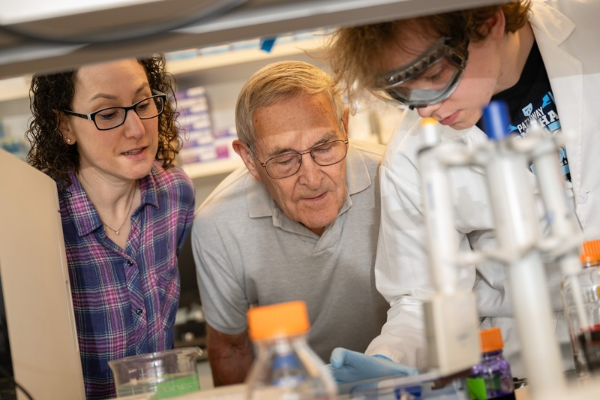
According to McAnally, previous research from Robins and former students has shown active-chlorine compounds to be stable, effective for odor control and antimicrobial agents.
The team’s long-term goal is to modify bandages already containing superabsorbent polymer (SAP) granules by coating the SAPs with active-chlorine compounds.
“SAPs are present in regular bandages to absorb wound exudate, keeping the area dry. Coated SAPs allow for a bandage that delivers active-chlorine compounds directly to a chronic wound to improve wound healing.”
His first research project, which remains ongoing, focuses on the stability of N-chlorotaurine (NCT), an active-chlorine compound, on NCT-coated SAP granules between room (about 20°C) and fridge ( about 4°C) temperatures.
“This [research] matters because NCT’s stability across temperatures determines how NCT coated SAP containing bandages should be stored for maximum effectiveness,” McAnally said. “Stability was measured by the amount of active chlorine present on the granules (mg Cl+/g SAP) via HACH digital iodometric titration over time.”
McAnally found that NCT coated SAPs stored at about 4°C maintained their original stability after over 200 days and counting, while SAPs stored at room temperature saw significant decreases in stability since coating – results that he presented at the spring 2026 STEM Symposium.
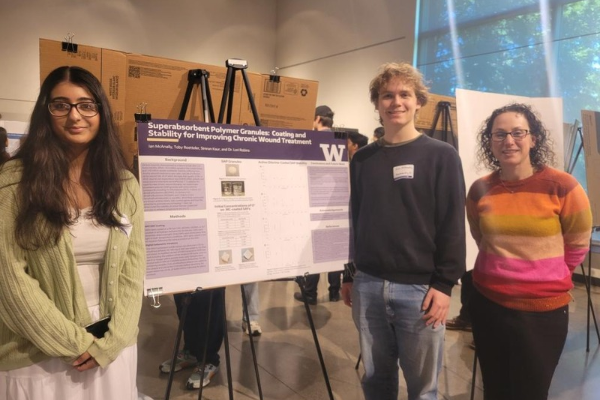
McAnally has received several scholarships through his research and volunteer experience, including the Department of Physical Sciences’ Chair’s Summer Research Award Scholarship and the American Chemical Society’s Julia A. Rutherford Memorial Scholarship.
“What means the most to me about these awards is they recognize the hard work I’ve put into my education, research, and volunteering,” he said. “The funding I’ve received from these awards lets me spend more time in the lab instead of working to help support my education, which is invaluable.”
Becoming a scientist
Working in the lab taught McAnally a variety of research techniques, from spectroscopy to digital iodometric titration, and expanded his understanding of biochemistry, scientific methods and the human body. McAnally underscored that the most important thing he has learned – and is still learning – is how to be a good scientist.
“Outside the lab in our coursework, we’re handed a packet of instructions made by our professors and told to complete the experiment. And while lab coursework is very fun and I love it, it’s not the same as being in a research lab,” he said.
“In research, when something goes wrong, there isn’t a set of instructions telling you how to fix it. You have to design your own experiments and methods, reverse engineer them, and really think about what a seemingly bad result may be telling you: something you don’t get to do in class.”
Starting research early in his academic career meant McAnally was often working with techniques and experiments before he fully understood the chemical theory behind them, a challenge for someone eager to understand how things work.
“I’m very curious about the world and how things work, so not fully understanding the chemistry behind some experiments wasn’t very satisfying,” he said. “But as the quarters went on I excelled in my classes and got to learn more, which connected directly to research and satiated my curiosity.”
Looking back, the experience ultimately accelerated McAnally’s growth as a researcher, exposing him to advanced laboratory techniques ahead of time and giving him a proper scientific foundation.
“By learning the scientific method and experiencing setbacks in the lab early on, I was more prepared for harder course/lab work. Being involved in research as a freshman also means I can have almost four full years of research, allowing me to make meaningful progress and oversee long term projects instead of leaving after only a couple quarters had I joined as a senior,” he said.
Research for the future
With a new quarter underway, McAnally is continuing his research and hopes to publish his first journal paper by the end of the academic year.
“One of my research goals is to consistently make and purify our own MMP-9, which we’re already very close to meeting,” he said. “After we can do this, I want to study MMP-9 more closely by measuring its activity with and without NCT, studying MMP-9 kinetics, and maybe even get into mass spectrometry sequencing work with MMP-9.”
In addition to his lab work, McAnally realized from his CNA experience that he enjoys working directly with patients. He now works as an endoscopy technician with Washington Gastroenterology, where he works closely with physicians, patients and the entire care team by assisting with procedures. He also learns from a physician whose career combines medicine and research.
“I’m fascinated by his work,” McAnally said. “Being able to research problems seen in the clinic/procedure room and bring back solutions is inspiring and exactly what I’d like to do one day.”
With research and patient care at the forefront of his academic and early career journey, McAnally is determined to improve people’s lives and genuinely make a difference. After graduating from UW Bothell, he hopes to attend the UW School of Medicine and pursue a career as a physician-scientist.
“Ultimately what got me started with research was my curiosity about the world and wanting to make a real world, people centered impact with it. Connecting my passion for research with patient care solutions has been something I’ve realized I want to pursue as a career, even if it’s not chronic wound research. But as of now, I’m working hard (but with much joy) to help improve the quality of life for those with chronic wounds globally,” he said.
“In hindsight, I can confidently say being a part of research has been one of if not the best decision of my life.”