Mysterious Kokanee
Kokanee in Lake Washington and Lake Sammamish, once common, have declined and made a comeback- but their future hangs in the balance. Their story is still being written- read on below!
Follow your interests by exploring videos, photos, and writing all about the topics on each sign. Looking for a different page? Click here to explore all topics!
What’s on this page:
The Little Red Fish
What is Kokanee Salmon?
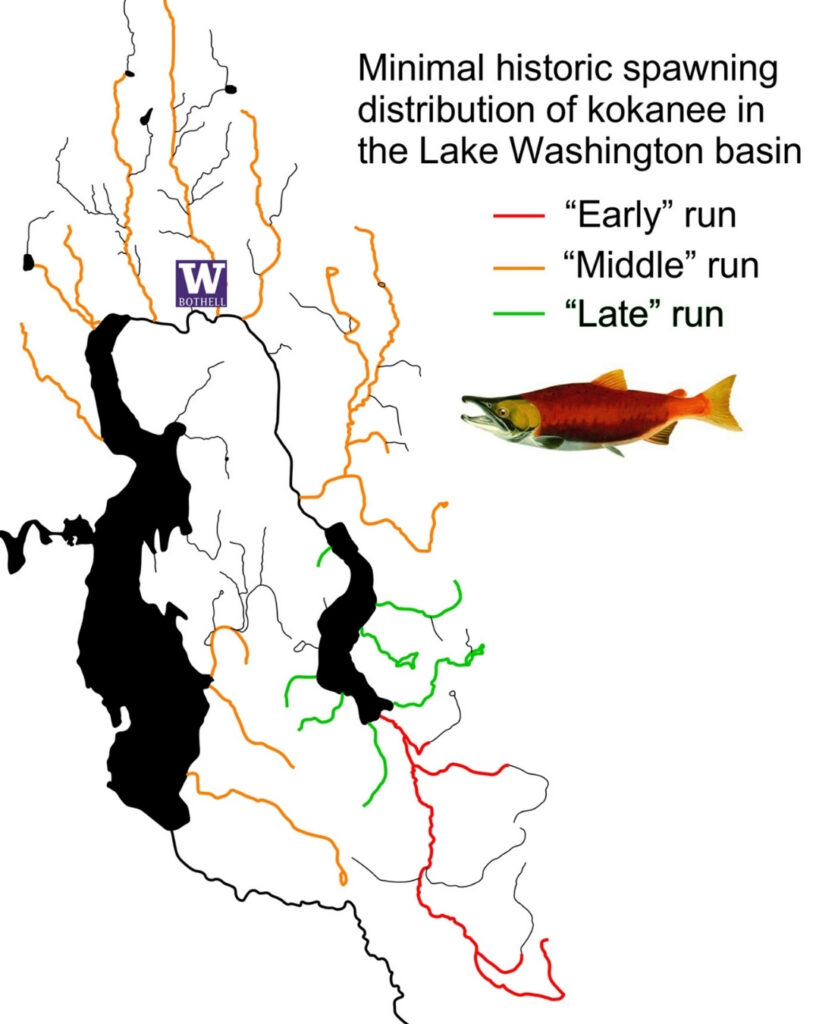
Kokanee are a variety of Sockeye salmon that don’t migrate to the ocean. Instead, Kokanee evolved to grow and mature within lakes before returning to streams to spawn. (Hmm… what might have stopped them from returning to the ocean?) They are smaller than Sockeye salmon, spawn a bit later, and they have different DNA. At least three populations of Kokanee were present: an “Early Run” starting in August and a “Late Run” through January in Lake Sammamish, and a “Middle Run” in Lake Washington. These different spawning times provided a steady source of fall and winter nutrition to tribal peoples.
Plentiful Fish, Plentiful Food
What fish do you think of when you think of salmon in Lake Washington and Lake Sammamish?
You might know about Coho, Chinook, and Sockeye that pass through the Ballard Locks each year. Before the mid 1900s, the answer might have been different- the “Little Red Fish” or Kokanee salmon was the most common back then.
There were thousands of ‘Red Fish’ in both creeks; silver trout, landlocked sockeye salmon [Kokanee], hundreds of salmon spawning in both creeks.
Ernie Raymond, LFP school class of 1922, quoted in Growing Up with Lake Forest Park
The abundant Kokanee may have brought the Snoqualmie Tribe to Lake Sammamish and Lake Washinton. It has been said that Kokanee’s fall and winter runs were what allowed them to live here year-round. Read more from the Snoqualmie Tribe Culture Department.
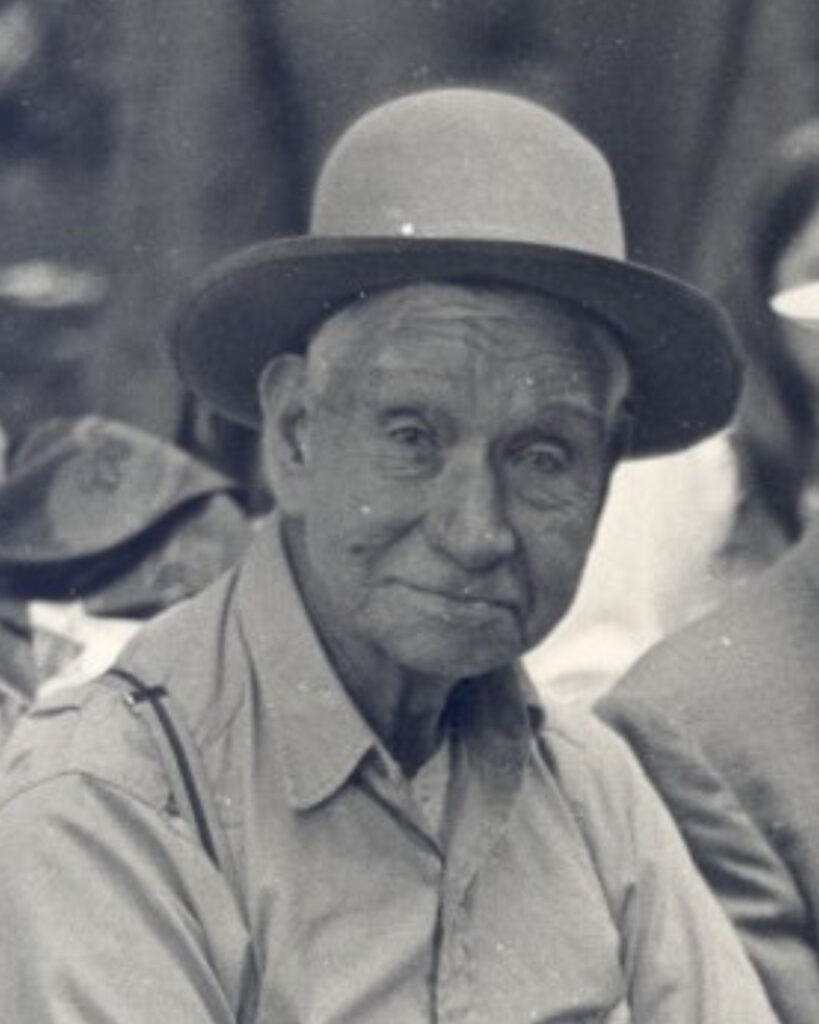
The Snoqualmie come to settle in Lake Sammamish, Lake Washington. To find that red fish and that red fish was only in two lakes, I think … Then they got a taste of that red fish and they settle there. And that fish runs in a, oh, from fall to Christmas.
Ed Davis, Snoqualmie community elder (1888-1987)
A Slow Disappearance
As time went on, urbanization and industries like logging and coal mining caused pollution and habitat loss in the Kokanee’s home. In 2002, the Lake Sammamish “Early Run” was declared extinct, and most fishery biologists believed Lake Washington Kokanee had disappeared decades ago. Despite everything, some of the Lake Sammamish Late Run Kokanee managed to survive.
Kokanee Comeback?
Mystery Fish
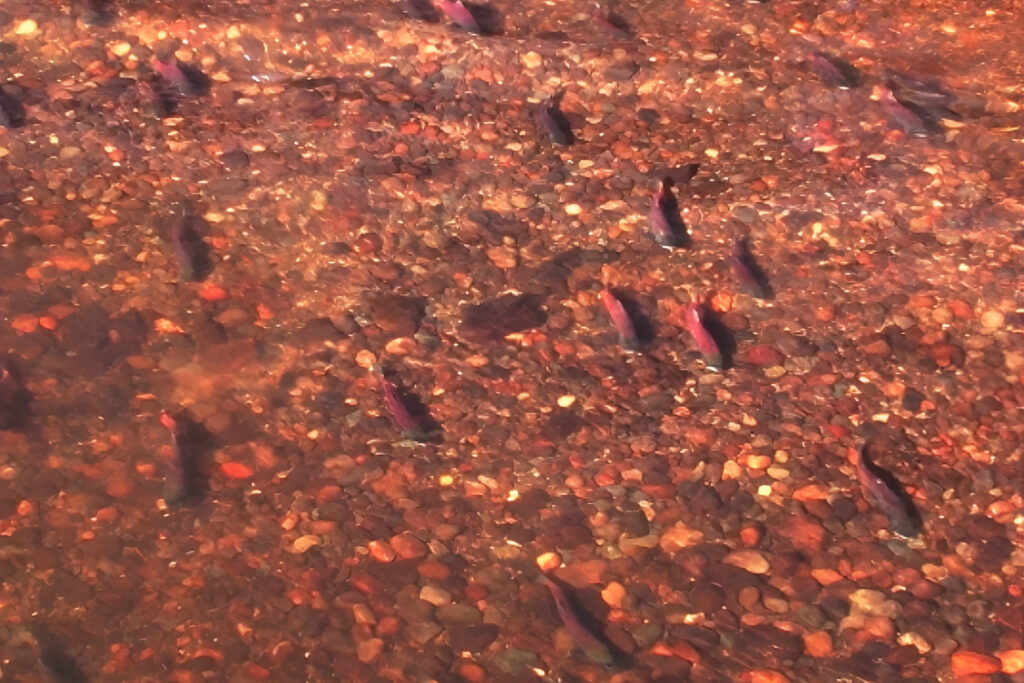
In 2011, many small red salmon appeared in the Sammamish river, between lake Washington and Lake Sammamish. What could they be? Most people thought they couldn’t be native Kokanee. Perhaps they were introduced (like the millions of Kokanee moved from Lake Whatcom), or maybe they were “residual” Sockeye that stayed in the lake while the rest of the population migrated to the ocean. Residual Sockeye can look identical to Kokanee. The red fish were a mystery.
Genetic Investigation
These fish remained a mystery until they showed up again in large numbers in 2017 and 2020, prompting researchers to take a closer look. Each population of Kokanee, like the early, middle, and late runs have different DNA from residual Sockeye, introduced Kokanee, and even each other. By analyzing their DNA, researchers could uncover who these mystery fish were and where from.
To everyone’s surprise, they were closely related to, but different from, Lake Sammamish Kokanee. The “Middle Run” of Lake Washington, once considered extinct, had been rediscovered! Kokanee returned in strong numbers again in 2022, 2023, and a surprising 2024 run exceeded expectations by 4X. Despite some strong spawning years, Kokanee are at risk. To keep up with Kokanee and find out where they’re spotted each year, check out local Kokanee researcher Jeff Jensen’s blog!
Research in Action
Scientists, students, and community volunteers are working together to track our Kokanee and understand how to help them survive the journey from egg to spawning adult.
Remote Site Incubators
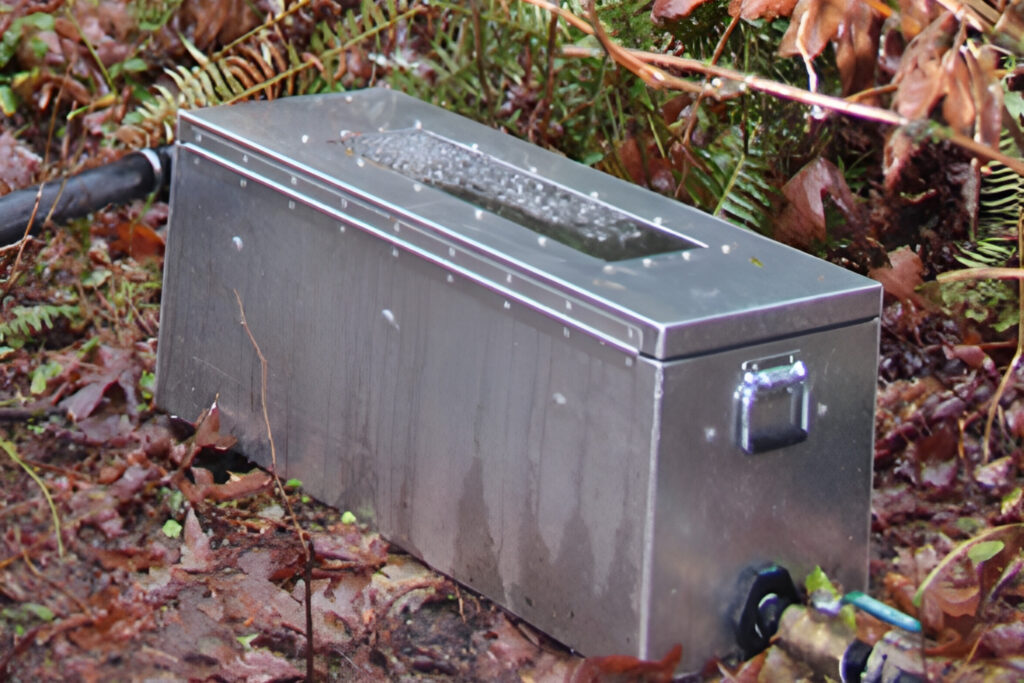
Urban development creates surfaces like roofs, roads, and parking lots which rapidly funnel rain into storm drains that empty into our creeks. For vulnerable salmon eggs, a rush of rainfall can wash them out of their gravel protection. Remote Site incubators are designed and monitored by Trout Unlimited and UW Bothell faculty and students, built to mimic natural conditions while protecting eggs from the “flashy” conditions until they hatch, develop, and swim into the creek.
Remote site incubators can re-introduce native Kokanee to streams they no longer spawn in! In collaboration with private property owners and government entities, these spawners can be loaded with fertilized eggs from native Kokanee of nearby creeks. One day, the adults may return and spawn naturally in the creek as they once did. Learn how they work from Lake Sammamish Kokanee.
Fry Trapping
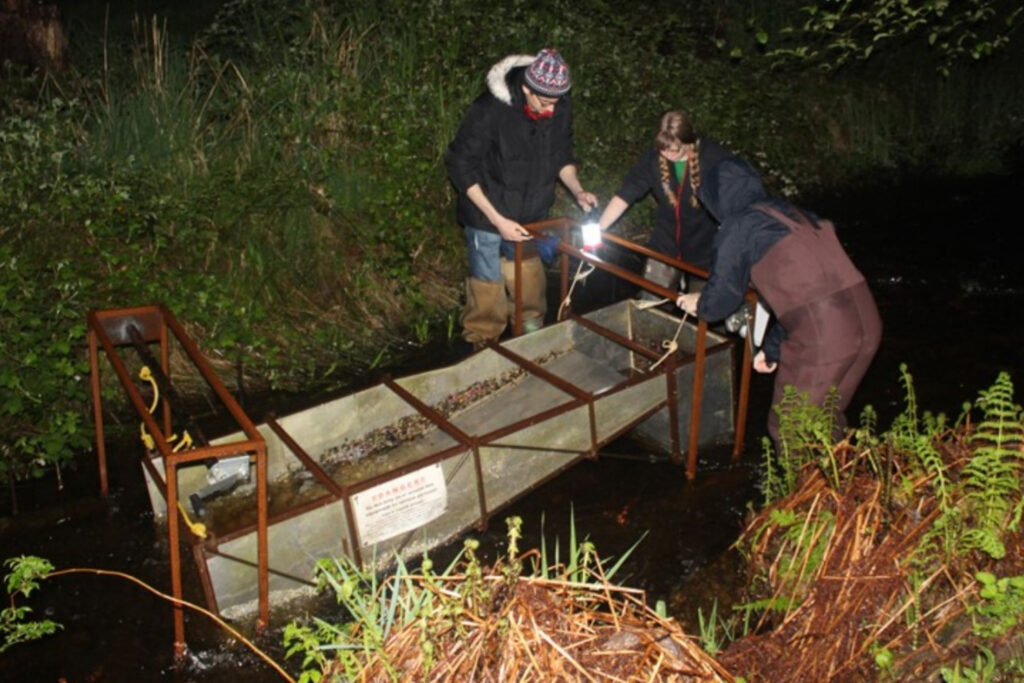
Salmon face more challenges after they leave the safety of of the gravel or incubator. They may be eaten by native or non-native predators, or struggle to survive into adulthood in polluted conditions. Fry traps catch young fish as they swim downstream. This way, volunteers can identify and count the number of Kokanee fry that pass in an hour before they are released back into the creek. By comparing the amount of fry to the number of returning adults in the next few years, we can estimate how many young fish are surviving and know whether the population is increasing, decreasing, or staying about the same.
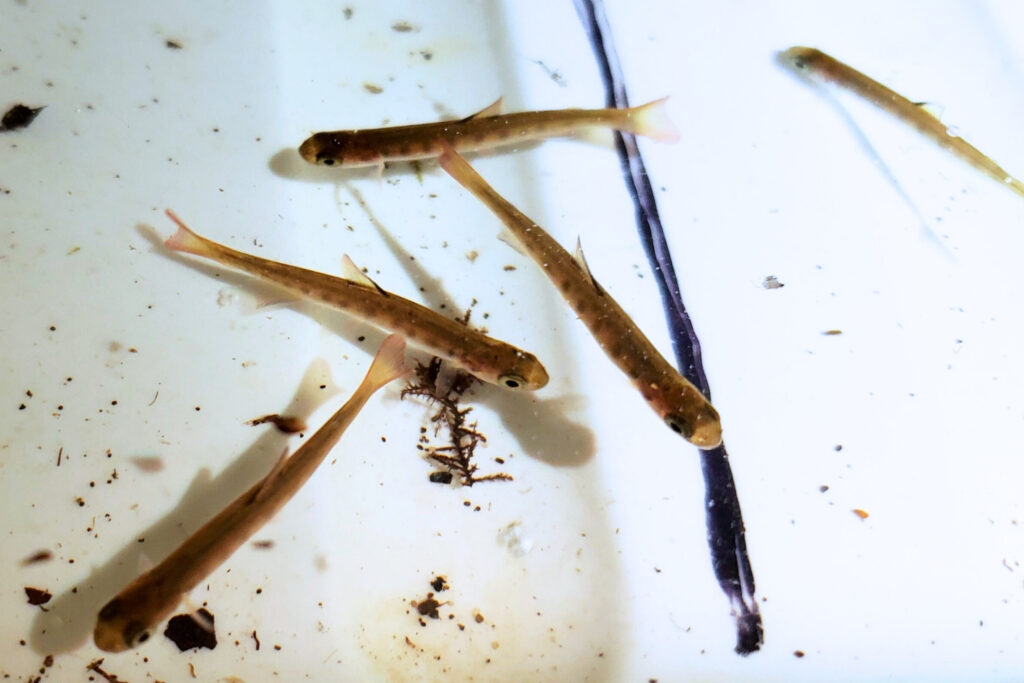
Dr. Jeff Jensen from UW Bothell is helping to develop another way to “count” the amount of fry with less labor- environmental DNA! Just like we shed our DNA into the environment (hair, skin), so do Kokanee fry. If the concentration of Kokanee DNA in the stream is related to the amount of fry counted, more streams could be “surveyed” with less work.
Every year, from the late winter through early spring, the Three Rivers Chapter of Trout Unlimited and Dr. Jensen team up with volunteers who help monitor the movement of newly hatched Kokanee fry. Sign up to volunteer each winter here!
Spawning Salmon
The number of adult Kokanee returning to creeks each year varies significantly. Current spawning creeks have had zero Kokanee some years and thousands other years- a sign of an unstable population. Teams of community volunteers dedicate time every year to record observations of salmon in our local creeks. This work is key to understanding where Kokanee (and other salmon species) are each year and estimate the amount of Kokanee returning that year. Sign up to be a North Lake Washington Salmon Watcher or learn how to identify a Kokanee!
Can you tell a Kokanee from a Sockeye salmon using a picture? What if it was a living fish in a stream? Learn how at Kokanee vs Sockeye from Dr. Jensen!
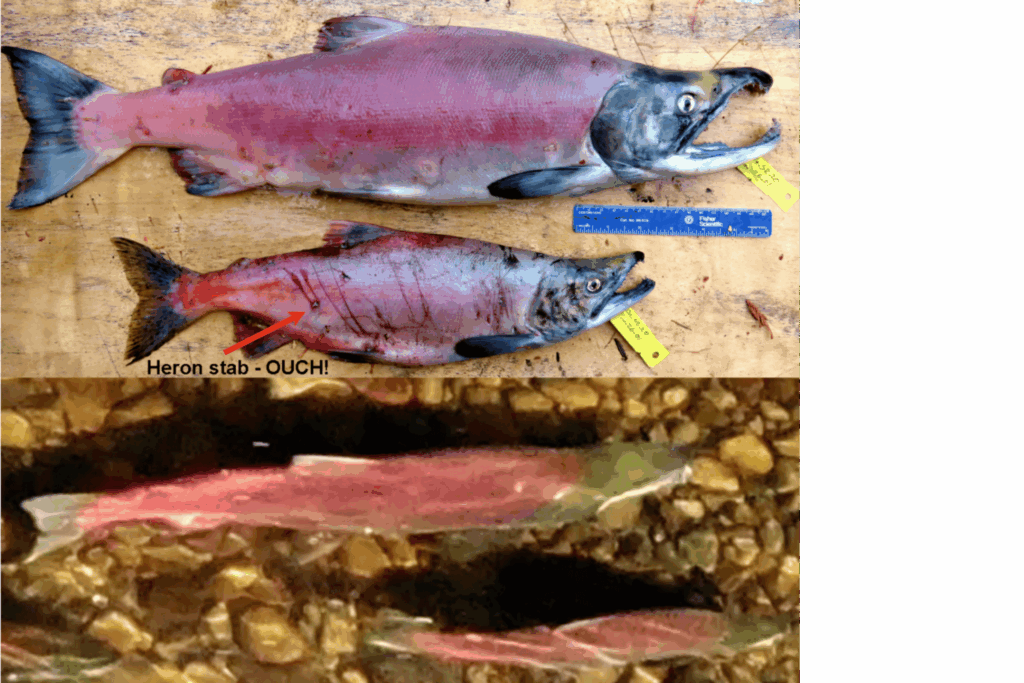
Q: What can we learn from a dead fish that we can’t learn from a living one?
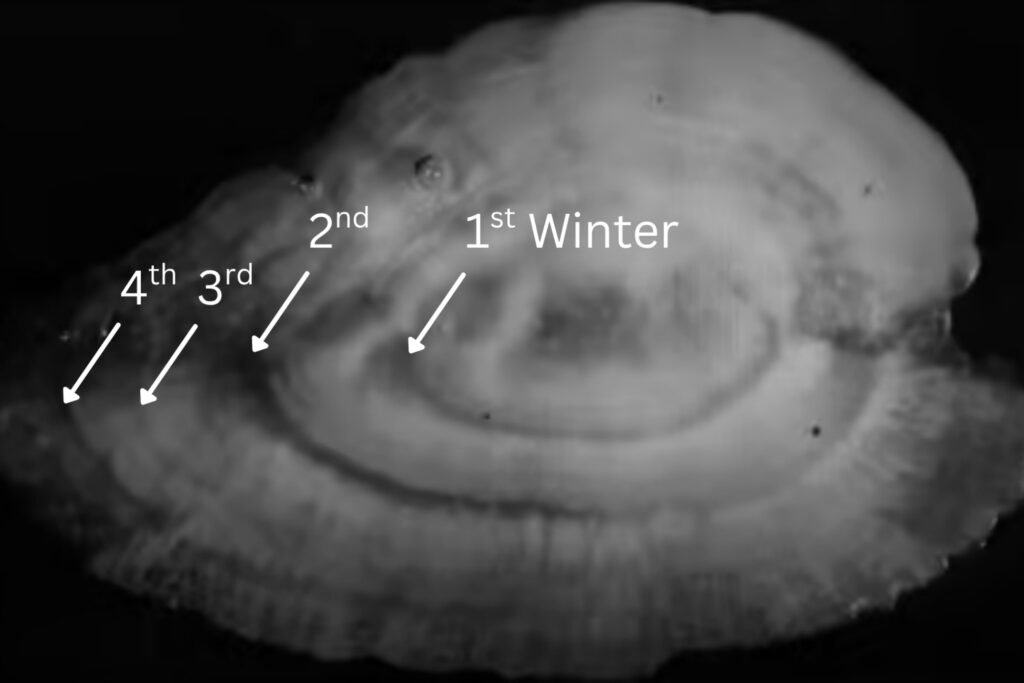
Sometimes it is unclear if an adult fish is a Kokanee or Sockeye salmon. They have a very similar shape and color, but usually their size and spawning times don’t overlap. If Kokanee arrive early, grow especially large, or show up at an unusual location, it’s important to correctly identify the fish. Collection of the carcass can confirm if the fish is a Sockeye or Kokanee using DNA from a scale or analysis of an “otolith,” a small mineral structure in the head. DNA reveals whether it’s a Kokanee and which run it is from, while the otolith can show us the age, and tell us whether the fish’s mother has been to the ocean! Learn more about how otoliths are used from the Freshwater Fisheries Society of BC.
Fragile Future
While Kokanee are similar to Sockeye, genetically distinct populations like those in Lake Washington and Lake Sammamish have evolved over many generations to suit these environments, making them important members of our ecological community. Our understanding of these mysterious fish is still growing while their population shrinks; Kokanee are on the brink and may be beyond the point of return within 30 years.
Challenges
Despite an amazing run of Kokanee in Lake Sammamish in 2024 (8,000 spawning Kokanee!), the population is declining due to poor fry survival. Young salmon face many challenges.

Development causes high waterflow in streams during rain, which can wash eggs or alevin downstream before they’re ready. Development also causes more pollution to run into streams, which harms stream life.

Invasive and introduced animals also impact Kokanee. Introduced Yellow perch, Smallmouth bass, native Cutthroat trout and predatory birds prey on young fish, including Kokanee.

Even invasive species on land can cause problems- invasive plants like Himalayan Blackberry don’t provide quality habitat like native plants do. Native plants can help keep the water clean, cool, and provide wood and roots for young fish to hide in.

Larger challenges like climate change can cause low water levels in streams, limiting spawning habitat. Rising lake temperatures also mean shrinking Kokanee habitat. Kokanee must live deeper in the lake to stay cool as temperatures rise, but shallow enough to have enough oxygen.
Learn more about the challenges Lake Sammamish Kokanee face in the free 1-hour documentary “Spawning Grounds” below.
Recovery Efforts
The future for our Kokanee is uncertain, but our community, researchers, tribes and governments are working hard to make sure our native Kokanee are here to stay. Together, they formed the Lake Sammamish Kokanee Workgroup to help identify problems and work on solutions.
One way communities help Kokanee is with restoration projects. These can be invasive plant removal and native planting, or adding logs and replacing culverts (the pipes that we use to move streams under roads). See a local culvert replacement in the 2-minute clip below.
Another way is to help raise young Kokanee in hatcheries (like the Issaquah Hatchery—read a short article here) or in remote site incubators. These Kokanee are more likely to survive than wild Kokanee, and they can be transported to re-start runs in other streams! Surveys that count fish, collect carcasses, and determine whether the adults came from transported fry help us know what’s working and what’s not. Read about the 2024-25 strategies at “Return of the Kokanee” from the city of Issaquah.
Zackuse Creek used to have culverts that made it unusable for fish. The creek had an overhaul—culvert removal (see the video above), channel restoration, and replanting—which made it usable for salmon. Fry were placed in the creek so that they might one day return and spawn as adults. In 2021, the adults returned! Watch them swim in Zackuse Creek for the first time in 40 years below. With more hard work, Kokanee may return to more of the streams they once swam in.