Building responsible AI integration for business
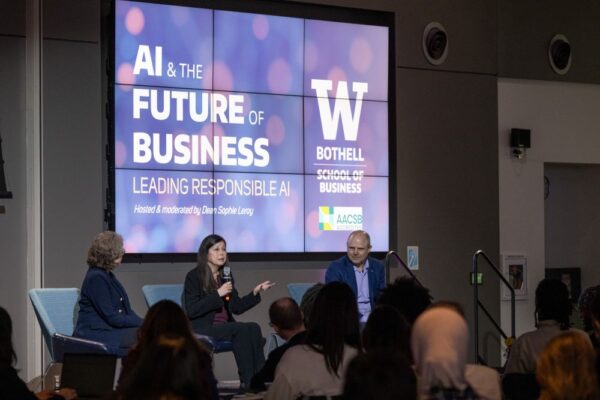
As artificial intelligence rapidly transforms the business landscape, leaders are under increasing pressure to adopt AI in ways that are both effective and responsible. On April 1, the UW Bothell School of Business hosted the next installment of its AI & the Future of Business series, focused on what it means to integrate AI responsibly.
With growing concerns around governance, safety, fairness and transparency, responsible AI is top of mind for organizations across industries. The conversation explored how leaders can manage this rapidly advancing technology in ways that drive innovation while establishing clear guardrails.
Romelia Flores, distinguished engineer and master inventor at IBM, emphasized the importance of cross-functional collaboration in making informed and responsible AI decisions. She highlighted the need to align business and technical teams, understand how data is managed and stored, and evaluate AI use cases through a lens of trust. Establishing strong guardrails, she noted, is essential to ensuring AI systems are both effective and accountable.
Gavin Bartlett, managing director, consulting TMT transformation, at KPMG, addressed the ongoing challenge of balancing governance with innovation. Too much oversight can slow progress, while too little can introduce significant risk. The goal, he explained, is to create structured guardrails that enable teams to experiment and build responsibly without stifling innovation.
Across the discussion, one message stood out: responsible AI is not a one-time effort, but an ongoing commitment. As AI becomes more embedded in business operations, leaders must continuously adapt, building systems that deliver results and earn trust.