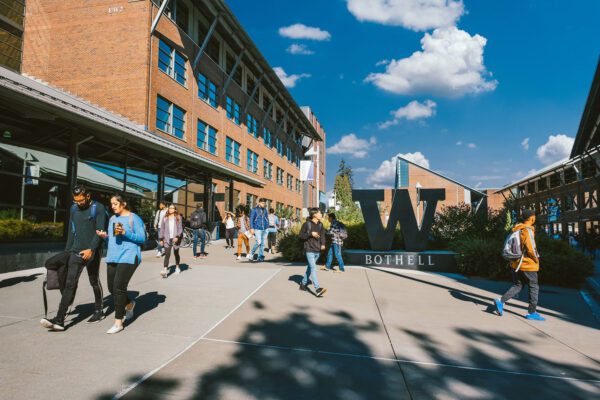
UW Bothell at a glance 2026-27
Fast facts
UW Bothell opened as a regional public campus in 1990 — and is now ranked the No. 1 regional university in Washington state, according to U.S. News & World Report (2027).
6,458 Students
- 5,938 undergraduate students
- 520 graduate students
Academics
41
degree programs
5
schools
Average class sizes
33
Undergraduate
17
Graduate
333
Faculty
381
Staff
Student diversity
- < 1% American Native or Alaska Native
- 32% Asian
- 10% Black or African American
- 10% Hispanic or Latino
- 3% International (student visa)
- < 1% Native Hawaiian or Pacific Islander
- 8% Two or more races
- 27% White
- 9% Not indicated
Academic excellence
Our student retention rate averages 86%.
Source: Integrated Postsecondary Education Data System (2024)
Accreditation
The University of Washington is accredited by the Northwest Commission on Colleges and Universities and is a member of the Association of American Universities.
At UW Bothell, several schools hold additional specialized accreditations:
- School of Business – Association to Advance Collegiate Schools of Business
- School of Nursing & Health Studies – Commission on Collegiate Nursing Education
- School of STEM – Engineering Technology Accreditation Commission

Research excellence
In 2025, UW Bothell was designated a “Research College and University” by the Carnegie Foundation for the Advancement of Teaching. The classification recognizes the faculty’s expanding research — nearly $80 million in expenditures over the past decade — which emphasizes collaboration, innovation and impact across the Puget Sound region.
The value of a UW Bothell Education
Highest wages in WA
The wages of UW Bothell alumni with bachelor’s and master’s degrees are consistently the highest in the state among all graduates with comparable degrees from public, four-year institutions.
Source: Educational Research & Data Center (Jan. 2026)
On average, alumni earn more than $110,000 annually, according to 2026 Lightcast data.
Recognized for ROI
UW Bothell ranks No. 2 in Washington for both Best Value In-State and Best Value among Regional Universities West in U.S. News & World Report’s 2027 rankings. Across the region, the campus ranks No. 5 for Best Value In-State and No. 25 for Best Value.
Access and opportunity
All incoming first-year undergraduates are paired with a Peer Coach in their first two quarters, providing crucial early support in their college journey that boosts retention.

In autumn 2026, 36% of incoming first-year students and 42% of new incoming transfers are the first in their immediate families to pursue a four-year degree.

31% of all UW Bothell students were eligible to receive a federal Pell Grant award in autumn 2026.

6% of students at UW Bothell are veterans or military-affiliated.

In 2025-26, 75% of undergraduate students and 70% of graduate students graduated with no known debt.
Vibrant student life
In 2025–26, UW Bothell students participated in more than 1,100 events, including 1,030 club events and 106 student organization events.
- With more than 100 active student clubs, students had opportunities to develop leadership skills, explore their identities, build community and create meaningful connections.
- More than 44% of UW Bothell’s student population attended at least one campus event or student club meeting, highlighting the important role student engagement plays in fostering a vibrant and connected campus community.
Serving our region
96% of incoming first-year students and 93% of incoming transfers in autumn 2026 are from Washington state.
Top counties of residence

62% King

27% Snohomish
Top five cities of residence
- 10% Seattle
- 9% Bothell
- 8% Lynnwood
- 7% Bellevue
- 6% Everett
Regional impact
9 out of 10 of our 35,000+ alumni live and work in the state of Washington — and more than two-thirds live within a 25-mile radius of UW Bothell.
Economic contribution
UW Bothell generates an estimated $394 million in annual economic impact for the state of Washington. This includes direct spending, job creation, alumni earnings and the University’s role in supporting a skilled, local workforce.
Source: University of Washington 2024 Economic Impact Report
Community engagement
In 2026, UW Bothell was again recognized for meeting Carnegie Foundation standards for community engagement. Each year, students collaborate with hundreds of community partners — businesses, nonprofit organizations, government agencies and more — on projects that enrich their education while supporting partner goals.
Environmental sustainability
The campus houses a 58-acre wetland that is a sustainable, functioning floodplain ecosystem within an urbanizing watershed.
- As part of the Puget Sound Energy Green Direct program, UW Bothell purchases 100% of its electricity from the Lund Hill Solar project and the Skookumchuck Wind Project.
- UW Bothell is the first Salmon-Safe certified campus in the state and among the first two Green Grounds Platinum campuses in the nation.
- The campus holds a STARS Gold rating from the Association for the Advancement of Sustainability in Higher Education, demonstrating success in integrating sustainability into campus operations.
- The campus uses no pesticides and is home to a host of native plants, pollinators, salmon, beavers and other wildlife.
- It is a Bee Campus USA member and a Certified Wildlife Habitat campus.
- UW Bothell is included in The Princeton Review’s 2026 Green Colleges guide for its commitment to sustainability through student satisfaction, environmentally responsible policies and institutional practices.
- It is an institutional member of the National Wildlife Federation.
Learn more about our schools
Want to learn more about our five schools? You can visit their websites or view and download the school snapshots below.
- School of Business website | School of Business Fact Sheet (PDF)
- School of Educational Studies website | School of Educational Studies Fact Sheet (PDF)
- School of Interdisciplinary Arts & Sciences website | School of Interdisciplinary Arts & Sciences Fact Sheet (PDF)
- School of Nursing & Health Studies website | School of Nursing & Health Studies Fact Sheet (PDF)
- School of Science, Technology, Engineering & Mathematics website | School of Science, Technology, Engineering & Mathematics Fact Sheet (PDF)
Visit UW Bothell
UW Bothell sits about 12 miles from the University of Washington campus in Seattle. From downtown Seattle, UW Bothell is approximately 16 miles or about 30-45 minutes by car or bus.
Downtown Bothell is about one mile from campus or a 15-minute walk. It offers a growing array of restaurants, boutique shops, cafés, breweries, arts and cultural events, and recreational amenities — all accessible to students and visitors. Download a map that highlights some of our region’s features and attractions.
In the broader region, Bothell lies between Bellevue and Everett, in what is often called the “tech corridor,” giving access to regional employment, industry partnerships and transit connectivity.
At a Glance is updated annually each fall shortly after 10th-day enrollment statistics are finalized.