Crows on campus
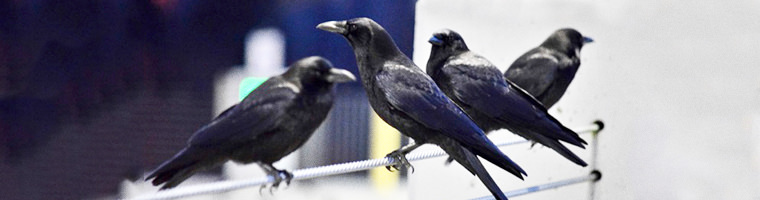
Gathering at UW Bothell
We get a lot of visitors on campus, from potential students to parents, neighbors, University supporters and other friends of UW Bothell. But our most frequent visitors for a long time were from the Corvidae family.
For many years, tens of thousands of crows visited the campus’ North Creek Wetland Restoration every night from late summer through early spring. Recently, though, things have been changing.
Few if any crows still roost overnight on the campus wetland. According to annual December counts conducted by Associate Professor Douglas Wacker from the School of STEM and the Pilchuck Audubon Society, the number of crows traveling to this roost at dusk has decreased precipitously.
- In 2023, Dr. Wacker and Audubon volunteer Todd Gladfelter observed more 9,000 crows flying southwards, past UW Bothell and towards a newly discovered roost in Redmond, Washington. This roost is less than five miles — as the crow flies! — from the UW Bothell campus.
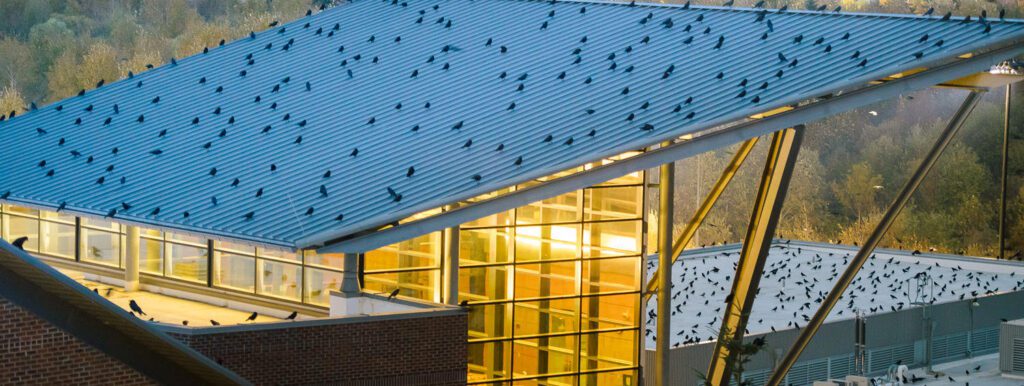
- In 2024, the number of crows flying to UW Bothell declined again. Although birds were observed pre-roosting on the campus building tops in late summer, by November the numbers were much lower and were lower again in December, which is usually when we see the highest numbers.
- By January 2025, there was little to no evidence of continued roosting, though it’s possible there are some birds still using the site.
Roosting in a seasonal phenomenon, with birds moving to nesting sites/territories during early spring. It will be interesting to see if any crows return to the North Creek Wetland to roost at the end of this breeding season in the late summer.
Want to read more about the crow’s leaving campus — and new crow research now being conducted by UW Bothell faculty and students? Check out this news story: Solving the mysterious disappearance of UW Bothell’s crows.
A phenomenon of nature
Crow communications
Research questions

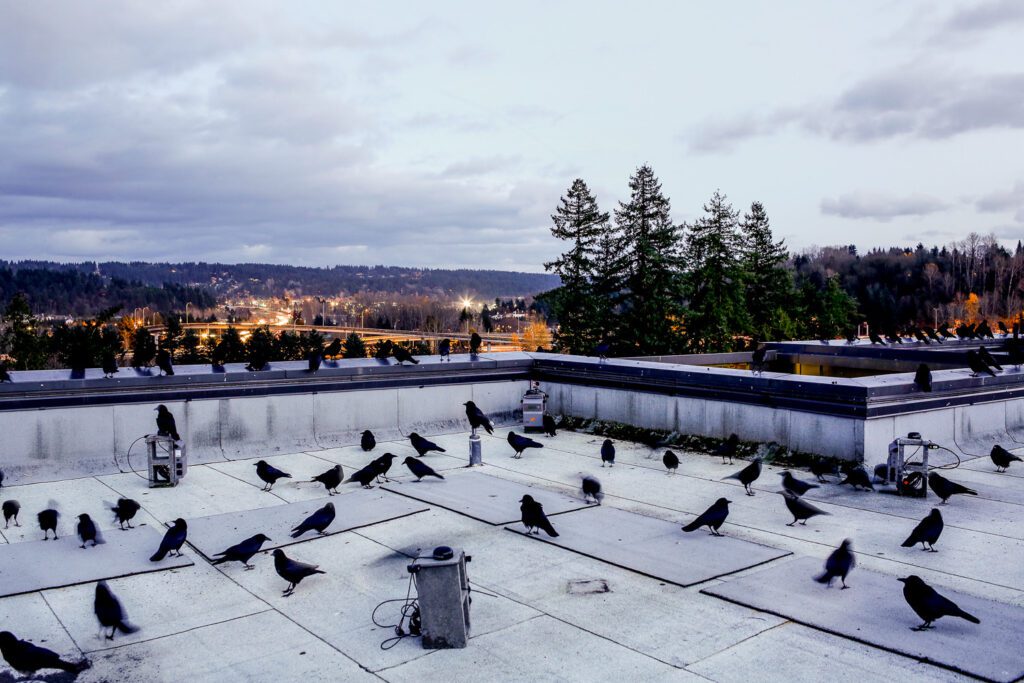
Like the wetland, the crows that used to gather campus were a convenient yet challenging research opportunity for faculty and students. One project tried to answer the question: What might the crows be communicating in their noisy gatherings before they roost?
Dr. Wacker and colleague Dr. Shima Abadi, associate professor of engineering and mathematics, had to go no farther than the roof of their building, Discovery Hall, to find dozens of cawing birds each evening.
Working with students in the School of STEM, they set up recording equipment to study crow vocalizations. A microphone array with GPS tracking was used to identify the location of each calling bird. That was matched with video showing the bird’s body position during the caw, typically a head-dipping motion.
Then the researchers searched for patterns in how other birds respond. Wacker suspected crows might be sharing information about the roost or food sources.
Crows are sometimes the most visible birds on campus, but they are not the only ones…
Dr. Ursula Valdez, a lecturer in the School of Interdisciplinary Arts & Sciences, leads natural history and ecology courses with students and in her research has identified more than 50 species of birds in the campus wetland.
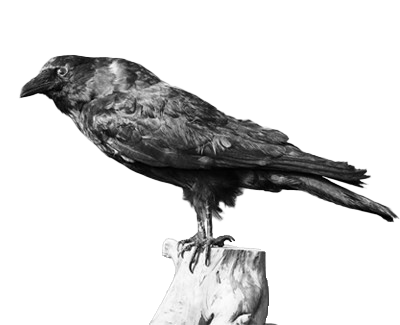
The American crow, Corvus brachyrhynchos
Crow-curricular learning
In a sense, crows are fitting partners for a college campus. Numerous studies have shown that birds in the family Corvidae — crows ravens, jays — can be highly intelligent. They observe. They experiment to see what works, and they share their learning with others.
Learn more
- Read about the rooftop research.
- Read how crows are part of campus life.
- Read about UW Bothell’s reputation for crows.
Crow: Did you know?
- Crows mate for life.
- After fledglings leave the nest, parents care for them for several months.
- Crows make many different sounds. Although some calls are reasonably well-characterized, like the begging call, many of their vocalizations remain poorly understood.
- Crows may be learning about danger at “funerals” where they surround a dead bird.
- Often seen as omens, the black birds figure in Northwest Native art, Scandinavian legends, American poems and pop music.
- Ravens are distinguished from crows by their larger size, larger bill and long wedge-shaped tail.