Building a Low-Cost Physics Device by Joseph Del Gianni
Q&A with Joseph Del Gianni
What did I do this summer?
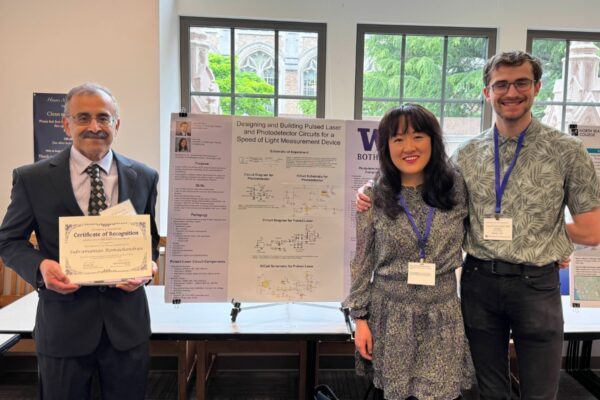
The purpose of my research is to develop an inexpensive, open source speed of light time of flight measurement device and associated curricula and lab manuals for undergraduate physics students. The device consists of a pulsed laser that fires the light across a measured distance and a photodetector that measures the incoming light. A separate oscilloscope measures the time the light takes to travel from the pulsed laser to the photodetector. With both the distance and time measurements, we can calculate the speed of light.
The reason my research is important is that the speed of light lab kits from manufacturers such as PASCO Scientific cost nearly $10,000, and schools are facing deep budget cuts. The speed of light time of flight measurement device I am working on will cost less than $200 to print the circuit boards, buy the circuit components, and assemble at a soldering station. I started working on this project in Autumn 2024 with my mentor, Dr. Subramanian Ramachandran, and my research partner, Carol Miu.
This summer, we worked on wiring the circuit boards and laying out the printed circuit boards (PCB). We also borrowed a 15-year-old prototype from UW Seattle with older and slower components (and unfortunately no schematics, wiring, or layout ECAD files that could be open sourced) for measurement and testing through the mediums of air, acrylic, and borosilicate glass.
What did I learn about my field? What did I learn about the research process itself?
I learned that physics can be both incredibly broad and deep, overlapping many engineering fields and requiring extreme attention to detail on tiny circuit components. Research is a process that tends to be slow and arduous which requires one to sit down and think of a solution to an unknown problem without any available set answer to work towards. While you may think the answer to be a straight forward solution at first, it often gets murkier the further you get into the process.
Did I encounter obstacles or challenges in the research process? If so, how did I adapt or work through them?
Yes, I encountered challenges because my project requires extensive knowledge of electrical engineering, which none of us on the research team had. I adapted by teaching myself through video tutorials and trial and error how to use KiCad, an open source program for circuit board layout and wiring. My research partner, Carol Miu, adapted by asking subject matter experts for help. She had an electrical engineer with nearly 20 years of experience troubleshoot my KiCad schematics and also reached out to Professor David Pengra at UW Seattle, who teaches the optics class and allowed us to borrow the 15-year-old prototype.
What have I learned from engaging in undergraduate research?
I have learned that research requires learning new skills over a long period of time. Since research is self-driven, the student needs to be very motivated to work on the project and able to work independently after an initial training period. Research has shaped my understanding of my personal and professional path in that I’ve learned that I enjoy hands-on experimental work more than computational work. Tinkering with real objects interests me more than thinking about theoretical topics.
What advice would I give to other UW Bothell undergraduate researchers who are just starting out?
Start research early. Don’t wait till senior year. Focus on a topic that you will enjoy, even if it is niche. Even if you don’t think that it will result in a groundbreaking discovery, you will learn from your project.
Learn more about the Research & Creative Projects for Undergrads at UW Bothell.