As a middle school teacher in Oregon, something didn’t sit right with Dr. Jason Naranjo.
“I saw quickly that there was a whole group of students regularly excluded from meaningful opportunities to learn because they were labeled with disabilities,” he said.
When he shared his concerns with colleagues, they brushed him off — delivering services to those kids was someone else’s problem.
“That was wholly unacceptable to me,” said Naranjo.
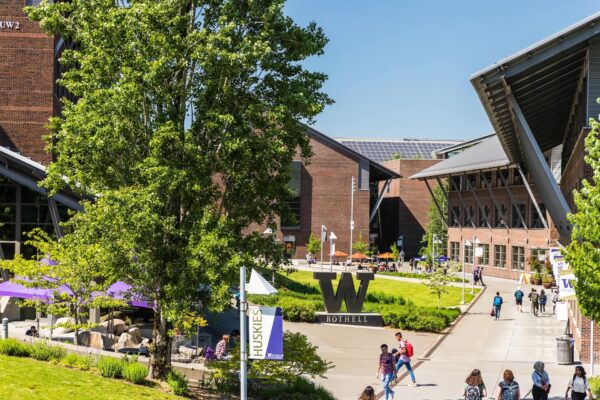
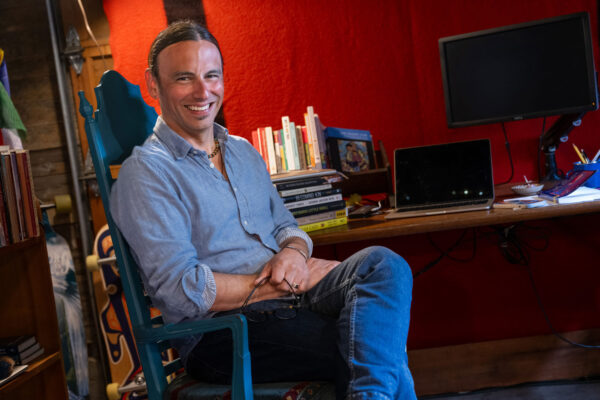
His determination to serve all students eventually led him to the University of Washington Bothell’s School of Educational Studies, where he is now associate teaching professor. And for his ongoing efforts to expand inclusion for people with disabilities, Naranjo has received UW Bothell’s 2026 Outstanding Community-Engaged Scholar Award.
“We view our communities as essential both in knowledge creation and in teaching and learning,” he said of UW Bothell’s approach. “It’s co-construction and co-implementation of these kinds of projects that the University provides space for.”
An in-demand endorsement
Naranjo arrived at UW Bothell in 2012 with a mission: Develop an inclusive program to equip new teachers with a dual endorsement in both general and special education.
“Being able to serve the most vulnerable students depends on our ability to meet their needs,” he said. “But most educators don’t get that training at the university level, so they’re unable to do it in depth and do it well.”
When Naranjo started at UW Bothell, he said, it offered a single, two-credit course in special education studies. Today, the School of Educational Studies is home to a full-fledged dual-endorsement program, preparing students to meet the needs of a diverse range of learners.
“Not many places in the country do what we do,” said Naranjo, who built the program from the ground up. As its founding faculty member, he did everything from drafting the state license to building the curriculum.
Naranjo tells his students, “You hold something that’s so important — deep care for children and families, and also for people with disabilities. And you can do something about that. I can help you deliver on that promise.”
Most school districts around the country face a pronounced shortage of special education teachers, and the UW Bothell dual endorsement is in high demand. “Our students are in a unique position in the job market,” Naranjo said. “They can choose where they want to go and teach.”
Student-inspired partnership
Naranjo’s courses aren’t solely for would-be educators. A wide cross-section of UW students from both the Bothell and Seattle campuses enroll in his “Disability & Society” classes.
“Most people’s concepts about disability are deficit-based,” said Naranjo. “They’re blown away by what they learn.”
So blown away, in fact, that students began asking for opportunities to get directly involved with the disabled community. Naranjo immediately thought of Outdoors for All, the West Coast’s largest provider of outdoor recreation programs for people with disabilities. An avid skier, he had already been volunteering with the nonprofit organization for four years when he approached its leadership about partnering with UW Bothell.
“I thought, wow, there’s such deep mission alignment between what we do at UW Bothell and what’s going on at OfA,” said Naranjo.
On campus, he was also advocating for community-engaged scholarship through faculty governance. Working with colleagues, Naranjo helped to secure UW Bothell’s first designation as a community-engaged campus from the Carnegie Foundation in 2020. The campus, along with the University of Washington in Seattle and UW Tacoma, earlier this year again received the Carnegie Classification for Community Engagement.
Outdoor joy for all
The partnership between the UW and Outdoors for All partnership continues to blossom through Naranjo’s course, “Disability & Society: A Focus on Community and the Outdoors.” In summer and winter quarters, students volunteer with Outdoors for All in a wide range of roles: drivers, equipment managers, ski and snowboard coaches, adaptive cycling coaches, paddleboard coaches and more.
“The class gets students out in the world and helps make access real,” said Naranjo. “It’s a direct opportunity to learn with and from people with disabilities.
“It’s pure joy,” he added, “so much fun to teach!”
When not outdoors, students are immersed in contemporary text and media that center the disability experience.
Dr. Keith Nitta, associate professor in the School of Interdisciplinary Arts & Sciences, called out Naranjo’s work with Outdoors for All as an exemplar of community-engaged teaching and service. “It is a model of reciprocity, with clear benefits for Outdoors for All and for the UW,” he said. “I am so impressed with the class that I used it as a model in a public lecture in Japan last year.”
After the class ends, many students continue to volunteer with Outdoors for All, expanding its mission and putting outdoor recreation in reach for even more people.
“We view our communities as essential both in knowledge creation and in teaching and learning. It’s co-construction and co-implementation of these kinds of projects that the University provides space for.”
Dr. Jason Naranjo, associate teaching professor, School of Educational Studies
Civic engagement redefined
One of those returning volunteers is Zainb Ali, who received her bachelor’s in Public Health-Global Health from the UW in Seattle in 2023. “What began as a class requirement grew into an ongoing commitment to supporting accessible recreation in my community,” she said.
She also raved about the course as one of the most meaningful and transformative learning experiences of her time at UW. “It challenged the way I see the world, expanded my understanding of accessibility and shaped the values I want to carry forward in my career and community work,” she said.
Ali’s expanded understanding is exactly the kind of insight Naranjo hopes to spark in his students, no matter what draws them to enroll.
“These courses change the way students see themselves as citizens in a democracy,” he said. “They understand civic engagement as different than ‘I’m just showing up to help someone.’
“They begin to see it as a responsibility to community.”