Researchers at the University of Washington Bothell played a key role in the discovery of the fastest ultraviolet outflow ever observed from a supermassive black hole, a finding that offers new insight into how black holes influence the evolution of galaxies.
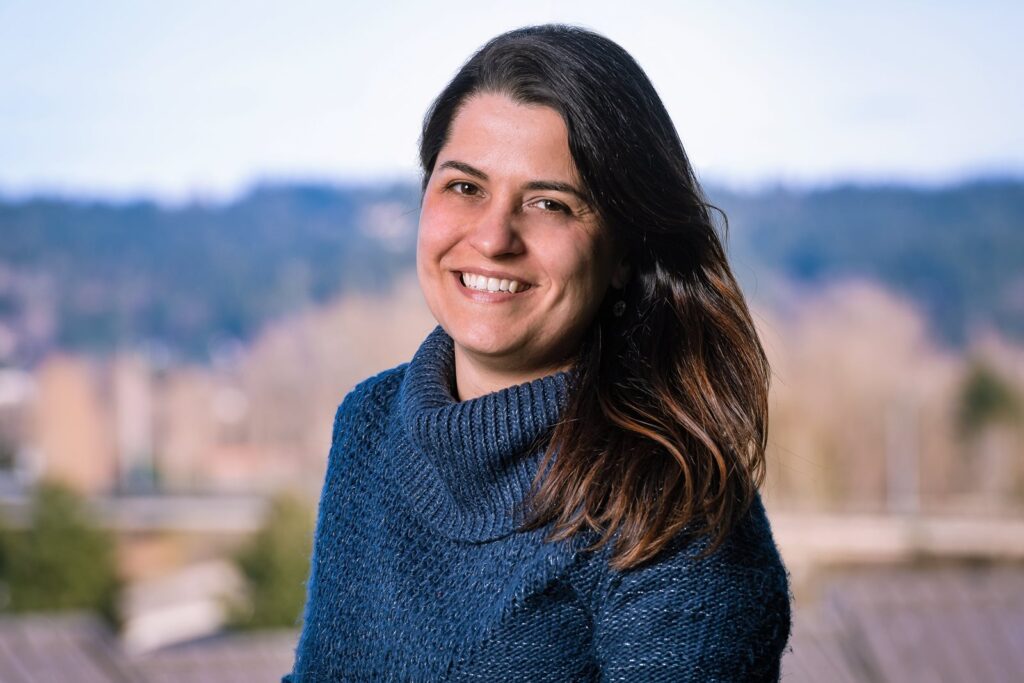
The discovery, published June 4 in “The Astrophysical Journal,” includes contributions from Dr. Paola Rodríguez Hidalgo, associate professor in the School of STEM, and Liliana Flores (Physics ’25), a former undergraduate researcher who worked alongside an international team of astronomers studying a distant quasar known as J2318. The team was led by researchers at York University in Toronto.
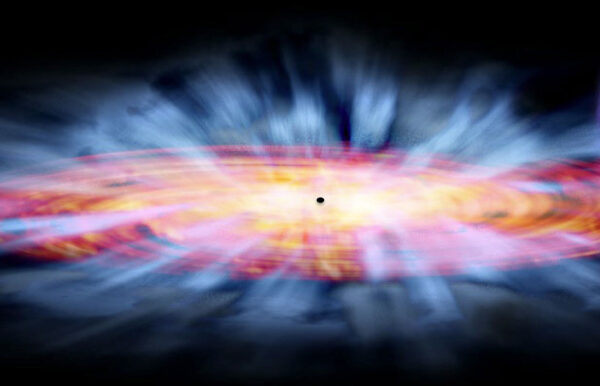
The quasar hosts a black hole approximately 1.7 billion times the mass of the Sun and generates a powerful wind at nearly 30% of the speed of light — the fastest ultraviolet quasar outflow ever detected.
“These extreme outflows carry incredible amounts of energy that can affect the galaxies around them,” Rodríguez Hidalgo said. “They serve as a sort of missing link between the active central region of a galaxy and the rest of the galaxy. While this process has been included in simulations of galaxy formation for decades, we still have much to learn from observations.”
The research highlights the impact undergraduate students can have on cutting-edge scientific discoveries. Flores, who conducted research with Rodríguez Hidalgo as an undergraduate through the Sloan Digital Sky Survey Faculty and Students Team (FAST) initiative, helped analyze the quasar’s spectrum to measure the speed and strength of the outflow. FAST supports faculty-student research partnerships and provides undergraduate students with opportunities to contribute directly to astronomical discoveries.
“I was in charge of fitting the absorption profiles in the quasar spectrum to determine their velocity and equivalent widths,” Flores said. “Repeated observations revealed that the amount of absorbed light changes over time. Something in the wind conditions must be changing for that to happen.”
The discovery emerged from observations gathered through the Sloan Digital Sky Survey, an international collaboration that has mapped the universe for more than two decades. The team who made this discovery was led by colleagues from York University: Dr. Patrick Hall, Faculty of Science; graduate student and lead author Lucas Seaton; and other members of the SDSS collaboration.
“Both Patrick and I have been working together — and with undergraduate students — thanks to the SDSS Faculty and Students Team initiative that supports these collaborations,” Rodríguez Hidalgo said. “Programs like this allow students to focus on research while completing their undergraduate studies. These students are the next generation of scientists, and they are already making important discoveries.”
“Programs like this allow students to focus on research while completing their undergraduate studies. These students are the next generation of scientists, and they are already making important discoveries.”
Dr. Paola Rodríguez Hidalgo, associate professor, School of STEM
Quasars are among the brightest objects in the universe. They form when matter spirals into a supermassive black hole, creating a hot, luminous disk of gas. The intense radiation produced by the disk can drive powerful winds outward at extraordinary speeds.
In the case of J2318, the wind reaches velocities of up to 30 percent of the speed of light. While even faster winds have been detected at X-ray wavelengths, researchers say J2318 represents the fastest ultraviolet outflow ever observed.
Researchers say the finding could help astronomers better understand how energy from supermassive black holes regulates star formation and shapes the growth of galaxies over cosmic time.
Rodríguez Hidalgo and Flores continue to search for additional extreme quasar outflows across the observable universe.
“It won’t be easy to find a faster ultraviolet outflow than that of J2318,” Flores said, “but we are continuing this search from the nearby universe to the most distant reaches of the universe that we can see.”