At the close of each academic year, student research is showcased and honored through events such as the University of Washington Undergraduate Research Symposium. The event is an opportunity to recognize not only the work of students — but also their mentors.
Students presenting in the symposium each year can nominate mentors who have had a profound impact on their education and research. A small committee of faculty and staff then reviews the nominations to select recipients of the 2026 Outstanding Undergraduate Research Mentor Award.
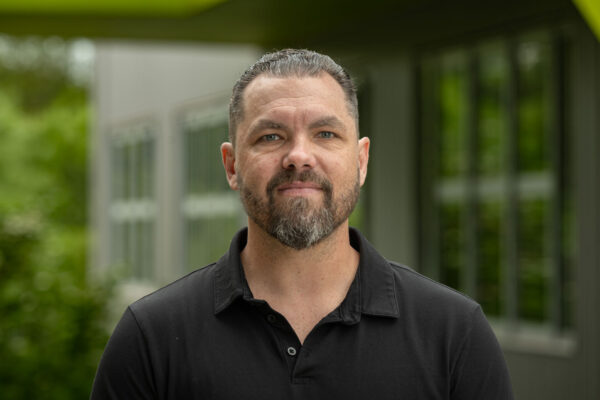
This year, Dr. Charlie Collins, associate professor in the UW Bothell’s School of Interdisciplinary Arts & Sciences, was among the 11 recipients selected from a pool of 305 nominations.
“Dr. Collins has been an exceptional mentor,” wrote Adarina Uthman, a senior majoring in Psychology, in her letter nominating Collins for the award. “What further distinguishes Dr. Collins is his commitment to developing scholars, not just projects on paper. He invests ample time in sharing his research skills while encouraging intellectual curiosity and modeling integrity in human subjects research.”
The deep impact of educators
Growing up, Collins didn’t always see himself attending university. No one in his family had gone to college before, and he struggled in a traditional high school. It wasn’t until he moved to an alternative high school that he finally found a learning environment that truly engaged him.
“My teachers were incredible, and it was one of the first times that I had experienced adult educators who were willing to answer the dumb questions,” he said. “It really was inspiring to see the impact an educator could have on a student.”
After graduating, Collins went to community college and again was surprised by how different it was from his K-12 experience. He said, “I really struggled in traditional high school, but I thrived in college because I could pick my own path.”
He then transferred to the University of California, Riverside, where he received a bachelor’s degree in Psychology. He received his master’s in Psychological Science from California State University, Chico.
“I loved the university setting and found it so empowering, so I wanted to continue my career after graduate school in a university setting,” he said. “I love research — but I also love teaching and wanted to move into teaching in a way where I could contribute to my community and give back to students with similar backgrounds to my own.”
He finished his doctorate in Ecological-Community Psychology at Michigan State University in 2013 and joined the faculty at UW Bothell shortly after.
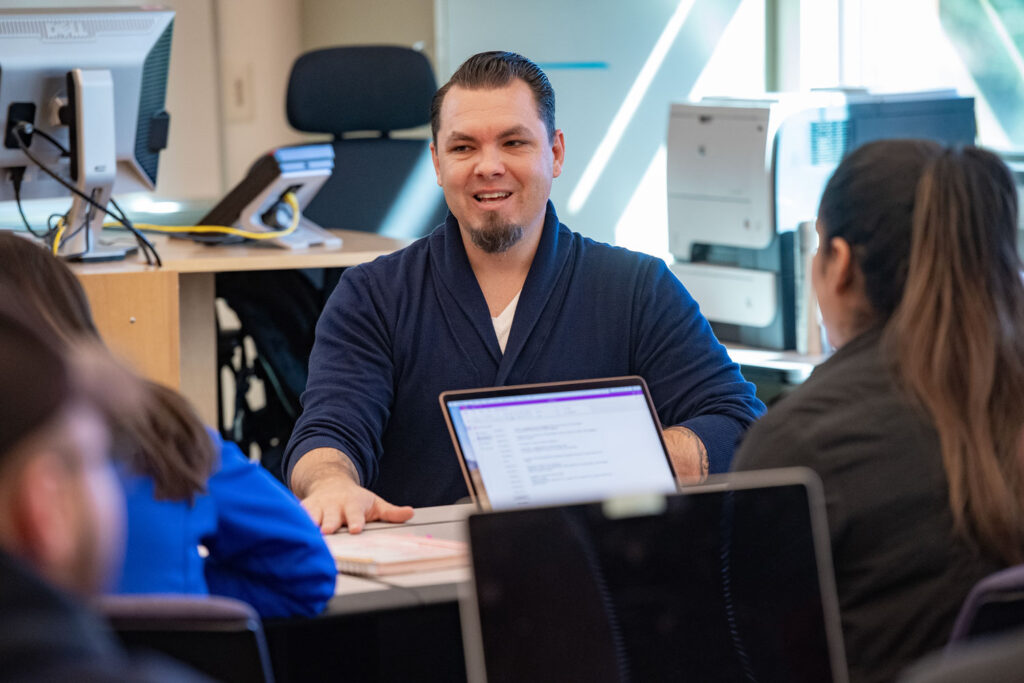
Perspectives of non-traditional students
In his research, Collins examines how economic structures, racial hierarchies, political institutions and social systems shape psychological well-being, health and collective capacity. He often includes his undergraduate students to participate.
“I actively recruit non-traditional students to work with me on my research projects because it’s a way for me to raise the floor for students who already have significant hurdles, compared to their peers who are more privileged or come from traditional backgrounds,” he said.
Collins centers the perspectives of non-traditional students not only in his role as a mentor but also as a researcher, focusing on topics that may affect them, such as systemic instability and inequality. In his latest project, Collins and his team of student researchers are exploring the impacts of structural instabilities on students’ well-being.
The project developed from a previous paper Collins published establishing a framework and theory of systemic psychological insecurity.
“This work began in large part due to the sociopolitical context and chaos at the federal level in recent years,” he said. “When people live in unstable and unpredictable systems, we’re unable to plan for the future and make decisions.”
An example of this is to consider the typical college student who is getting a degree in computer science, he said. “If they’ve put in four years of effort into getting their degree and all of a sudden, there are a ton of layoffs — which is happening now in the tech industry — what does that student do? How does that affect them psychologically?”
Environment of genuine collaboration
In the ongoing participatory action research project, Collins uses university systems as a case study for his framework.
“University students face increasingly unstable conditions related to employment, food access, finances, transportation and evolving academic requirements,” said Uthman, the project manager. “The project specifically inquires: What does systemic insecurity look like among students, and how do students perceive and navigate university support systems?”
The student researchers have conducted 10 interviews and plan to conduct at least 10 more before analyzing their data. They will also be using a survey for additional data collection. The findings, Uthman noted, have the potential to inform successive university policies, improve support systems and cultivate interdisciplinary conversations about student well-being in unstable social contexts.
Uthman and three other student researchers — Yonathan Dagnew, Alastar Diem and Basil Mayhan — presented on the study thus far at the UW’s 2026 Undergraduate Research Symposium. The students were also among 27 honorees of the 2026 Population Health Initiative Undergraduate Recognition Award, which recognizes projects that demonstrate strong relevance to population health and excellence in both innovation and presentation.
Their success, Uthman said, was made possible by Collins’ mentorship.
“Dr. Collins has also been exemplary in fostering an environment where undergraduate researchers are treated as genuine collaborators,” she wrote in her nomination letter. “His guidance has exceeded mere logistical training: He challenges students to think critically about how structural forces shape psychological well-being while encouraging both rigor and social responsibility.
“With his mentorship, I — and our research team — have strengthened our ability to translate complex theoretical frameworks like systemic psychological insecurity into meaningful, community-based research.”
“With his mentorship, I — and our research team — have strengthened our ability to translate complex theoretical frameworks like Systemic Psychological Insecurity into meaningful, community-based research.”
Adarina Uthman, Psychology ’26
A shared sense of ownership
In his research and mentorship, Collins said he is passionate about creating projects that are designed for students, by students. It is important to him that student mentees serve as partners in the shared research.
“I bring my expertise in social and psychological research and methodology, but they are the experts in their lived experience,” he said.
“The best thing I can do is try to implement processes and convey a message that they have shared ownership over this work — and be there to guide them when they need it.”