Expanding Access to Environmental Learning: The Story Behind CoSEE’s Adaptive Library
“Learning doesn’t happen in boxes. It’s happening all the time across topics, no matter where we are or what we are doing.”
Maddie Iem, Program Manager
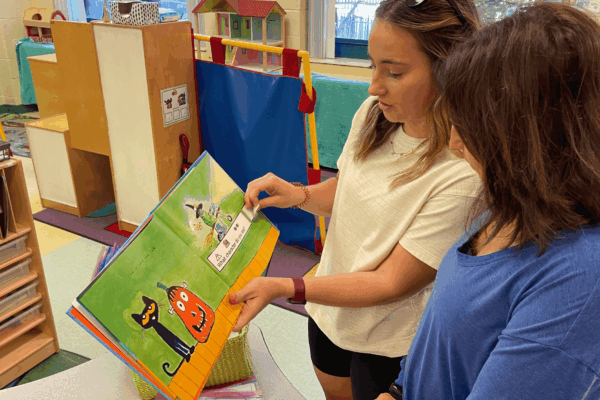
At the Collaborative for Socio-Ecological Engagement (CoSEE), environmental learning is built around the belief that everyone should have opportunities to engage with the natural world. One initiative working towards that goal is the Adaptive Library, which is a growing collection of children’s books designed to make environmental and STEAM (Science, Technology, Engineering, Arts, and Mathematics) learning more accessible for learners with diverse communication and support needs.
The Adaptive Library focuses on adapting children’s books so that more students, including those who use alternative and augmentative communication (AAC) or receive special education services, can meaningfully participate in environmental learning.
The idea for the Adaptive Library grew out of the experiences of CoSEE Program Manager Maddie Iem, whose background in special education helped shape the vision for the project.
From the Classroom to Environmental Education
Before joining CoSEE, Maddie worked as a special education teacher in Chicago Public Schools, where she taught students from preschool through fourth grade and supported learners with a wide range of support needs.
During her time in the classroom, one of the strategies she used most frequently was adapting children’s books to make them more engaging and accessible for her students. These adaptations helped students participate in shared reading experiences while continuing to develop communication, literacy, and academic skills. They allowed students to work on goals and participate in ways that they may not have been able to previously.
Many of these adaptations included the use of core word vocabulary, which plays an important role for students who use AAC. Core vocabulary focuses on high-frequency words that support everyday communication and can help students build language skills as they prepare to use higher-assistive communication technologies.
Through this work, Maddie saw how thoughtful adaptations could help students engage more fully with stories, participate in discussions, and connect with classroom learning.
Connecting Student Interests with the Natural World
While working with her students, Maddie also noticed something else: many of them were deeply curious about the natural world.
Students were often excited by topics like worms, butterflies, dirt, and outdoor exploration.
“My students had many questions about how the world worked and what they were seeing on the playground,” Maddie explained. “I wanted to find ways to take that learning back into the classroom and integrate it throughout the day.”
Topics that were often only reserved for “science time” became opportunities for exploration across multiple parts of the school day. These interests created opportunities to bring environmental themes into the classroom through books and activities that reflected what students were naturally drawn to.
These experiences helped spark the idea that children’s books about nature and science could be powerful tools, not only for science learning, but also for literacy, math, and communication.
“The hope is that ‘science’ stories aren’t just saved for the maybe one hour a week of science instruction,” Maddie said. “These books can be used throughout the day during math, reading, or writing blocks. Although our school days might be broken up into subjects, learning doesn’t happen in boxes. It’s happening all the time across topics, no matter where we are or what we are doing.”
Later, Maddie pursued her master’s degree at the University of Washington, where she completed an outdoor education residency and studied the impact of inclusive outdoor spaces.
Through that experience, she began to see a gap: while there were many wonderful children’s books about nature and science, very few were designed with accessibility in mind for learners receiving special education services, and even fewer were making their way into mainstream classroom use.
“People tend to fall back on the things they know and love,” Maddie said. “So, what if I start making it easier for teachers to say yes, and include books that expand environmental learning while also including interactive elements across disciplines?”
Building the Adaptive Library
The Adaptive Library grew from this intersection of supporting all learners and expanding environmental education.
The program works to identify STEAM-focused children’s books, books that explore science, technology, engineering, arts, and mathematics concepts through environmental topics, and adapt them so that they can be used by learners with a wide range of communication and developmental pathways.
Each adapted book includes features designed to support engagement and accessibility. These may include:
- Embedded communication supports that incorporate core and fringe vocabulary
- Verbal prompts to encourage participation and discussion
- Sensory materials that help students interact with the story in tactile ways
- Communication boards tailored for each book that include key words students might need when discussing the story
- Opportunities to practice math and literacy skills embedded within the book
The books are also designed to connect with additional learning kits, educational materials, or hands-on activities that allow students to explore the concepts from the story in real-world settings, both in their classrooms and out in the field.
In this way, the Adaptive Library is not only a collection of books—it is a toolkit for helping students engage with environmental learning through storytelling, communication, and exploration.
Looking Ahead
The Adaptive Library continues to grow as CoSEE staff and student interns collaborate to adapt new books and develop supporting materials.
The goal is to expand access to environmental learning so that students of all abilities can participate in conversations about ecosystems, climate, the natural world, and more.
The collection is always growing, and in the coming years CoSEE hopes to explore opportunities to write and publish place-based books that focus on hyper-local topics, such as Kokanee salmon in Lake Washington.
By combining principles from special education with place-based environmental learning, the Adaptive Library reflects CoSEE’s broader mission: creating opportunities for more people to engage with socio-ecological systems and the communities that depend on them.