Understanding English Holly Invasion at Saint Edward State Park
New research by Santiago Lopez connects science, stewardship, and climate resilience
Urban forests play a vital role in supporting biodiversity, community well-being, and environmental learning, yet they are especially vulnerable to invasive species. New research by Santiago Lopez, former director and long-time advisor to the Collaborative for Socio-Ecological Engagement (CoSEE), sheds important light on how one such invader, English holly (Ilex aquifolium), is spreading through Saint Edward State Park, an urban forest near the UW Bothell campus.
The study, “Novel insights into the spatial dynamics of English holly invasion in an urban forest ecosystem in the Pacific Northwest of the United States,” was recently published in Discover Plants and is available as an open-access publication. This means anyone — students, educators, land managers, and community members — can read and share the full article without restrictions.
Why English Holly Is a Problem
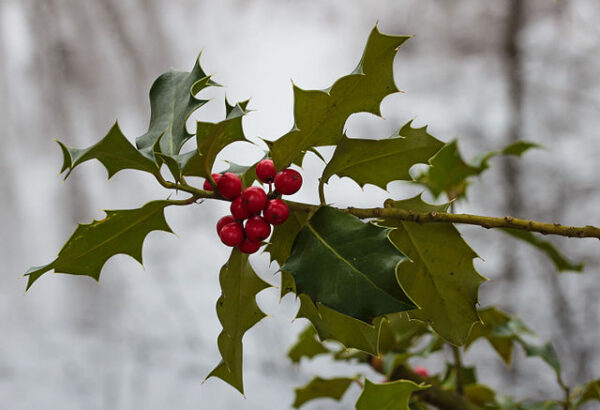
English holly is widely known as an ornamental evergreen, but in forest ecosystems, it can become highly invasive. Holly is shade-tolerant, allowing it to thrive under established canopies where it competes with native plants for sunlight, water, and nutrients. Its bright red berries are easily dispersed by birds, helping the plant spread well beyond landscaped areas and into intact forest systems.
At Saint Edward State Park, holly has become increasingly visible in the understory, raising concerns about its long-term impacts on native biodiversity, forest succession, and ecosystem services.
What the Research Found
Dr. Lopez’s study combines species distribution modeling and spatial analysis to better understand where holly establishes and why. The results show that evergreen forests support holly establishment more strongly than deciduous vegetation. Temperature also emerged as a key predictor of holly presence, suggesting that warming conditions associated with climate change may accelerate its spread across the Pacific Northwest.
Interestingly, soil nutrients showed a slight negative association with holly occurrence. This may indicate that holly is particularly tolerant of nutrient-poor soils or that it may be less competitive in nutrient-rich environments. The research also raises the possibility that holly alters soil chemistry or depletes nutrients over time, further influencing forest dynamics.
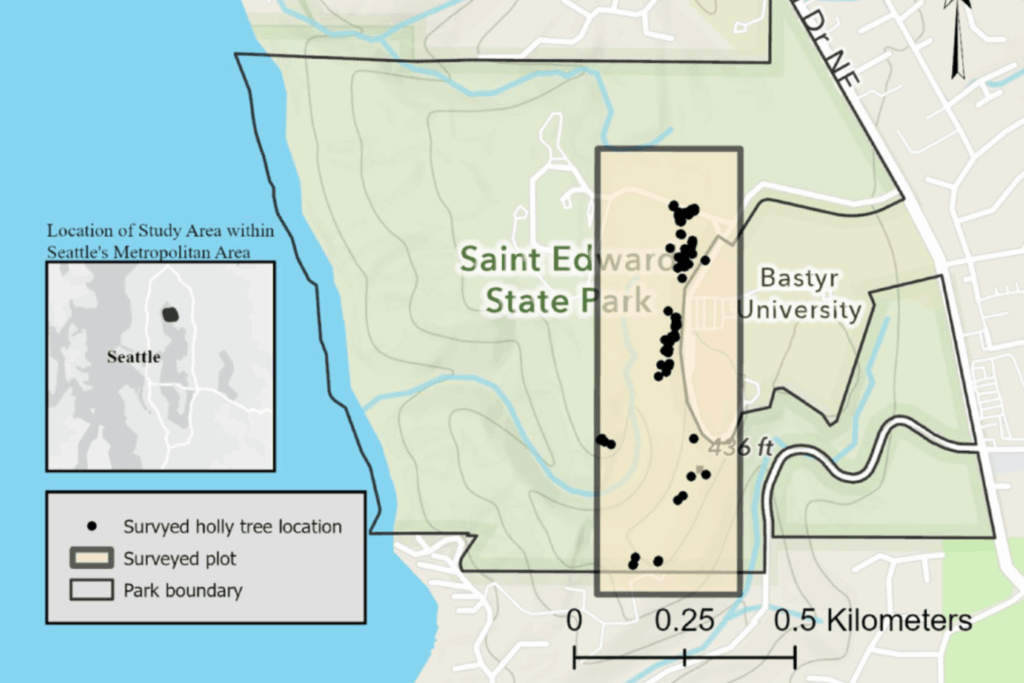
Spatial analysis revealed that holly does not spread evenly. Instead, it tends to grow in clustered patterns, likely driven by short-distance seed dispersal, vegetative spread, and the presence of mature, seed-producing trees. Once established, these trees can act as local hubs, increasing the rate of invasion in nearby areas.
Why This Matters
These findings provide valuable guidance for invasive species management in urban forests. Rather than approaching holly removal as a uniform task, land managers can prioritize high-impact areas — such as evergreen stands, warmer microclimates, and existing holly clusters — and focus on removing mature, seed-producing trees first.
For CoSEE, this research highlights the importance of place-based science. Saint Edward State Park is not only a site of recreation but a living classroom where research directly informs restoration, education, and stewardship efforts carried out with students and community partners.
Read the Full Study
We encourage readers to explore the full open-access article (PDF) to learn more about the methods, data, and implications of this work. Research like this strengthens our collective ability to care for urban forests and respond thoughtfully to ecological challenges.
The full study is available through Discover Plants, and we’re grateful to Dr. Lopez for contributing research that supports resilient forests and meaningful socio-ecological engagement in our region.
This research was made possible by a Scholarship, Research, and Creative Practice (SRCP) Grant from the University of Washington Bothell and a research permit from Washington State Parks (SRP #220906). We gratefully acknowledge the student volunteers from the University for their contributions during the data collection phase, as well as the partnership between CoSEE and Washington State Parks, both of which were critical to the successful completion of this research.