Learning from the Water: Environmental Exploration with the Alyssa Burnett Center
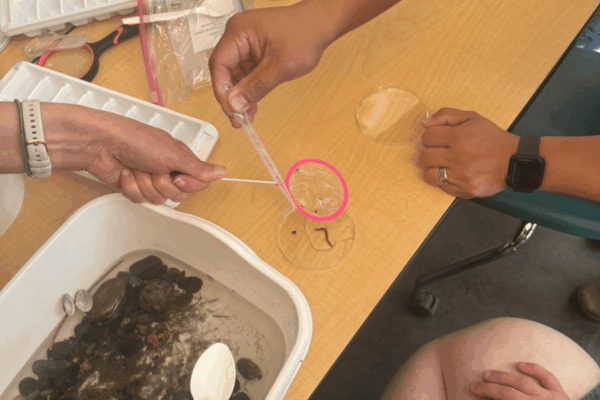
Students from the Alyssa Burnett Center visit the EERC to investigate watersheds, water quality, and macroinvertebrates through hands-on environmental learning.
At the Environmental Education and Research Center (EERC), partnerships with community organizations are an essential part of how the Collaborative for Socio-Ecological Engagement (CoSEE) connects people to environmental learning. One of CoSEE’s longest-standing and most meaningful partnerships is with the Alyssa Burnett Center, a program within Seattle Children’s Hospital that supports adults with developmental and intellectual disabilities.
Since the opening of the EERC classroom at Saint Edward State Park, the Alyssa Burnett Center has been a regular partner in CoSEE programming. Students from the center visit the EERC twice each quarter to participate in hands-on environmental learning experiences designed to explore local ecosystems and scientific inquiry in accessible and engaging ways.
These visits provide opportunities for participants to learn about environmental science while connecting with the landscapes and ecosystems of the Pacific Northwest.
Exploring Water and Ecosystems
During a recent September visit, students from the Alyssa Burnett Center joined CoSEE staff in the EERC classroom to explore the topic of water systems and macroinvertebrates.
The session began by examining how water moves throughout our local ecosystem. Students explored the concept of watersheds, looking at how water flows across the region and how local waterways connect to Lake Washington. Through maps and discussion, participants learned how water travels through landscapes, communities, and habitats before reaching larger bodies of water.
Understanding these connections helped students see how the health of smaller streams and watersheds can influence the health of larger ecosystems.
Investigating Water Quality
After learning about watersheds, students explored different ways scientists measure water quality.
Participants used water quality test strips to observe how scientists can analyze characteristics of water such as chemical balance and potential pollutants. These tools introduced students to the kinds of methods researchers use when monitoring the health of aquatic ecosystems.
Students then turned their attention to macroinvertebrates, organisms that often live in freshwater environments and can provide important clues about water quality.
Breaking down the word helped students understand the concept: macro meaning large enough to see, invertebrate meaning an animal without a backbone—essentially, “a big bug without a backbone.”
Using magnifying glasses and careful observation, students examined different macroinvertebrates and worked together to identify and sort them. These organisms are often used by scientists as indicators of water quality because some species thrive in clean water while others are more tolerant of pollution.
As students sorted the organisms, they also made hypotheses about what the presence of certain macroinvertebrates might reveal about the water where they were collected.
Connecting Science to the Bigger Picture
Throughout the session, students discussed why understanding water quality matters, not only for aquatic ecosystems but for the entire interconnected environment.
Healthy water systems support fish, plants, insects, and other wildlife, but they also play an essential role in supporting human communities. By exploring how water quality impacts ecosystems, students began to see the connections between environmental health and the wellbeing of people, animals, and plants.
Activities like identifying macroinvertebrates help demonstrate how even small organisms can provide important insights into larger environmental systems.
A Partnership Built on Community Learning
CoSEE is deeply grateful for its ongoing partnership with the Alyssa Burnett Center. Their visits to the EERC highlight how environmental education can bring together diverse communities to explore science, ask questions, and engage with the natural world.
By creating opportunities for hands-on learning, these programs help ensure that environmental education remains inclusive, accessible, and community-centered.
The continued collaboration between CoSEE and the Alyssa Burnett Center reflects a shared commitment to building meaningful learning experiences that connect people to ecosystems, scientific inquiry, and each other.