Kris Yu loved playing video games as a child — sometimes too much. When his dad wanted to limit how much he played, he would remove various parts from the computer. Yu then had to figure out how to fix it. Over time, he learned a lot about hardware from putting his PC back together.
“That hands-on experience really sparked my interest in technology,” Yu said.
That spark led him to pursue an undergraduate degree in computer science in Taiwan, where he grew up. While he enjoyed the program, what he found even more valuable was the coding club where he discovered his ultimate calling — building mobile apps.
“I really liked how writing apps can have a direct impact on users,” he said, “and that feels more fulfilling than working with hardware alone.”
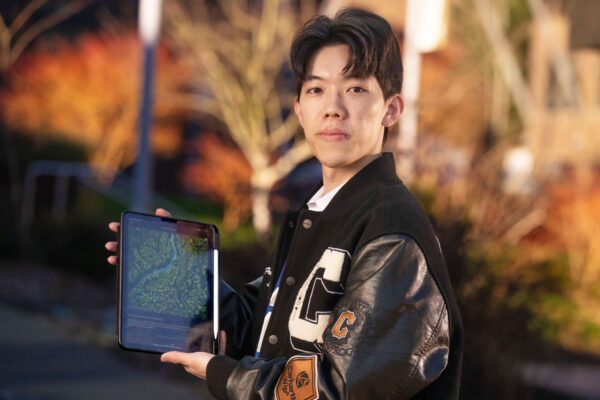
After graduating, Yu’s desire to learn more about the software side of tech brought him to the University of Washington Bothell. Now a graduate student in Computer Science & Software Engineering, he has worked on several apps, from an interactive environmental education app to a learning tool for individuals with autism.
Classes with working professionals
Yu said much of his undergraduate courses were focused on math and theory, yet he was drawn to UW Bothell’s CSSE program for its emphasis on a more project-based curriculum. “It seemed like a great opportunity for me to participate in real-world scenarios and gain real experience.”
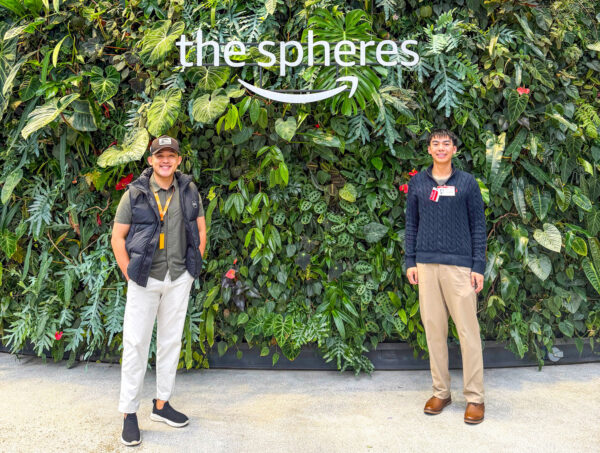
Looking to dive straight into his passion for app development, he signed up for a mobile computing course in his first quarter. He was thrilled not only to get the hands-on training he’d been wanting but also to learn from someone who had industry experience — Hansel Ong, a part-time lecturer in the School of STEM, whose work history includes tech giants such as Amazon and Microsoft.
“It didn’t feel like he was just teaching a class,” Yu said. “He takes students into his life and his work, and he sets us up to know what is happening in the industry and what is happening in real life instead of what is happening in a textbook.”
Yu added that, as he progressed through the CSSE program, he was surprised to find that many of his instructors came from industry.
“What they teach in class is on a whole other level. It’s fascinating. It’s like you’re talking to a CEO, and he’s teaching you how to prepare for your future,” he said.
“And because the class sizes are so small, they’re also really accessible. It’s great to be able to just walk up to professors after class and talk to them.”
“ It didn’t feel like he was just teaching a class. He takes students into his life and his work, and he sets us up to know what is happening in the industry and what is happening in real life instead of what is happening in a textbook.”
Kris Yu, graduate student, Computer Science & Software Engineering
An app for climate awareness
Yu had created a few apps on his own before coming to UW Bothell. He even submitted two of them to the Swift Student Challenge, an annual competition sponsored by Apple where student developers from around the world submit creative app prototypes. The first year he created a cybersecurity-themed mini-game. His second year, in anticipation of applying to graduate programs in the U.S., he developed a language learning app to help him master English.
During his first year at UW Bothell, he created his third submission — Forest Guardian, an interactive educational app that teaches environmental conservation through storytelling — and this time, he was selected as one of just 350 winners from all around the world.
The inspiration behind Forest Guardian came from his own volunteer experience cleaning river waste in Taiwan during his undergraduate studies. Although he was aware of climate issues before, he said, it was seeing the impacts firsthand that really drove him to act.
“I was collecting trash by a river and saw a bunch of abandoned bicycles and plastic waste. It really hit me how much human behavior impacts nature,” Yu said. “I was shocked. I wasn’t aware of how serious the situation had become, and I thought that maybe a storytelling app could help raise awareness.”
In the app, players take on the role of a forest guardian as they navigate through stories and face real environmental challenges, such as wildfires, pollution and ecological changes. Each choice they make affects the forest’s health points. Whether the user helps the forest to recover and thrive or to decline is seen in the environmental score they receive.
“I wanted to create something where people could experience those consequences in an engaged way and not just a lecture,” Yu said. “This app shows how human decisions can make a difference — for better or worse.”
A learning tool for individuals with autism
This year, Yu plans again to enter the Swift Student Challenge. His submission will be a simplified version of his capstone project, “Social Stories,” a learning tool for individuals with autism. Social stories are visual and audio narratives that help prepare neurodivergent individuals for various life events and for changes in their daily routines.
The app is part of an ongoing research project led by his mentor, Dr. Annuska Zolyomi, assistant professor in UW Bothell’s School of STEM. Her research focuses on interviewing individuals with autism as well as parents and caregivers to explore how effective digital social stories are in aiding individuals who have autism with understanding social interactions, emotions and activities.
When she was ready to take her project to the next phase and leverage these interviews into a learning tool, she invited Yu to channel his technical expertise into an app.
“Professor Zolyomi asked me if I’d like to help her implement the research into a real tool that could help people have a better life, and I thought, ‘Hell yes, I’d love to do that,’” Yu said.
The app is nearly finished, he added. Now, the team is completing a user study to see what aspects can be improved.
The simplified version of the app Yu is submitting for the challenge will be a three-minute condensed version of the project. Someday, his goal is to be named as a distinguished winner in the challenge, which would give him the opportunity to visit Apple headquarters in Cupertino, California, for a three-day networking event.
Preparing for a future in tech
As he looks ahead to graduation in spring 2026, Yu said he feels more prepared to enter the tech workforce now that he has so much hands-on experience developing apps. He has learned a lot not only from his instructors, he added, but also his peers, many of whom already work in tech and have returned to school to advance their careers.
“It’s great to learn from my classmates about their work experience,” Yu said. “We kind of get to grow together, and I think that’s the most important value you get from college — the ability to challenge each other’s ideas and perspectives, and to create new ideas together.”
After graduation, Yu wants to find a job as a software engineer, although he also plans to continue making apps of his own.
“I want to continue building products that solve real problems,” he said. “I hope I can develop my own apps and continue to use the technical knowledge I gained from UW Bothell to create a great company.”