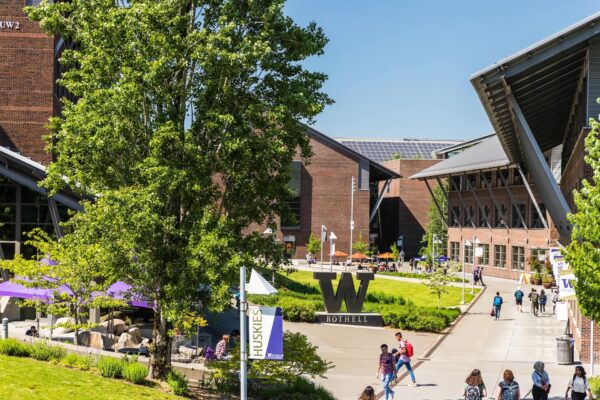
A University of Washington Bothell education is in high demand. Last fall saw its largest-ever enrollment, with more than 1,100 first-year students pushing the total student body beyond 6,300.
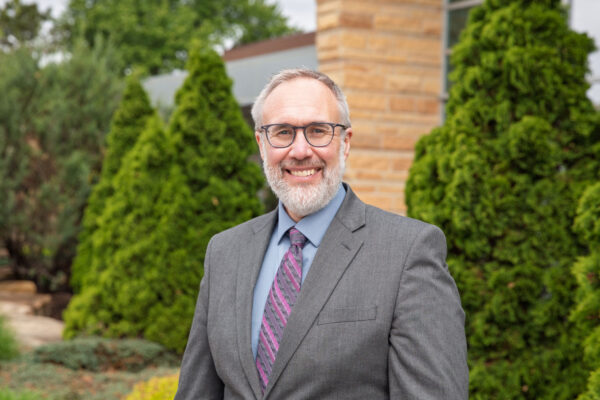
“Those trends speak a lot to the experiences our students are having and who we attract,” said Dr. Brian Martensen, executive vice chancellor for Academic Affairs. “It’s clear that people care about students here — and they care about each other.”
Six months after joining UW Bothell, Martensen has distilled this essence of the close-knit campus. He is still discovering how best to support what is a still developing and dynamic university.
He said he is leaning into a three-pronged approach: clear information and analysis, streamlined systems, and collaboration. “We do a lot of things right, and now it’s a question of how to scale them.”
The flipside of UW Bothell’s growth, noted Martensen, is that all the programs and systems that keep the campus humming don’t always keep up, which makes coordinating across five schools, several hundred faculty, hundreds of staff and more than 6,300 students much more complicated.
Collaborating to support a dynamic campus
His first order of business: Get the best information to the people who need it.
“We want to put the right tools in people’s hands,” Martensen said. “The faculty and staff know the students well, but can we use data more effectively to coordinate our efforts?”
For example, in some majors, sophomore year presents a critical turning point when students are vulnerable to dropping out. How can UW Bothell better uncover potential obstacles and highlight the need for support?
“Guided by the right data,” Martensen said, “we can make targeted investments — from reducing class sizes where it would be most effective to expanding mentored experiences and increasing innovative, high-impact services and resources for students.”
This approach will also systematize support and simplify processes for UW Bothell faculty. The bulk of Martensen’s role, in fact, involves coordinating academic affairs with each of the five school deans, plus the Campus Library, Office of Student Academic Success, Office of Faculty Success and Office of Sponsored Research.
“We want to make the systems easy,” he said, “and make sure the faculty’s work is in the places where they can be most effective and use their expertise.”
Building on a UW Bothell strength
With the faculty, Martensen is also looking to coordinate and scale the rich roster of community engagement opportunities for UW Bothell students. These include research projects, internships, capstones, mentorship opportunities, study abroad and career connections — a full range of offerings to fit the needs of a diverse student body.
Yet with the systems now in place, said Martensen, it can be difficult to know how many students are participating in different types of community-engaged learning — and better data can enhance this critical aspect of the UW Bothell Husky experience.
“It’s a matter of scale,” he said. “How can we make sure that every student on campus has access to these opportunities? How can we get even more of them involved?”
Since arriving at UW Bothell last summer, Martensen has also dived into joint, long-term planning for all three UW campuses and is excited to see UW Bothell’s strengths lauded and embedded in the University’s overall work.
“There are a lot of things we do that the UW as a whole is recognizing and incorporating,” he said. “Community engagement, training students to talk across differences … these are being taken on more broadly at the tri-campus level.”
“We want to make sure the faculty’s work is in the places where they can be most effective and use their expertise.”
Brian Martensen, executive vice chancellor for Academic Affairs
Planning for statewide impact
Martensen is deeply involved in long-term strategic planning that’s specific to UW Bothell as well. As a veteran of such efforts, he strives to balance the lofty and the tactical by asking, “What’s the thing that we can do that’s unique and that we can maximize?”
One part of his answer: a commitment to interdisciplinary approaches. “It’s why we’re well-positioned to help the region and the state,” he said.
From AI and cybersecurity to biotech, aerospace, medical and health — each of these burgeoning fields is interdisciplinary in nature.
“It’s a real opportunity,” said Martensen. “There are lots of experts on this campus who have the ability to look at trends, help shape them and figure out how best to use them.”
Also distinct to UW Bothell? The fact that it is both part of a research university and has a student-focused mission at its core. “The UW’s multi-campus model means we can both be ourselves and part of something larger,” he said.
A shining example of education
A recent arrival to the Pacific Northwest, Martensen has become a champion of UW Bothell’s strengths: faculty expertise, interdisciplinary approaches, community-engaged learning and thousands of enthusiastic students.
He said he doesn’t even mind the clouds and drizzle that can blanket the region for weeks or months at a time.
But he does not want UW Bothell to be hidden, he added.
“People often say we’re a hidden gem, and it shouldn’t be a secret,” he said. “UW Bothell is really a gem of a campus in the way we integrate our learning and our impact.”