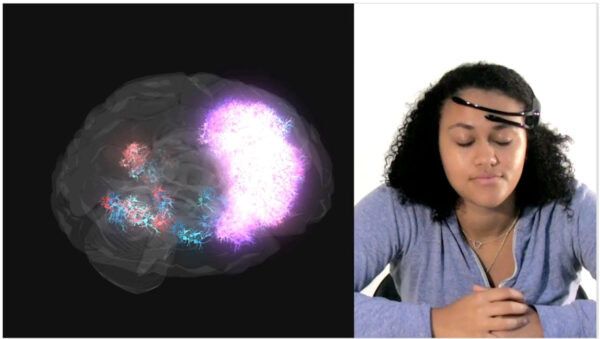
Imagine what it’s like to be a bat. Are you flying through the night sky along a river in search of insects to eat? Hanging upside down in a cave, roosting with the rest of your colony? Or perhaps you’re chowing down on a mango high up in a tree, deep in the Amazon Rainforest.
Whatever you’re picturing, it’s unique to you. Considering what is “bat-like” is a thought or idea colored by your own knowledge and experiences.
And as it turns out, “bat-like” could also be a place — a psychological location where the mind can go.
In his latest paper, Dr. Jin-Kyu Jung explores this idea as a creative re-interpretation of an area of study called psychogeography.
Researching across disciplines
Jung is a professor in the University of Washington Bothell’s School of Interdisciplinary Arts & Sciences. As an urban geographer and planner, his research focuses on exploring the critical, qualitative and creative possibilities of geographic visualization in understanding socio-spatial processes as well as in understanding the politics of urban space and community.
A little more than a decade ago, he ventured into a new area of research when he began collaborating with Dr. Ted Hiebert, an artist and former IAS faculty member who currently serves as chair of Toronto Metropolitan University’s School of Image Arts. The pair have been exploring how to merge geographic and artistic representations of information and analysis — particularly as it relates to psychogeography, research into a person’s psychological experiences in relation to a place.
Their shared work initially focused on the psychological dimensions of real space, but they have since expanded on the conceptual framework of psychogeography to investigate imaginary spaces and the spatiality of the mind.
“‘What is it like?’ is an experiment in psychogeography that takes the literal idea that thoughts and ideas might be seen as places we can go to,” Jung said. “It attempts to start discussions about what this reconceptualization of the mind might mean.”
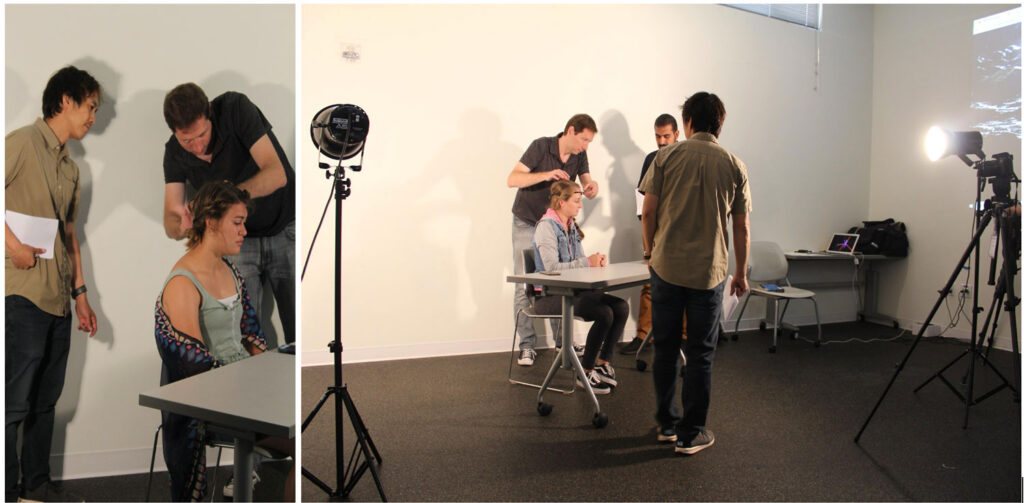
Asking ‘What is it like?’
In this experiment, participants talked about bats and attended a lecture given by a subject matter expert — Dr. Sharlene Santana, an associate professor at the UW’s College of Arts & Sciences. Then, Jung and Hiebert asked participants to imagine what it’s like to be a bat.
Why, specifically, a bat? The project was in some sense a critical response to a 1974 essay by researcher Thomas Nagel. In the essay, titled “What is it like to be a bat?,” Nagel suggested that humans are unequipped to think about the subjective character of experience without relying on the imagination.
“In contrast,” Jung said, “our project centers the unique capacity of the imagination to provide encounters with that which cannot be known directly.”
“Our project centers the unique capacity of the imagination to provide encounters with that which cannot be known directly.”
Dr. Jin-Kyu Jung, professor, School of Interdisciplinary Arts & Sciences
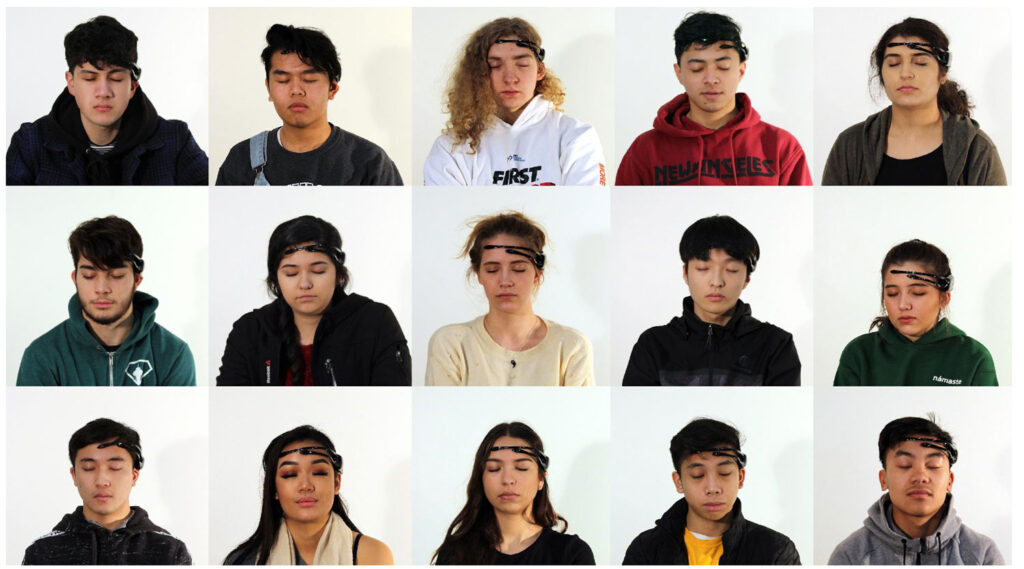
As the participants were imagining what it was like to be a bat, they listened to audio recordings of bat sounds. They also wore electroencephalography (EEG) sensors to record their brainwave activity.
“As a geovisualization project, the end goal is not just to imagine but to constitute the imagination as holistic, creative and qualitative forms of data — and how might we map the experience of imagining without ignoring its content and quality,” Jung said. “We are not so much trying to map the imagination as we are trying to scaffold the act of imagining by purposefully delineating imaginary engagement.”
Considering a non-human application
In their paper, “More-Than-Human Psychogeography: On ‘Bat like’ Places and Imaginary Geographie,” published in the Livingmaps Review journal, Jung and Hiebert share the findings of their experiment. They also look at their research from a different kind of non-human imagination: artificial intelligence.
They question whether AI has the capacity to imagine — whether prompted with “What it is like to be a bat?” or even “What is it like to be human?”
Although AI could conjure a manifestation of data at a particular point in virtual and algorithmic space, it is not quite the same thing as “imagination.” At least, not as we experience it, they wrote.
“One might imagine all the possible data in the world — synthesized, perhaps, as only intelligent machines and algorithms might do — forming a complete picture that nevertheless lacks that crucial dimension of ‘what it is like.’
“All the measurable somethings are accounted for, yet one still evades capture: the something for which there is nothing it is like.”
Despite this lack of a special “something,” AI does still make things up, they noted. These “hallucinations,” as they’re coined, are not considered an act of imagination, however, but a problem — a bug to be fixed.
Engaging in two parts
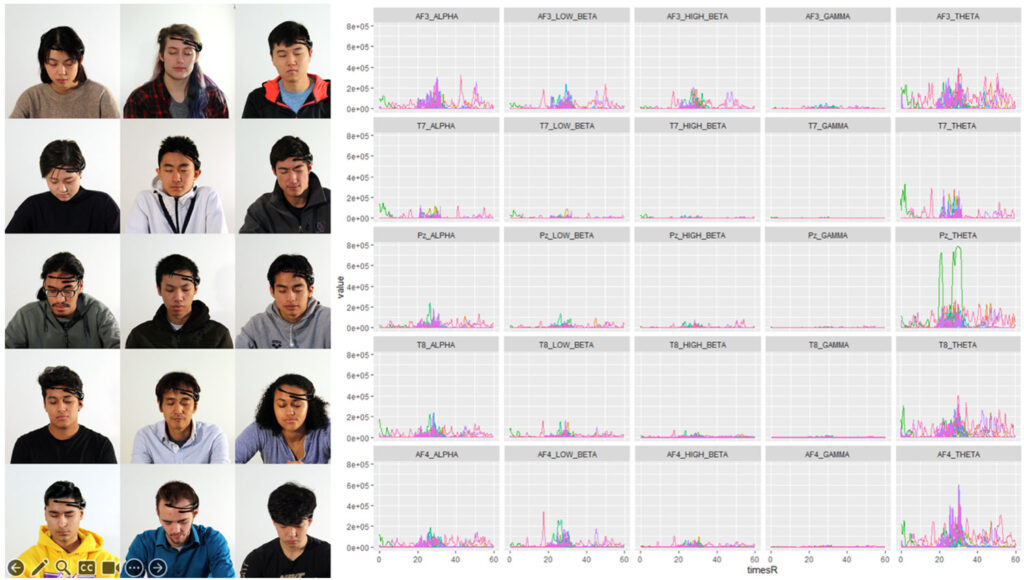
From the EEG readings, the pair was able to see the peaks, intensities and levels of cognitive engagement of the human experiment participants. These values alone cannot communicate “what it is like” to be a bat — or anything else for that matter.
As Jung and Hiebert noted in their paper, “imaginary data” requires imagination in order to engage with it. This means that the question of “what is it like?” is posed not only to the participant but also to the observer.
“The imagination is not a problem to be solved but the connective tissue of the project,” Jung said. “It’s less a survey of the mind and more an attempt at providing guided meditations with a twist, not designed as a self-help tool but later as a conversation about what happens when we treat seriously the places that our minds are able to take us.”
Drs. Jin-Kyu Jung and Ted Hiebert are currently working on a book to document their psychogeography research from the past decade.