Every International Women’s Day, I find myself returning to Frida Kahlo.
Not just the flower crowns or the unibrow or the merch-lined museum gift shops, but the woman in the hospital bed, the woman in the mirror, the woman who refused to look away from her own pain. I return to her because she teaches me something about what it means to tell the truth about your life, even when it is messy, political and painful.
I started painting when I was very young. I remember being the kind of child who asked for sketchbooks and art supplies instead of toys, and carried pencils everywhere. Art was literally my first language before I had the vocabulary for feminism or theory or critique. But I was also a perfectionist.
I obsessed over clean lines and symmetry. I studied faces and tried to make them conventionally beautiful, focusing on smooth skin, proportional features, soft expressions. I avoided anything that felt “ugly,” and I never painted anger. I never drew bodies that looked scarred or imperfect, and I never explored grief, jealousy, illness or any of the devastations women are often taught to swallow politely. Those topics simply felt taboo to me.
Because of this, my art stopped feeling like freedom to create and instead started feeling like a test.
By my sophomore year of high school, I quit. Not dramatically, just slowly. I told myself I was too busy or that I had outgrown it, but the truth was that my perfectionism had made art unbearable and no longer rewarding. If I couldn’t create something beautiful in a mainstream sense, I didn’t want to at all. Then I was introduced to Frida Kahlo.
When I initially looked at her self-portraits, I felt unsettled. The first piece of hers I ever saw was “The Broken Column,” where her body is split open and her spine is replaced with a crumbling pillar. Nails puncture her skin, and tears fall down her face. Instead of hiding her pain, she frames and centers it. She looks directly at the viewer with a steady, almost confrontational gaze.
Kahlo, who survived polio, a near-fatal bus accident and chronic pain for most of her life, painted what hurt. She painted miscarriages, blood, hospital beds, back braces, facial hair and bodies unidealized by mainstream media. In a world that preferred women as muses (especially women married to powerful men like her husband, Mexican muralist Diego Rivera), she insisted on being the subject.
As a Gender, Women & Sexuality Studies student, I have learned the phrase “the personal is political.” But Kahlo is the one who showed me what it looks like on canvas. Her self-portraits are not confessions for the sake of spectacle; they are acts of reclamation. She is the one who decides how her body is seen and what parts of her story are visible. She transformed her pain into authorship, and watching her do that felt like permission to do it myself.
I realized that my refusal to paint anything “ugly” was about fear, not just aesthetics. Fear of being judged, revealing too much, or of disrupting the expectation that women should be composed and digestible. I realized that if Kahlo could paint a fractured spine and make it art, I had no reason to censor my own inner world.
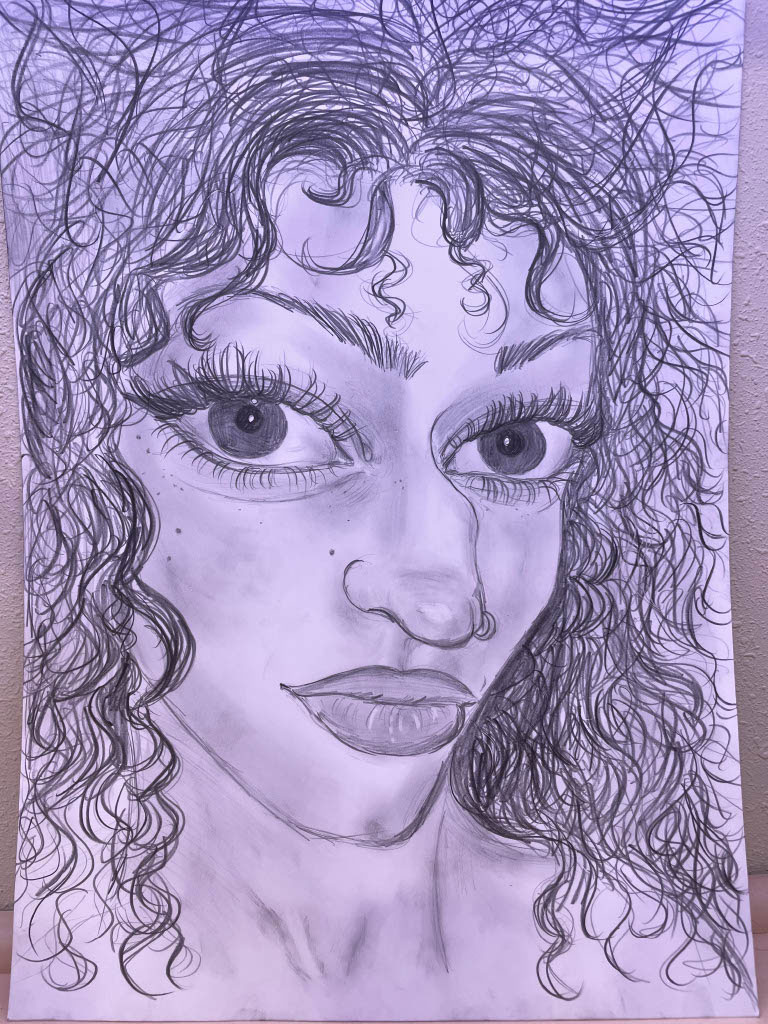
Slowly, I returned to drawing. At first, it was tentative with looser lines and less erasing. Then I began experimenting with themes I had once avoided. I painted my own tired eyes, bodies that took up space, and I sketched a brutally raw self-portrait of my own that exaggerated my features I had specifically deemed as flaws. I stopped asking, “Is this beautiful?” and started asking, “Is this honest?” It was incredibly freeing!
International Women’s Day often celebrates resilience and achievement, and Kahlo certainly embodies both. But what I honor most about her is her refusal to sanitize her experience. She did not flatten herself into inspiration. She allowed contradictions of softness and rage, devotion and defiance. She claimed her Mexican identity, her politics, her bisexual desire and her disability. Doing so, she made immense space for complexity, and she made space for me and every other young girl under the influence of toxic perfectionism.
Art is still my personal hobby, but now it feels less like performance and more like dialogue between my inner life and the canvas, between the expectations placed on women and the realities we live. Kahlo taught me that vulnerability is a form of resistance, not weakness.
On this International Women’s Day on March 8, I am grateful not only for what Frida Kahlo contributed to art history but for what she gave me personally: the courage to create without apology, to let imperfection exist and to paint what hurts.
I used to think art had to be beautiful to matter. Now I know it just has to be true.
Karma Nashed is an undergraduate student at the University of Washington Bothell majoring in Psychology with a minor in Gender, Women & Sexuality Studies. Her writing during her college career has explored feminist theory, voice and the politics of storytelling. She is the author of “Pramila Jayapal,” a biography that appears in Badass Womxn and Enbies in the Pacific Northwest Volume 3. She is especially interested in how art and literature create space for marginalized narratives. After graduation, she hopes to work in counseling and to continue using art as a form of expression.