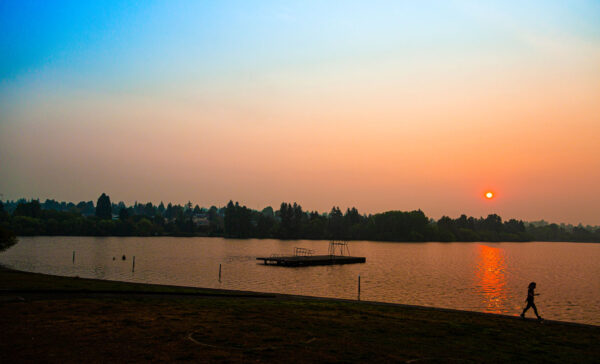
A professor in the University of Washington Bothell’s School of STEM, Dr. Sharon A. Jones has lived in the Pacific Northwest for well over a decade. During that time, she’s seen the intensity and frequency of wildfires in the region grow.
Jones worked as an engineer before coming to academia, and she continues to apply an engineer’s eye for problem solving and design to her work as a faculty member. Her research has focused on sustainable infrastructure systems while centering environmental justice including adaptation and resiliency policies in light of climate change.
In recent years, she has collaborated with a former colleague from the University of Portland — where Jones previously served as the dean for the Shiley School of Engineering — Dr. Ruth Dittrich, an associate professor of economics. Together, the pair became interested in how people, communities and organizations adapt to and plan for wildfires within the Pacific Northwest.
Their latest research homes in on one of the demographics most vulnerable to climate impacts: young children. In their recent paper, they examine how childcare providers adapt to wildfire smoke.
Delving into a personal and social issue
Jones and Dittrich didn’t know much about the childcare space when they began, but they had a personal stake in the matter — Dittrich had two young kids, and Jones has grandchildren.
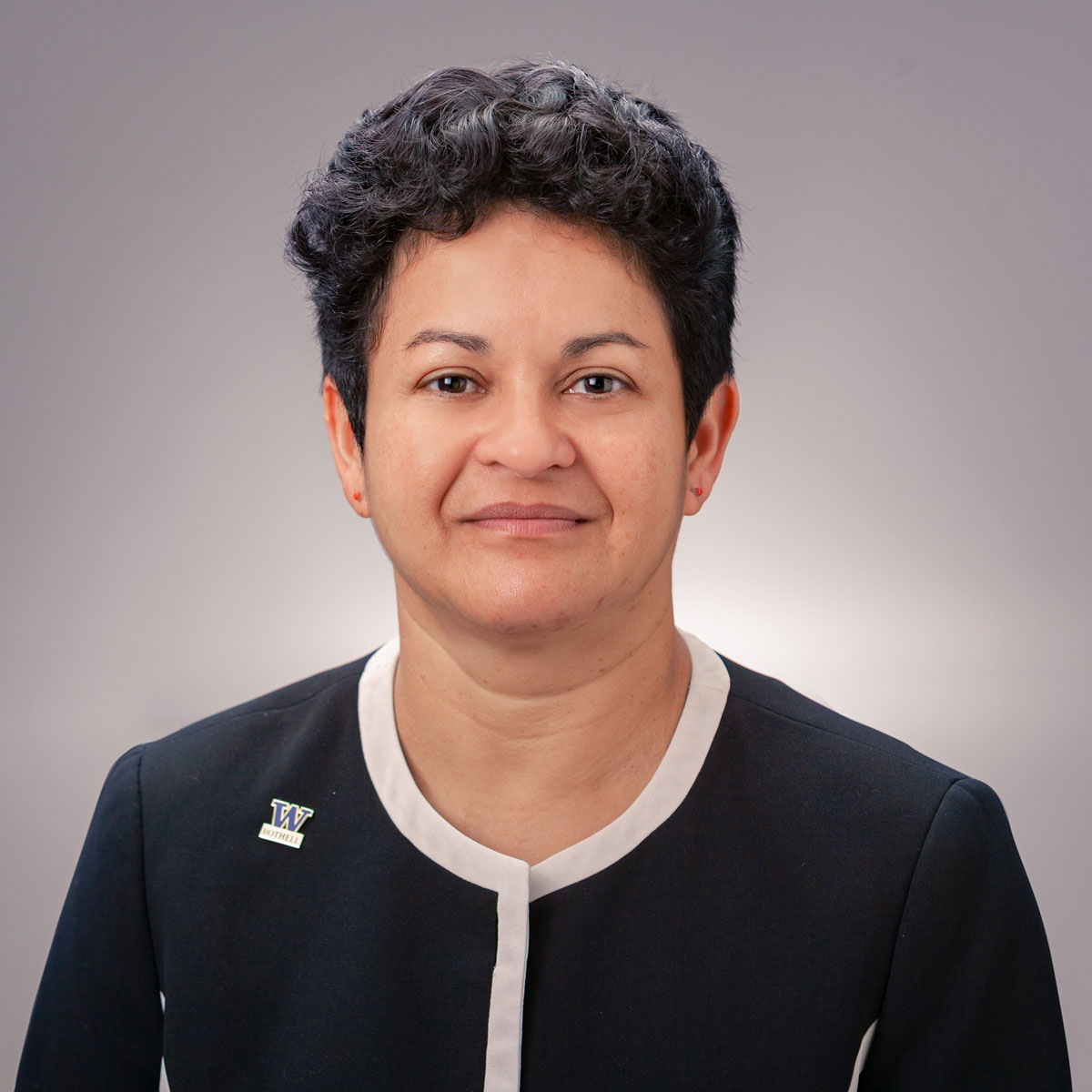
“We knew a lot about climate change, wildfire smoke and environmental health risks but not childcare other than having very young children in our lives who were in care,” Jones said. “With increasing wildfire smoke episodes, we’d been thinking about how to adapt within our own homes and our workplace when the question came up about how childcare providers are responding.”
They also wanted to bring an equity lens to their research, she added. “From the beginning, we had been looking at how different populations deal with climate change and the environmental justice perspective. Childcare, of course, encompasses a range of different socioeconomic levels.”
After doing extensive background research on the industry, the pair moved to the next phase. Together with a team of student researchers, they began surveying licensed childcare providers in Seattle. The survey asked providers questions about how they accessed information, perceived risks and implemented protective actions during wildfire smoke events.
José Lins, now a data analyst and visualization specialist for UW Bothell, first became involved in the research as a student in 2022 when the team was looking for an intern with geographic information system experience.
Using an equity lens
“The topic immediately resonated with me,” said Lins, who graduated with a degree in Applied Computing and a GIS minor in 2023. “I have lived in the greater Seattle area since I was 10 years old, and over that time I have witnessed noticeable changes in our environment.
“I have also always been passionate about GIS because it allows us to use spatial data to better understand complex problems and identify practical solutions,” he added. “This project brought together all of those interests by combining environmental justice, public health, climate impacts and spatial analysis.”
Lins’ role included gathering, organizing, mapping and visualizing spatial datasets to help identify patterns connected to environmental justice. By looking at factors such as locations of childcare facilities, demographic and socioeconomic characteristics, and historical redlining patterns, he and the research team aimed to better understand whether certain childcare facilities faced disproportionate risks and barriers to adaptation.
“One of the key takeaways I hope readers gain is that the impacts of wildfire smoke are not experienced equally,” he said. “Factors such as housing conditions, access to resources, existing environmental burdens and community infrastructure can influence how vulnerable people are to smoke exposure.”
On the environmental justice side of the research, Jones said, there were two major findings: Childcare providers located in the most vulnerable neighborhoods tended to rely on informal and interpersonal sources for information — they also have a much greater willingness and desire for government support to upgrade facilities.
Recognizing providers’ needs
Looking at the larger dataset, childcare providers overall preferred digital wildfire smoke alerts. Across the board, Jones noted, the most urgent need providers identified was real-time, facility-specific indoor air quality data — including monitors — and filtration.
For Sumaya Yusuf, who joined the project in 2024 as a student, the gap between providers’ needs and resources was an issue that hit close to home.
“My aunt runs a childcare home, and I’ve seen firsthand how much of her own resources go into running it and caring for the kids there,” said Yusuf, who graduated with a degree in Applied Computing and a minor in Data Science in 2025. “I was drawn to seeing how research like this could actually lead to policy change — whether that’s advocating for funding, resources or things like indoor air quality monitors for facilities that can’t afford them on their own.
“Knowing that the work could translate into real support for providers made me excited about this research.”
The project sparked Yusuf’s interest in doing more research at an academic level. She’s currently working on a project looking into the limits of autonomous AI researchers through a partnership between the UW, Stanford University and Pacific Northwest National Laboratory. This fall she is starting a master’s program in Information Management, with a specialization in Data Science at the University of Washington in Seattle.
From the beginning, Jones said, this project has been supported by many students from both institutions. “The shape of this work is a direct result of the interdisciplinary perspectives these students brought to it — both academically and as community members who live in the region and are affected by this issue.”
“This project brought together all of those interests by combining environmental justice, public health, climate impacts and spatial analysis.”
José Lins, Applied Computing ’23
Moving from “what” to “why”
The research has had a profound impact on the students as well.
“I am very grateful to have been part of this project. Sharon was an incredible mentor whose guidance had a lasting impact on both my personal and professional development,” Lins said. “This project gave me the opportunity to apply my GIS skills to a real-world problem with meaningful public health and environmental justice implications — and it remains one of the most rewarding research experiences I have been involved in.”
The research is also ongoing, as the team has now moved on to the next phase: in-depth interviews with childcare providers, policy advocacy and project proposals with community partners. “The surveys provided the ‘what,’ and the interviews will provide the ‘why’,” Jones said. “We want these next stages to result in meaningful change.”
The project focuses on childcare providers, she added, but the research results have a real-world application for everyone.
“Though children spend a good portion of their time in either K-12 or childcare, they also spend a good portion of their time at home or in their grandparents’ homes or with other family members,” she said.
“How you stay tuned in to what’s happening in terms of indoor air quality or what resources you need to have in place to respond if there’s an emergency — these are questions we can all ask ourselves.”