The first time the sticky note appeared at her desk, Maria Isabel Hernandez Olivares was a 46-year-old student at a local technical college, struggling to learn touch typing.
“You got this, Mama,” read the note.
It went straight to Hernandez’s heart. Her teen daughters, Erika Valeria Macias-Hernandez and Samantha Pamela Macias-Hernandez, had posted the message, and they would repeat the gesture many times over the next six years.
During that span, Hernandez — a Mexican immigrant with a deep love of learning — earned an associate degree, then pivoted to undergraduate studies at the University of Washington Bothell. And her daughters cheered her on through all the highs and lows.
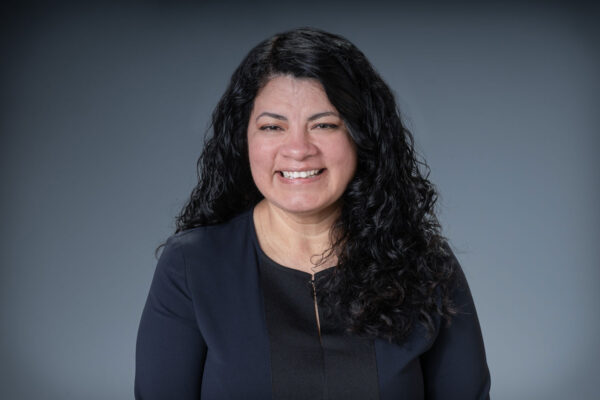
Hernandez graduated in June with degrees in Psychology and in American & Ethnic Studies as well as a minor in Human Rights. But, she said, she gained much more than an academic pedigree. She and her daughters — Samantha is a UW Bothell senior majoring in Education Studies: Elementary Education, and Erika is a UW Bothell alumna (Community Psychology and Gender, Women & Sexuality ’23) — discovered greater common ground and grew closer during her student days.
For Commencement, Hernandez decorated her mortarboard with the message that meant so much:
“You got this.”
A mother seizes her moment
Both of Hernandez’s daughters completed Running Start, but when it came time to enroll Erika in an undergraduate program, things got complicated. Mother and daughter struggled to navigate a complex system. Resources and useful guidance were hard to find. Eventually, Hernandez discovered Northwest Education Access, where an advocate helped clear the path for Erika’s enrollment in UW Bothell.
Then, Hernandez remembered, the advocate turned to her and asked, “What about you?”
A light bulb went off. “This is also my moment!” she realized.
Hernandez soon found herself in a student orientation at Lake Washington Institute of Technology, where the session was peppered with jargon: modules, Canvas, portal. “I spent an hour just listening and wondering, ‘What is a module?’” she said. “But I was too embarrassed to ask.”
Back at home, her daughters laughed and showed her the ropes: This is how you navigate Canvas; this is how to submit an assignment. “She had lots of doubts in the beginning,” said Erika, now 24. “But I think my sister and I did a good job of reassuring her that she was made for this.”
Two years later, Hernandez had almost completed her associate degree in Accounting when she discovered two courses that would alter her life trajectory: sociology and psychology. It was love at first sight. “I want more!” Hernandez remembered thinking.
Isolation and imposter syndrome
She pursued her newfound passion all the way to UW Bothell, where, like daughter Erika before her, she enrolled in the Psychology program.
The first year was rough. As an older, Hispanic student, Hernandez struggled with imposter syndrome and a deep sense of isolation.
“Except for my Chicano classes,” she said, “I didn’t feel the connection. I ended up taking as many classes as possible online. I avoided coming to campus.”
That situation began to shift in Dr. Yolanda Padilla’s “Introduction to Latinx Studies.” Hernandez recalled a conocimiento (knowledge) exercise in which students were encouraged to practice being vulnerable as they shared their personal histories.
That’s how Hernandez made what she called a “root connection” with her professor, associate professor in the School of Interdisciplinary Arts & Sciences and another Hispanic woman. The two continued their conversation after class, and Padilla mentioned UW Bothell’s Student Diversity Center.
“That changed everything!” Hernandez said.
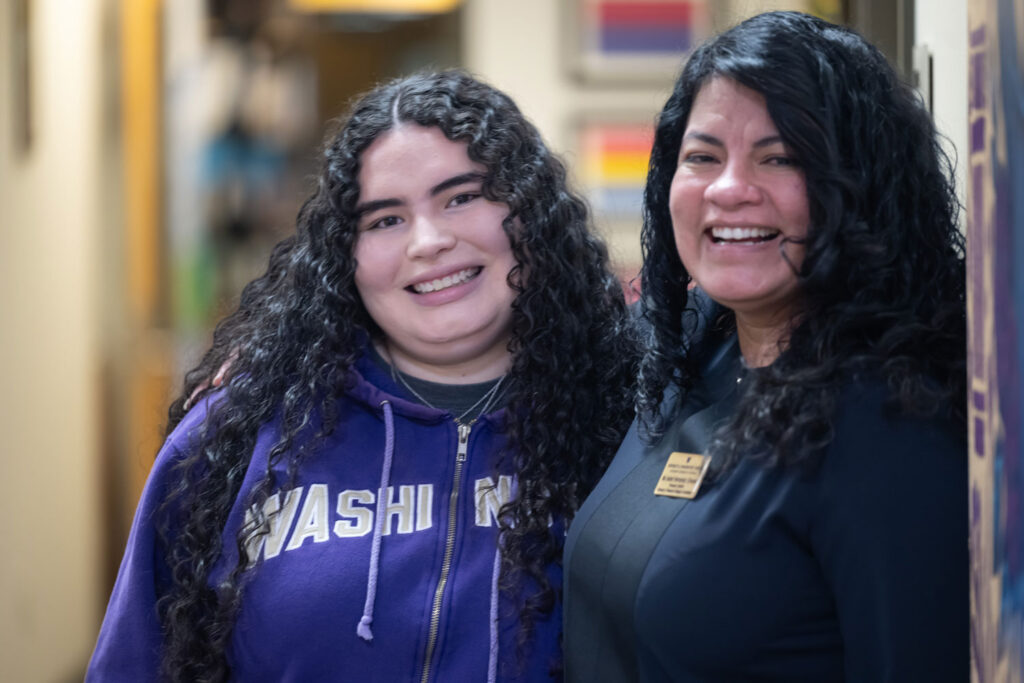
Root connection bears fruit
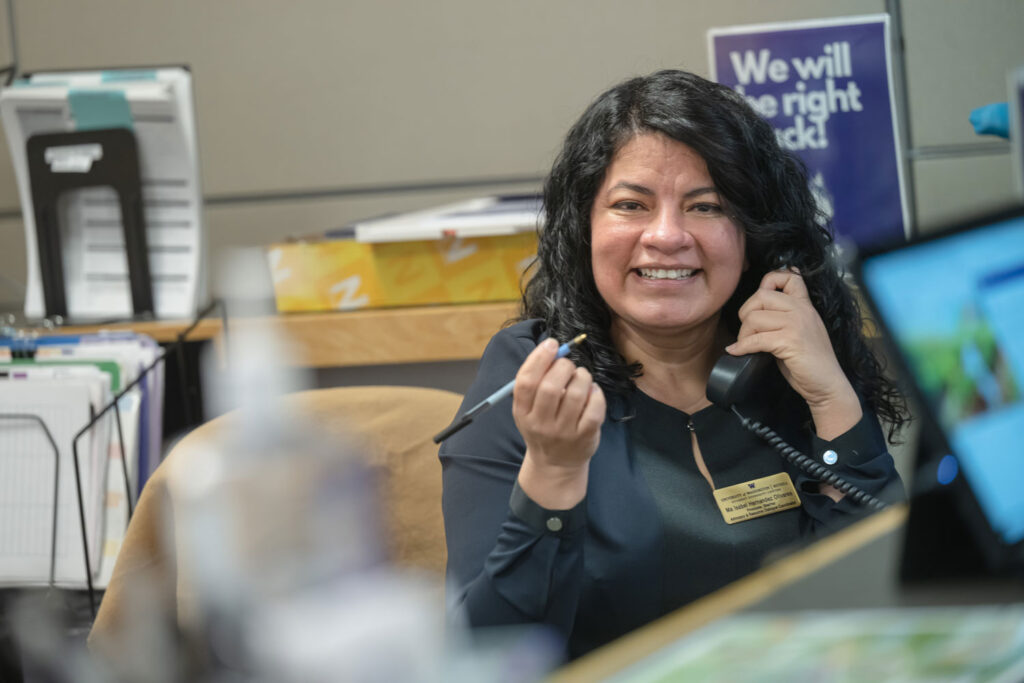
Hernandez tapped SDC resources, attended meetings, made connections and began building community. When a job in the center opened the following year, she was hired as a student staff member.
“The environment was really, really supportive,” she said of the SDC. “I felt like I belonged, like I found my people. The ‘inner me’ got really strong.
“My mind, my spirit has grown, and myself,” she said. “I’m not the same person as when I came to UW Bothell.”
Daughter Samantha was excited about attending the same campus as her mom. “Being in school together gave me the opportunity to not only learn alongside her but also to learn from her,” she said. “I was incredibly proud that she worked at the Student Diversity Center, and it became my community, too. My friends and I would go there to do schoolwork, eat lunch, hang out or just chat with her.”
Over the course of her three years on campus, Hernandez also joined the Latino Leadership Initiative and became a Global Scholar. Instead of traveling for that program, she gave back to her community by teaching an English as a Second Language class for parents of students in the Northshore School District.
“The environment was really, really supportive. I felt like I belonged, like I found my people. The ‘inner me’ got really strong.”
Isabel Hernandez, American Ethnic Studies and Psychology ’26
Coming full circle
Even more than campus resources and programs, Hernandez said she credits her daughters with motivating her academic journey. As fellow students, the three swapped book recommendations and steadied each other when times got tough.
“Now I understand them more,” said Hernandez, who started a new job as a program manager at the SDC after graduation. “We are companions on the journey. I’m not helping them academically, but I’m there backing them up.”
Before graduating, she also had a full-circle moment with Erika, who is studying for her master’s degree in Applied Child and Adolescent Psychology: Prevention & Treatment at the UW in Seattle. For her multicultural counseling class, mother interviewed daughter about her experiences in graduate school.
“There are no words that could truly describe how proud I am of her,” said Erika. “I’m just so glad that she’s putting herself first and pursuing the goals she wants to.”
Said Hernandez of both daughters: “I’m so lucky to have that experience with them during this time of their life. They were my inspiration, my source of strength, my motivation, my compass. When things got hard, they were a safe space, and I want to think I’m the same for them.”