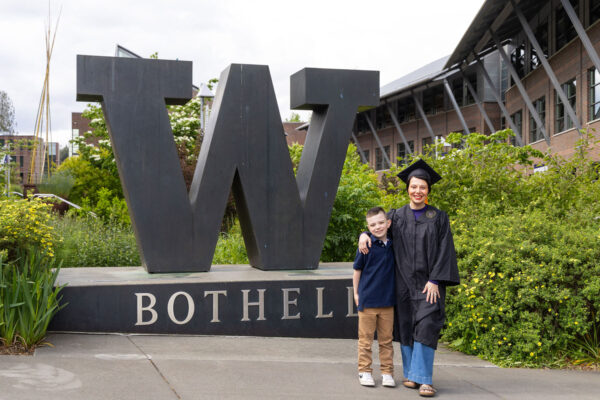
When she arrived at the University of Washington Bothell to earn her bachelor’s degree in Nursing, Lisa Levinson had already worked for 15 years as a professional nurse in clinical, research and leadership settings.
“I didn’t need to pursue my bachelor’s, but I wanted to,” she said. “I had the clinical experience but lacked the understanding and appreciation for the processes needed in order to drive change.”
Soon after beginning classes in the School of Nursing & Health Studies, light bulbs started going off for Levinson. She saw how the program would connect the dots between evidence-based processes, behavior motivation and big-picture decisions such as resource allocation.
A week into the BSN program, she thought, “Oh my gosh. What have I been doing without this?”
Recognizing the benefits of discomfort
On top of a full courseload and a full-time leadership role at the Fred Hutch Cancer Center, Levinson also juggled family responsibilities. That’s why, when the opportunity arose to do a summer course culminating in a trip to India, she hesitated.
“I had every excuse not to pursue it,” she said. Among them: “I’m too old, I’m a mom, I have no business doing this.”
It was her nine-year-old son who helped change her mind. “He said he would be proud if I did it, and so I said, ‘Okay, that’s what I’m going to do.’”
A two-week trip to India might pose some discomforts, but Levinson reflected on the occasional necessity of being uncomfortable — both for growth and for a change of perspective.
With family support and a scholarship in place, Levinson enrolled in India: Population Health in a Cultural Context.
Gaining a global perspective
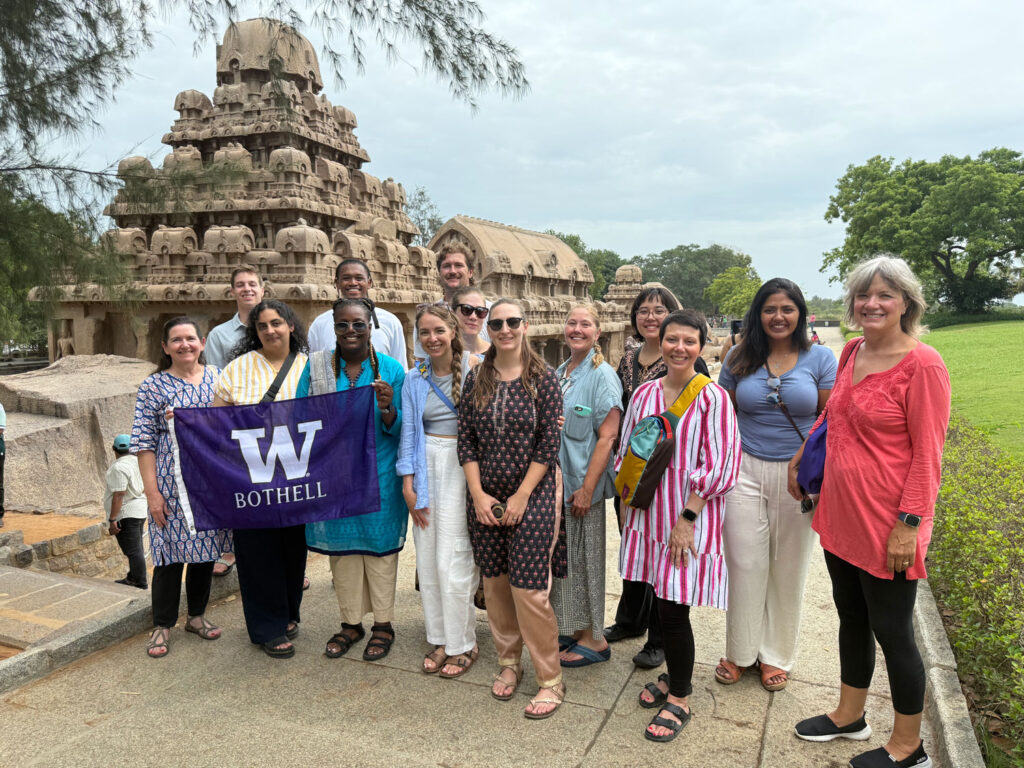
The program kicked off with an on-campus summer class, its cohort comprised of 15 working professionals. Levinson was impressed with the faculty’s uncanny ability to track everyone’s nursing specialties — which ranged from public health to pediatrics — and use that information to enrich the class.
Dr. Linda Eaton, associate professor, and Dr. Jamie Shirley, teaching professor, led the program. “They both knew all my peers,” said Levinson. “They validated and valued each of our own experiences as working nurses and incorporated them into class discussions.”
In August 2025, the cohort traveled to the southern Indian city of Vellore. Under the auspices of the Christian Medical College, the UW Bothell students observed the Indian healthcare system in action. They accompanied local nurses on visits to a nearby village, where they supported community engagement and health promotion activities in clinics, daycares, schools and a senior center.
“It was an amazing opportunity to be in India for an extended period of time,” Levinson said. “There was a lot of work done to ensure we had a cultural understanding of life in Southern India and the history but also to see present-day healthcare and how things are functioning.”
Preparing for big opportunities
A seasoned traveler, Levinson was nonetheless overwhelmed at times by the sights, sounds and smells of Indian village life.
“It affected me in ways I probably don’t recognize yet,” she said. “I’m a Type A-prepared person, but the situations you can’t prepare for can offer you the biggest opportunities.”
Eaton, who has co-led the UW trip to India four times, echoed that sentiment. She observed that the things that tend to unnerve students the most — the sensory overwhelm, the lack of resources — often prompt the deepest reflections.
She praised Levinson’s comportment while in Vellore. “Lisa always approached her experience in India with openness, humility and a strong reflective mindset,” Eaton said. “She also demonstrated genuine curiosity about practices that differed from her prior professional experience.”
A longtime diabetes care and education specialist, Levinson completed her bachelor’s degree after the trip to India. The program was such a positive experience, she said, that she immediately enrolled for her graduate degree.
“I didn’t need to pursue my bachelor’s, but I wanted to. I had the clinical experience but lacked the understanding and appreciation for the processes needed in order to drive change.”
Lisa Levinson, Master of Nursing candidate
Paying it forward next
This summer, she embarked on another study abroad program, this time to investigate health promotion in Ireland. She plans to graduate with her Master of Nursing in June 2027.
As cancer diagnoses continue to rise in the U.S., Levinson sees an opportunity to expand her professional role in oncology-related wellness and prevention. She also wants to support the next generation of nurses. “How can I foster growth and offer encouragement?” she asked. “What can I do for nurses new to the workforce?”
As for seasoned professionals pondering a nursing degree at UW Bothell, she offered clear advice: “Just do it. Don’t even think about it.
“To make yourself most marketable, to be in a position to best serve patients, having a bachelor’s and master’s is really setting you up to do that most effectively.”