The summer of 2024 saw a transformation at the University of Washington Bothell: the launch of a brand-new, centralized approach to undergraduate advising. No longer spread around campus at individual colleges and schools, 26 advisors relocated to a single unit in Founders Hall.
Their shared mission: a seamless, coordinated approach that serves all undergraduates.
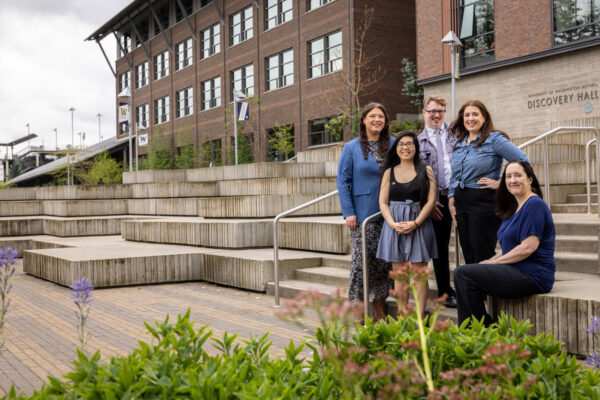
The reorganization, which included cross-training existing staff, onboarding new members and establishing shared policies and procedures, was accomplished in just 10 months. A high-energy team of five, led by Suzanne Yates, assistant dean for academic advising, collaborated to build the new unit from scratch.
In recognition of their efforts, the entire Undergraduate Advising Centralization Leadership Team — Yates, Claire Grant, Garick Sherburn, Nhi Tran and Jessica Trenkamp — has received the University of Washington’s 2026 Distinguished Staff Award for Innovation. This category honors excellence in a team that has created lasting change through implementing an innovative solution to a complex problem or driving a significant effort that enhanced service and/or efficiency.
A customized approach
“The work we did was always ultimately centered on the specific needs of UW Bothell students,” said Yates. “We built something that we knew would work given our students’ unique needs and challenges.”
UW Bothell has a higher-than-average level of diversity among its 6,000 learners, she noted, including many first-generation students, older adults, neurodiverse learners and people with disabilities. While creating the new advising model, Yates and her team strived to keep these students top of mind, and to build in supports and flexibility.
“There’s no one-size-fits-all solution,” she said.
The initiative faced initial resistance, generated in part by uncertainty, Yates said. “This was so big, and it affected the livelihoods of 26 people. It’s a huge change, and no one loves change,” she said. “Folks less experienced with this model were really worried whether it would be the right move for our students.”
In designing the new approach, the centralization leadership team kept student and advisor success at the heart of its work. It also leaned into a host of resources: people at other universities, national organizations and national research that supports a centralized model.
“We reached out to other universities in the Pacific Northwest similar to ours,” Yates said. “We picked from the best examples we knew would work for us.”
In support of student success
Among its other benefits, the new approach has created a more consistent experience for students and streamlined the advising process, Yates said.
Before July 2024, first-year students who arrived at UW Bothell undecided about their direction would typically have one advisor as a pre-major, then switch to another when they declared a major. Now, those same students can potentially work with the same advisor throughout their academic journey.
Feedback from undergraduate students has been enthusiastic, Yates reported. With all advisors now located on the first floor of Founders Hall, they are more accessible. And if one advisor happens to be unavailable, it’s easy for a student to find a backup resource. “Everyone knows where to go now,” Yates said.
The numbers bear her out: Since the centralized advising structure launched on July 1, 2024, the combined advising team has held more than 11,500 appointments with UW Bothell students. The advisors have guided thousands of students from orientation through the graduation processes.
“These numbers reflect more than efficiency — they represent timely, personalized support that empowers students to thrive academically,” said Cinnamon Hillyard, associate vice chancellor and dean for student success. “Students are now ensured an equitable professional advising experience regardless of their degree program.”
The advising team’s new location offers advantages beyond academic advising. Situated close to important resources such as the counseling and student success centers, Yates said, “it’s become a great source of referrals.”
A higher professional profile
Yates emphasized the newfound benefits for advising staff as well — from centralized support and resources to more robust opportunities for professional development.
Advisors also experience greater knowledge transfer and sharing, she said. In the old model, with one advisor dedicated to a single program, a lot of information lived in people’s heads. “Now, we have a historical record and can support students with these systems. We can piggyback off each other’s strengths instead of being so disconnected.”
And, as a cohesive unit, advisors have a greater ability to advocate for students. The team has more institutional heft, Yates said, with the ability to analyze student data and bring it to the attention of campus leadership.
“We have some weight we can throw around,” she said.
Hillyard also pointed out how centralized advising has strengthened partnerships with student-serving units such as Career Services, Orientation & Transition Programs and Undergraduate Research.
“Instead of navigating multiple departmental advising units, these offices now have a single point of collaboration,” she noted.
“We built something that we knew would work given our students’ unique needs and challenges.”
Suzanne Yates, assistant dean for academic advising
A model for collaborative change
A year after the new model launched, “Skepticism has faded as the positive impact on student success becomes clear,” Hillyard said. “Confidence in the model has grown because the team listened, responded to concerns and created inclusive systems. Now, other groups seeking change look to this team as a powerful example of transformation.”
Those groups include national organizations, where interest in the team’s work has been keen. UW Bothell team members have presented to groups such as the National Association of Student Personnel Administrators. This summer, they will address the American Association of State Colleges & Universities for a second time.
“This work required vision, resilience and collaboration at every level,” Hillyard said. “By laying this foundation, this leadership team has positioned UW Bothell as a leader in advising excellence and student success. Their achievements are not only a testament to their dedication but are also a model for transformative change in higher education.”