Despite attending junior high and early high school in the San Francisco Bay Area, Dr. Georgia Roberts had never heard of the University of California Berkeley until one of her community college professors recommended she apply. As a first-generation student, she also didn’t know what a Ph.D. was until she was already in college.
Roberts never pictured herself going into academia. It wasn’t until she was working on her doctorate in English at the University of Washington that she first realized it could be her dream career.
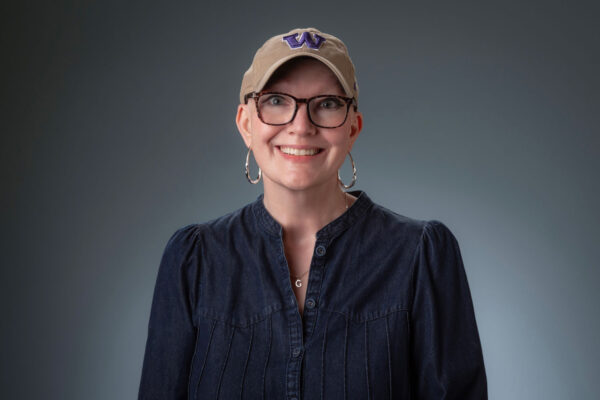
Now, Roberts serves as a lecturer in UW Bothell’s School of Interdisciplinary Arts & Sciences, where her educational journey plays a huge part in her pedagogy — as well as her relationship with students and fellow faculty members.
For her “dedication to creating transformative learning experiences,” Roberts was recently named the recipient of UW Bothell’s 2026 Distinguished Teaching Award.
Pursuing knowledge
In her early 20s, Roberts worked various jobs and at 24 decided to take a drama class at a community college as a way to meet people. She enjoyed it so much she continued taking classes and eventually transferred to Berkeley, where she majored in English.
It was there that she met the person who would have the biggest impact on her education — and her lifelong passion for learning.
“Dr. Ronald Takaki was a phenomenal storyteller. He made history seem completely alive and relevant,” she said. “His Intro to Ethnic Studies was a profound class for me in a lot of ways, and one of the reasons I decided to minor in Ethnic Studies. He became the sole inspiration for me to want to study history in a more dedicated, serious way.
“I didn’t know at the time that I was going to end up teaching, I just knew I had a lot to learn.”
Her pursuit of knowledge led her to UW Bothell, where she teaches a range of classes — from literature to ethnic studies. This fall will mark her 20th year with the campus.
Being nimble
As a lecturer, Roberts is sometimes asked to cover courses for other faculty members and enjoys putting her own spin on the curriculum — often weaving in pop culture themes.
“Roberts’ capacity to teach from the 100- to the 500-level is remarkable. Not only does she possess a pedagogical nimbleness that allows her to create developmentally appropriate syllabi and assignments across the student lifespan, but Roberts also understands how to build classroom community while discussing difficult topics,” wrote Dr. Alice Pedersen, associate teaching professor in the School of IAS, in her nomination letter.
“Dr. Georgia Roberts is a tremendous instructor who has impacted the lives of thousands of UW Bothell students. Over the past decade, she has come to be known as a veteran instructor who remains deeply committed to and skilled in creating connection, meaning and change in students’ lives.”
Roberts is also known as a mentor to her fellow IAS instructors, Pedersen noted. “She is truly a teacher’s teacher.”
Inspired by interdisciplinarity
In many of the courses she has created, Roberts centers her own niche passion for “the nexus of literature and hip hop.” She has a particular affinity for the work of Tupac Shakur, noting that “there’s a running joke that I can make any class a Tupac class.”
The first class Roberts taught at UW Bothell was on the historical and philosophical literature that influenced Shakur. The course, which she developed as a graduate student, has become one of her most popular and her favorite to teach over the years. She enjoys how the focus on Shakur’s work allows her to bring in a broad range of texts — from Sun Tzu and Machiavelli to Malcolm X.
“Thinking with students over many years about the political potential, as well as the limits of popular culture, has repeatedly affirmed my understanding of the necessity of interdisciplinary study,” she said.
The class proved especially meaningful for Brad Bomberry, an Indigenous military veteran who graduated with a degree in Science, Technology & Society in June 2026.
“Among the many courses I have taken, none have impacted me as deeply as those taught by Professor Roberts,” he wrote in his award nomination letter. “Her ability to draw parallels between Tupac’s work and the ways marginalized communities resist oppression and preserve identity encouraged me to reflect on my experiences and those of my community … Her commitment to the subject inspired us to see the material as more than an academic exercise. It became a way to better understand the world around us.”
Belonging in the classroom
Throughout her teaching, Roberts said she aims to be transparent about her own educational journey in the hope that other first-generation and nontraditional students believe that they, too, belong in the classroom.
“One of the priorities in my own pedagogy is to remain approachable, and that looks different in every situation,” she said. “Sometimes it requires me to be vulnerable about my own path through education. My path was just messier and not linear. I try to be as open about that as possible so that I can be useful to students.”
Roberts’ teaching method inspired Annika Cho Norheim to major in Interdisciplinary Studies. She graduated from UW Bothell summa cum laude in 2025.
“As a new student, I was balancing three jobs while caring for my family and dealing with internal struggles with my place sometimes in the classroom. I was nervous about entering a higher academic setting, so I am thankful to professors like Professor Roberts for providing an open and safe academic space,” she wrote in her nomination letter.
“She inspired me to think of my education and myself differently, that putting my academia first may not require much strain — I could find something beautiful in myself and my ability to learn and produce substantial work, and I can keep looking for answers in the most unique places.”
“Her commitment to the subject inspired us to see the material as more than an academic exercise. It became a way to better understand the world around us.”
Brad Bomberry, Science, Technology & Society ’26
A lasting impact
For Roberts, students like Bomberry and Norheim are a reminder of what she loves most about teaching: having an impact on someone else’s educational journey, just as Takaki had for her.
She said, “My hope is always that if students come into my classroom just because they need a certain credit, that the enthusiasm I have for a topic or that other people in the class are invited to have on the topic will somehow affect them and allow for something new to emerge.”