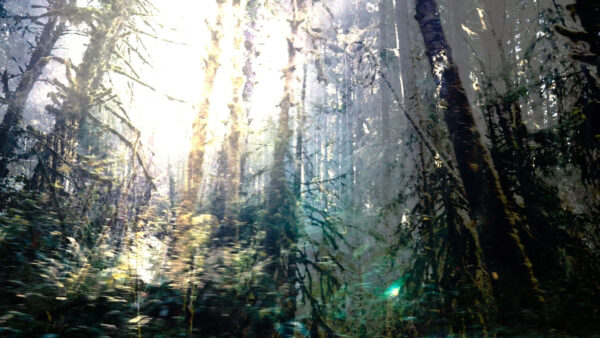
One of Minda Martin’s favorite things about the Pacific Northwest is the trees — the size of the old growth pines and the abundant forests where they appear almost infinite to the eye.
“It was one of my passions for moving here, to see these giant trees and be near them,” said Martin, a filmmaker and professor in the University of Washington Bothell’s School of Interdisciplinary Arts & Sciences.
A few years ago, Martin started working on a project about old growth forests. She wanted to create a short film as a poetic tribute to one of the largest temperate rainforests in the United States: the Hoh Rainforest.
“When I stepped foot in the Hoh, I was blown away by the golden fall light,” Martin said. “I’d never seen anything more stunningly beautiful, not just visually but also sonically.”
In the summer, she made another trip to record the sound of the forest. This time, all the magic seemed to have seeped out of it — and climate change was to blame.
Her film project, she said, had suddenly shifted “from an ode to an elegy.”
A spiritual sanctuary, lost
Located on the Olympic Peninsula just a few hours from Seattle, the Hoh Rainforest is a place Martin has long considered a spiritual sanctuary. She had wanted to capture that feeling on film as best she could, and sound was a vital part of that.
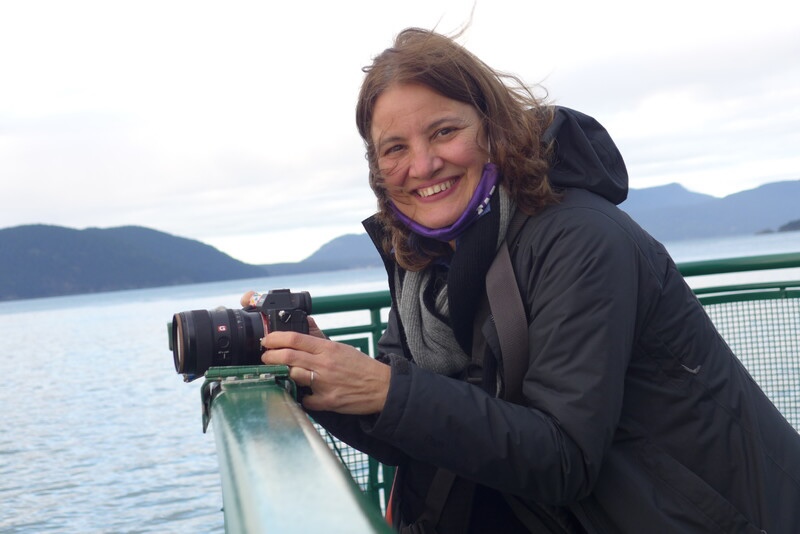
“It’s not just the lack of noise from trains or planes or cars, but it’s also the way that sound is absorbed by all those layers of soil,” she said. “I wanted to capture how sound is captured in a place like that.”
She worked with a sound designer who independently recorded sounds throughout different old growth forests. When she returned a year later to record additional sound in the summer, Martin was greeted by a stark contrast to the place that had held such a special place in her heart.
“There were fires nearby, and it was very dry, late summer,” she said. “It didn’t have the gold hue or that feeling to it. The color and sound of the forest had changed to be more brown and orange and I could hear helicopters, water planes and chainsaws. You could see and hear that it was a forest that was struggling with climate change.”
In addition to the climate-fueled fires, she also noticed evidence of resource extraction — clear-cut slopes encroaching on the ancient ecosystem.
“Seeing all of that was really harsh,” she said. “It drew me into knowing that this was something we may very well lose in our lifetimes or in our kids’ lifetimes. And the two reasons will be climate change and resource extraction.
“I think it’s just an unfathomable loss.”
A personal take
Martin has been making films since the early ’90s, when she first discovered a passion for narrative and experimental documentary films during her undergraduate years.
“My interest in film came from having life experiences that I knew weren’t represented in any of the media I was consuming at the time,” she said. “Seeing — particularly in independent and international cinema — these alternative ways of expressing original stories and different ways to connect and overlap narratives was inspiring for me, to say the least.”
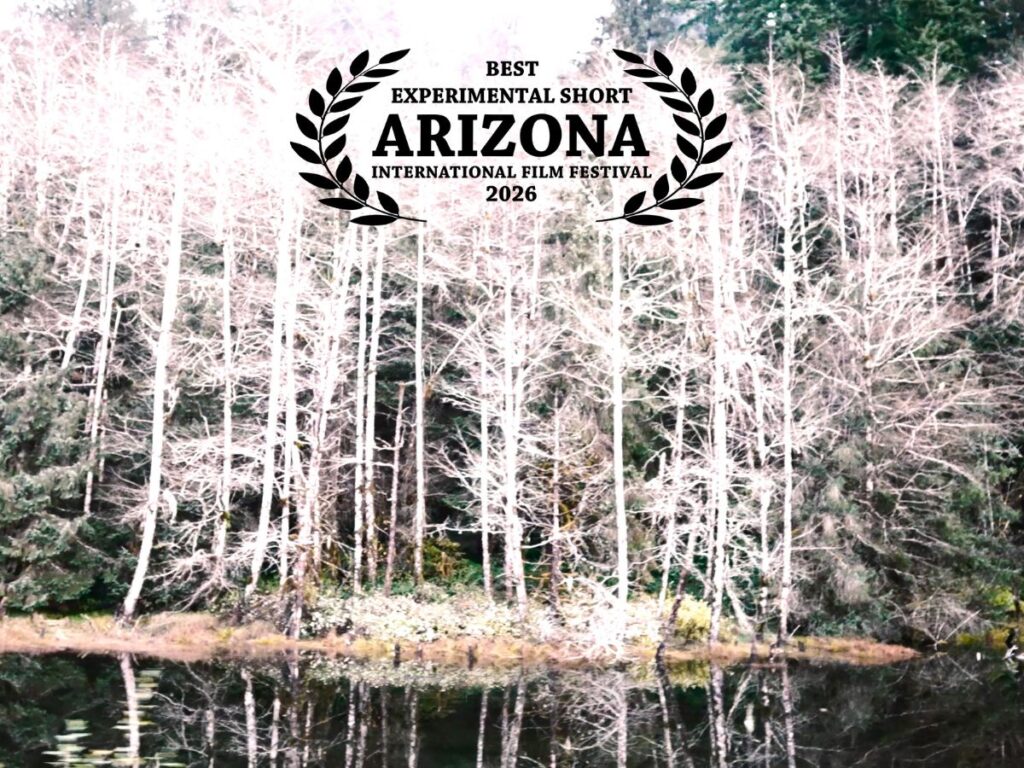
In her film, “Old Growth,” Martin overlaps two different versions of the same place, using both layered sound and composite imagery. “The slow, patient takes mirror the forest’s timescale,” she wrote in her director’s statement, “while composited images reveal its accelerating transformations. The sound design reflects the deep resonance of old-growth soil, the violence of fire and the hollow quiet left by clear-cutting.”
Martin herself also appears in the film to share her deep connection to the forest. Making it personal is a common theme throughout her work — one she encourages her students to explore as well.
“With any kind of assignment, whether documentary or narrative, I really emphasize the personal connection to students,” she said. “It’s important to me that they understand how their own life experiences and their perceptions shape their work and connect to it.”
Many of her students pursue environment-related degrees or have a deep affinity for the natural world. Like her, they see media as a way to convey knowledge, raise awareness and inspire action through storytelling.
“With any kind of assignment, whether documentary or narrative, I really emphasize the personal connection to students. It’s important to me that they understand how their own life experiences and their perceptions shape their work and connect to it.”
Dr. Minda Martin, professor, School of IAS
An urgency to act
“Old Growth” is currently making its way through the independent film festival circuit. It was recently awarded the Best Experimental Short Film at the Arizona International Film Festival.
“I hope that people who view the film see and understand and feel the connections to the beauty of this forest but also an urgency to act in some way — even in the smallest way, contributing to organizations working to save old growth forests or planting trees,” she said.
“Those things really do add up and make a difference.”