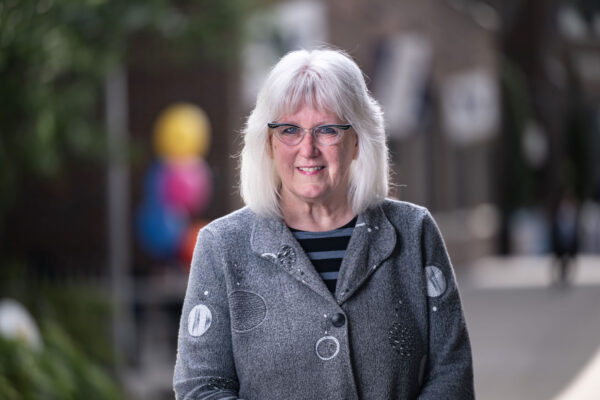
A coal miner’s daughter, Marlene Elliott never felt like she quite fit in growing up in Taylorville, Illinois. Her father worked for one of the world’s largest underground coal mines, and the town was home to mostly working-class families. Elliott’s ambitions, however, leaned more toward the creative side.
She taught herself to read at the age of 4. When she read “To Kill a Mockingbird” in the third grade, Elliott identified strongly with the story’s narrator, Scout. She knew then that she wanted to be a writer.
Unsure of how to become a writer without going to college, which she couldn’t afford, Elliott embarked on a decades-long career as an American Sign Language interpreter. Now, at the age of 68, she is living her dream as a graduate student in the University of Washington Bothell’s Master of Fine Arts in Creative Writing & Poetics program.
“I’ve returned to my first love, writing, after 38 years of being steeped in other people’s words,” she said. “It’s been a very full circle experience for me, coming back around to something that was my hope, my refuge and my future when I was very young.”
A sense of belonging
After high school, Elliott moved to Corvallis, Oregon. In the 1960s, Corvallis was a typical Pacific Northwest hippie town, and she discovered the sense of belonging she lacked in a coal-mining town.
“I spent my 20s writing poetry and hanging out at the coffee house, and living and writing with other poets and artists — a very bohemian lifestyle,” she said. “But I didn’t have any traction as a writer and didn’t know how to proceed with it as a career.”
In her early 30s, Elliott became a sign language interpreter and moved to Rochester, New York. She still kept her bohemian spirit alive, even living for a time in a yoga ashram. Then, when her son was born, she moved to Portland, Oregon, wanting to keep him connected to the Pacific Northwest, which she still considered home.
Elliott struggled to get enough work as an interpreter and later returned to Rochester after her son graduated from high school. She collaborated with a deaf clinical psychologist at the University of Rochester on research on early language access for deaf children. A decade later, after the research lost its funding, Elliott’s job ended.
“All of a sudden, my academic career was over,” she said. “But it turned out to be the best thing that ever happened to me.”
A writer at heart
Elliott again returned home to the Pacific Northwest. Only this time, at the urging of friends, she landed in Seattle.
She continued working as an interpreter, but by that time had started to lose her hearing which limited the type of work she could do. One of her friends recommended she look into vocational rehabilitation funding to pay for her to go back to school. With her tuition secured, she could at long last pursue a degree in writing — and on June 14, she will walk across the stage at commencement to receive her degree .
“The MFA in Creative Writing & Poetics at UW Bothell has been the perfect program for me, and I would not change a thing,” she said. “I feel so relieved and grateful to come home to myself as a creator and a channeler — I think of myself as channeling more than creating. That’s just my nature. I’m an old hippie, so I respond and tune into energy and go with the flow.”
The process wasn’t always easy, she added. There was still a lot of self-doubt along the way. But through the program, she said, she has been able to push that doubt away.
“Whatever criticism I had going about my age or just the feeling that I had waited too long, those were all counteracted by openness, curiosity and a spirit of non-judgmental experimentation that was fundamental to my experience and opened doors for me.”
Surrealism and whimsy
In her classes, Elliott was exposed to a variety of authors and writing styles, which helped her to hone her own style. “My work lives at the intersection of surrealism and whimsy,” she said.
Her approach to writing — and her thesis — was inspired by the novella “Trout Fishing in America,” by Richard Brautigan. Published in 1967, the book became widely known for its unique avant-garde structure.
“The book has no narrative arc, and it really blew open the doors of what it meant to write a novel,” Elliott said. “My thesis is an homage to ‘Trout Fishing in America’ and the idea of how you make a thing a novel when there’s no narrative arc. This was my creative problem to solve.”
The idea for her book, “Touching Trees,” first came to her more than 20 years ago, she added. Although she tried to write it then, she didn’t have the tools to finish it.
“I learned all of these tools in the first year of the program that I put to work on my thesis this past year,” she said. “And now I’ve finished it. I wrote that novel. I did it. And I never could have done it without the MFA in Creative Writing & Poetics. It was like they held up a big lantern for me and said ‘Hey, come this way.’ I’m so happy right now to have finished it.”
“I wrote that novel. I did it. And I never could have done it without the MFA in Creative Writing & Poetics. It was like they held up a big lantern for me and said ‘Hey, come this way.’”
Marlene Elliott, MFA, Creative Writing & Poetics ’26
Never too late
When talking to other people her age, Elliott said that like her, they often have things they wanted to do but never did. It’s important to her to share her experience so that others will know it’s never too late.
“It’s very tempting to say it’s too late for me. I may never get anything published, who knows? But I definitely won’t get anything published if I don’t write anything. And I definitely won’t get published if I don’t send it to anybody for publication.
“And I’ve gotten a lot of support in the program to do both of those things,” she said. “I would just say it’s always the right thing to do to engage with your creative life. It doesn’t matter what age you are.”
Whether she gets published or not, Elliott said the reward is in the writing itself. “I don’t have any words to describe how liberating it is to have done something I desired to do since I was probably 16,” she said. “It’s a very powerful kind of momentum.
“And now I have my degree, I have this novel that shows I can bring a project to completion, and now I get to carve out a creative life for myself.”