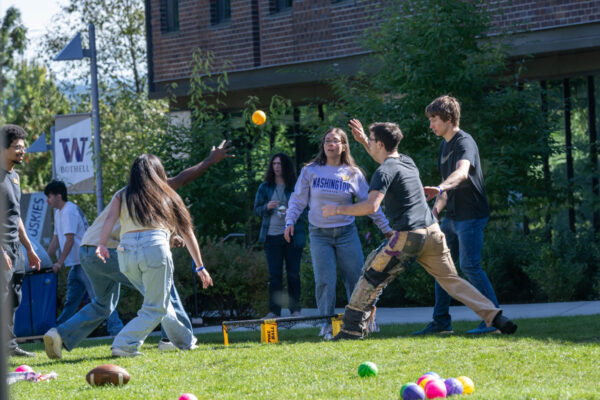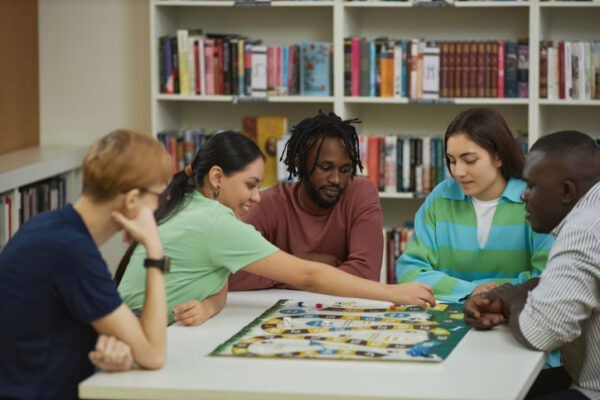
From tabletop and roleplaying to computer games and sports, gaming in all forms has long been a favorite pastime for Dr. Eric Stoerm Anderson. It’s more than just a hobby, though. It’s also what led him to pursue a career in nursing and later academia, where he now weaves gaming into his teaching.
“I’ve always kind of seen the world through a gaming lens,” said Anderson, associate teaching professor in the University of Washington Bothell’s School of Nursing & Health Studies. “I recognized the inherent gameyness in the world and that life in general is a sort of game. There are rules, and if you can cleverly use those rules to your benefit, you can do well.”
In his latest course, Anderson explored the utility of games in mental health, education, leadership and professional practice.
A lifelong gamemaster
Anderson loved playing games with his friends when he was young. As he got older, he noticed that many of his friends would stop showing up for games after graduating and entering the workforce. When he began thinking about his own future, he knew he wanted to find a good job that would afford him the money and time off to continue playing.
Nursing seemed the right fit, and it grew on him as he completed a nursing degree. Through this experience, he also fell in love with the world of higher education. Now, as a teacher, he finds the job of managing a classroom similar to his role as a gamemaster — the person in roleplaying games who represents the world that the players inhabit and responds to players’ actions.
“The experience of creating a sandbox for students to play around in is very similar to running a campaign,” he said. “In role-playing games I’ve run, I’m interested in players having more choices. And in that same way, I also want students to have more choices in class.”
In winter quarter 2026, Anderson launched 400-level and 500-level versions of the class, “Roleplaying and Strategic Gaming in Mental Health, Education, Leadership and Professional Practice,” which he developed from a 100-level survey course he’d previously taught.
“I’ve thought ahead about an entire game curriculum,” he said. “A series of courses that would make for interesting electives and at the same time address more individual interests, allowing students to self-direct into projects and topics that are particularly useful for their own personal and professional development.”
Learn to play it out
The class appealed to seasoned gamers and novices alike, as well as students from a variety of majors. For Orion Chua, a junior majoring in Global Studies, tabletop roleplaying games have been one of the biggest highlights of his life.
“The thing that I enjoyed most about this class was definitely the fact that having fun was an integral part of it,” he said. “The class encourages you to go out and play and experience games as opposed to just sitting there writing about theories. I learned way more about history than I expected to learn from this class. We also went really into depth about the fundamentals of game design that I found fascinating.”
Students not only played games, but they also developed concepts of their own through group projects. In her group, Tamara Sanchez, a graduate student majoring in Nursing, created a game that followed the flow of a patient from admission to discharge and the allocation of resources.
Sanchez found the emphasis on critical thinking in the class especially valuable.
“As a mother of a neurodivergent but extremely bright child, I recognize that to facilitate her learning I must ‘step up my game’ as a parent and an educator, and push critical thinking development to be explored, experience and internalized through practice,” she said. “Critical thinking requires navigating challenges like a maze or a game — where individuals must analyze, adapt and think well beyond conventional approaches.
“When learning is meaningful as well as enjoyable,” Sanchez said, “it becomes more memorable and impactful, helping individuals retain concepts and apply them more effectively in real-world situations that are not cut and dried.”
Prepare for disease and disasters
The curriculum explored a variety of gaming genres and styles, including roleplaying games known as “war games.” While traditionally used to model warfare, war games can be any simulation-based games where players’ decisions affect the outcome against an adversary — whether the opponent is another player, representing a nation or even a disease.
In the real world, war games also appear as tabletop exercises that simulate these same scenarios — from a major earthquake to a global pandemic. These exercises play a valuable role in helping to understand human decision-making and response to disasters, and to better prepare responders to act.
Alivia Spiess, a junior majoring in Health Studies, said the tabletop boardgame “Pandemic” taught her how to navigate unpredictability within a stressful environment.
“I was not expecting to learn how these games are actively utilized for training purposes and how these games can promote effective disease response,” she said. “This course immensely supported my career and academic goals. It allowed me to practice and enhance my skills within different roleplaying contexts, enhancing my ability to collaborate and navigate within unpredictable situations, which I believe will be pivotal within my future healthcare profession.”
Spiess plans to apply to medical school and specialize in cardiology.
“When learning is meaningful as well as enjoyable, it becomes more memorable and impactful, helping individuals retain concepts and apply them more effectively in real-world situations that are not cut and dried.”
Tamara Sanchez, graduate student, Nursing
Beyond fun and games
This first run of the upper-level course was a success, Anderson said, and he will be teaching it again next year.
In the meantime, students interested in exploring games can find Anderson at gatherings for the Tabletop Games Club on campus, for which he serves as the faculty adviser.
“I loved to see the wealth and diversity of what students were interested in and taking away from the courses,” Anderson said. “I feel very privileged to be in an academic environment that allows the expression of these intellectual ideas.
“The fact that UW Bothell continues to support and promote these kinds of interesting self- and student-focused learning experiences is something lovely that should be treasured — and I’m not the only person teaching cool classes like this one.”