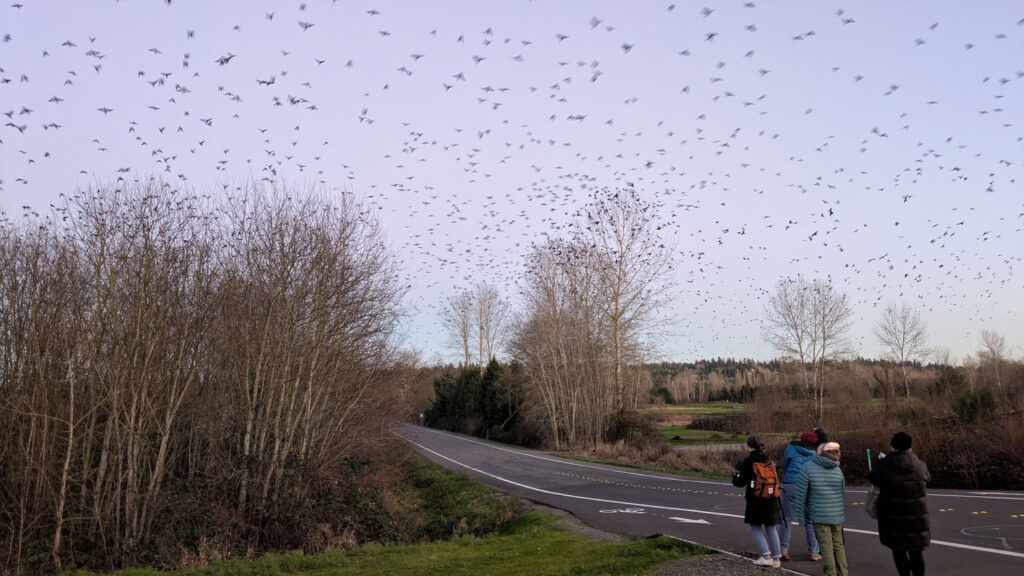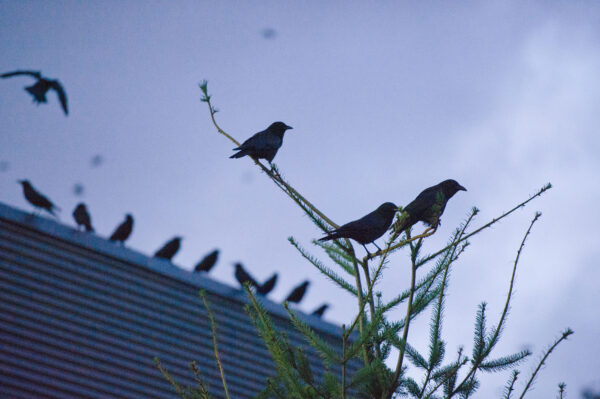
The University of Washington Bothell is known for many things — and for some people crows are the first thing that flies to mind. For the past decade, the University has become heavily linked with crows due to thousands of the birds “commuting” to the North Creek Wetland to gather on the campus grounds before they roost in the nearby trees.
UW Bothell students publish a yearly journal titled The CROW (Campus Research & Observational Writings). On campus you’d be hard pressed to look at a noticeboard without seeing at least one poster with a crow in the corner. (Even the writer of this article has a UW Bothell coaster on his desk featuring the bird.)
If you haven’t visited campus in the last year, though, you may not know that UW Bothell’s days as the premier destination for local crows have come to an end. As of early 2025, no crows have been coming to the campus wetland to roost.
Did you know? The oldest known crow lived to be more than 60 years old in captivity. In the wild, the oldest known crow lived to age 16.
A sudden drop in visiting crows
When it comes to crowing on about his research, Dr. Doug Wacker, associate professor in UW Bothell’s School of STEM, can be forgiven — he spends his time studying corvids, the family of birds that includes crows.
He said he hadn’t planned to focus on crows when he started working on campus in 2012. But when he noticed so many of the birds roosting on campus, he realized he had found his “caw-ling.”
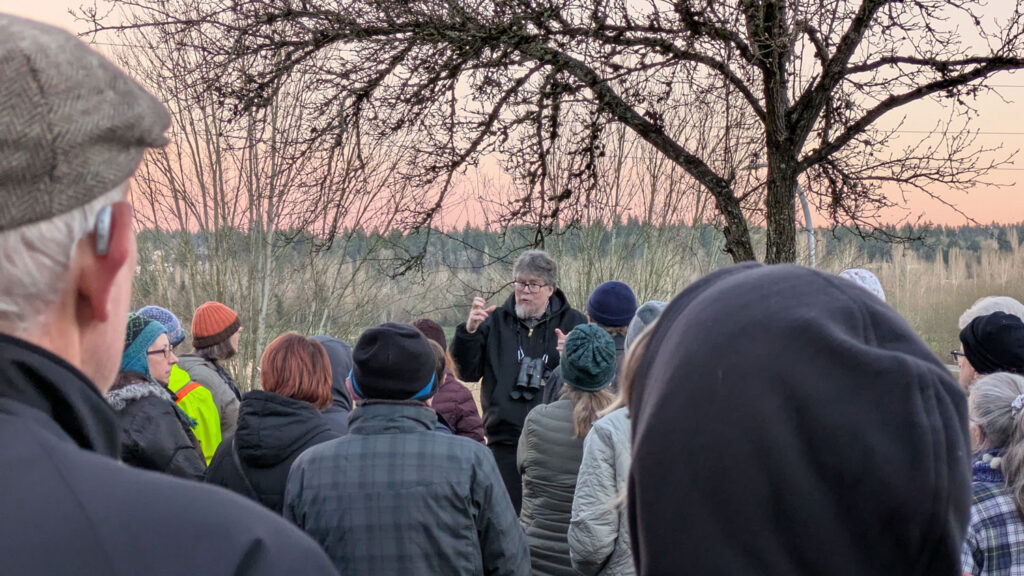
Wacker also thought the crows offered the perfect opportunity for undergraduate students to do easily accessible research, leading to a regular “crow count.” On one evening each year, Wacker joined with student researchers and community members to count the number of birds coming to campus, with participants strategically placed in a ring around UW Bothell.
He began seeing consistent counts of more than 14,000 crows in 2016. That number peaked in 2022 with around 20,000 crows each evening. At that point, the sky turned black at dusk, when the massive murder came home to roost. Just one year later, however, the crow numbers dwindled dramatically to fewer than 10,000 crows. By January 2025, Wacker said that the number was reduced to zero.
The case of the missing crows
So, where did thousands of crows go? Has there been a “crowpocalypse” that went unnoticed? Were the crows a figment of the imagination all along, like the legendary Sasquatch?
The answer isn’t quite so dramatic and unlikely to end up in an episode of “The X-Files.” Wacker explained that many of UW Bothell’s crows have simply moved to a new roost — a spot in the rural fields of the Sammamish Valley.
Yet, a researcher’s work is never done, and the solving of one mystery led to another for Wacker: Why did the crows move on? “It’s not well characterized in the literature for them to spontaneously move.”
While he emphasized that while the real reason may not ever fully be known, he has a few theories.
- Habitat change: Wacker said that the campus wetland matured significantly between the late 1990s and 2025, when the crows left. It’s possible it has grown to the point that it has become less suitable as a crow roost.
- Habitat temptation: It is also possible that the crows just couldn’t resist their new roost. Wacker explained that the site in the Sammamish Valley is another restoration project with younger trees they may prefer.
- Cackling geese: The crows may have been disturbed by thousands of cackling geese that have also been making the wetland their home. Perhaps the crows didn’t want to roost near such noisy neighbors?
- Campus development: Wacker said that the creation of new buildings (such as the residence halls and dining pavilion) in the past few years may have disrupted crows that were pre-roosting in those areas.
- Overcrowding: It is also possible the wetland roost has become a victim of its own success, Wacker said. The roost may have become so popular that the crows had outgrown it. They may have moved on to the Sammamish Valley and other sites as the population of the group has grown.
More than likely, Wacker said, this recent behavioral change by the crows is due to a combination of all his theories, rather than any one specific reason.
Did you know? Crows are monogamous … kind of. Male and female crows create a lifelong bond, but genetic research has shown they may not always stay faithful.
Continuing to crow about crows
Despite his main research focus of crows disappearing from campus, Wacker has a sense of humor about the move. “They’ve just graduated,” he said.
He also has continued his research into crows with his students in other neighborhoods around the region. One area of research is the new Sammamish Valley roost and the size of the population. Another area of research involves recording and studying crow calls to try to decipher their meaning. And the crow counts continue.
For all his crow research, Wacker is quick to laud the hard work of his undergraduate students. “Without our student researchers, I wouldn’t be here to talk about crows, because they did most of the work,” Wacker said.
So now you know the answer to the mysterious disappearance of the UW Bothell crows. If somebody asks you whether there are crows still coming to the North Creek wetland by UW Bothell, take a tip from another famous corvid: “Quoth the raven, ‘Nevermore.’”