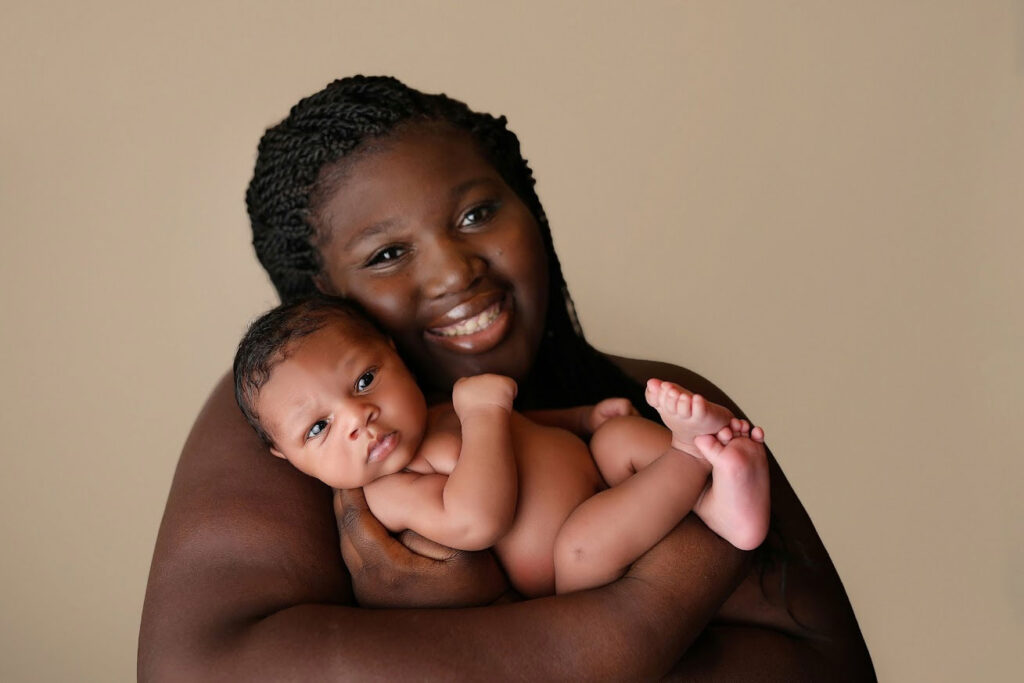
On Oct. 13, 2018, LaNiqua Bell gave birth to a baby boy named Kyren. He was healthy and beautiful, and he had her same “fluffy” cheeks, she said. “He was perfect.”
When he was 7 months old, Kyren caught a cold. Bell took him to a hospital but they were transferred to another. At the second hospital, they stayed for hours but were later discharged — despite her objections. She brought him in again later that same day, but her concerns were again dismissed, she said. Left untreated, his symptoms worsened. He died less than a day after the third visit.
The unimaginable loss of her infant son was overwhelming. What made it even more difficult to heal was reflecting back on the way she and her son had been treated. Bell felt that Kyren’s death wouldn’t have happened if not for systemic racism in U.S. health care. She was left with unanswered questions and no resolution.
“It was a terrible experience, and I needed to figure out what had happened,” she said. “I needed to know how we got to a world where ‘all’ doesn’t mean all.”
Her search for answers led her to the University of Washington Bothell. Now, as a graduate student in the Community Health & Social Justice master’s program, Bell aims to prevent future mothers from suffering the same fate by advocating for equity in health care.
Her life’s work
Born in Seattle, Bell was a first-generation student when she completed a bachelor’s degree in Political Science with a pre-law option at Eastern Washington University. College was difficult for her, and she said she wouldn’t have made it through if not for the support of her family and her community.

“There’s a village that’s continually pulling me up, and I really believe in that — and I have a desire to help pull the next person up,” she said. “From the beginning, my work has always been about giving access to people who don’t have it and helping to level the playing field.”
What came next was not just a career, she added, it was her calling. Through several roles, she found joy in helping other students get into college and jump-start their careers. Currently, she serves as the access program manager for The Museum of Flight, where she leads programs focused on engaging and supporting students who have been historically underrepresented in STEM.
After her son died, Bell also wanted to use her skillset to help solve the problem of disproportionate mortality rates among Black infants. “Carrying that grief for my son, I have to do something about this problem because it’s a part of my peace and my acceptance,” she said. “It’s my life’s work — my why, my purpose.”
Aware of Bell’s career aspirations and desire to promote representation in health care, one of her mentors suggested she pursue a master’s degree and sent her information on UW Bothell’s CHSJ master’s program.
“I came to this program not necessarily as a professional looking for a credential to make the change I wanted to see but as a mother first,” Bell said.
“What this program has painfully shown me and given me the language to understand is that what happened to us is not a one-off. Black infant mortality is a huge, structural problem.”
LaNiqua Bell, graduate student, Community Health & Social Justice
The elephant in the room
In the program, Bell has been able to relate her own experience to what she has learned about the social determinants of health and how inequity shows up in the health care system.
“When I started this healing journey, I thought that what had happened to us was rare, something that didn’t happen often,” she said. “What this program has painfully shown me and given me the language to understand is that what happened to us is not a one-off. Black infant mortality is a huge, structural problem.”
According to the U.S. Department of Health and Human Services, Black infants had a 95% higher mortality rate than the national average in 2023. Despite this high number, Bell said she has also learned through her classes that data alone is often not enough to shift perspectives. Storytelling and putting a face to the numbers can be a useful tool, too.
In one class assignment, Bell channeled her grief into a personal essay about Kyren’s death and the larger issue it represents.
“I titled the article ‘The Elephant in the Room’ because it’s a problem we can all see and agree on, but there’s not enough movement on it,” she said. “And because there’s not enough movement on it, I lost my baby.”
Sharing her story is not something that comes easy to her, Bell added. She chooses to do it anyway for the purpose of educating and promoting awareness on the issue.
“Even in writing my story, there is some grief because I did not set out to be an advocate in this way, and I don’t know that I do want to, but I feel that I have to — like it’s my duty,” she said. “This article is an observation of what I’m feeling and learning in my master’s program, but it’s also a call to correct the system. We have got to do better.”
A journey of healing
Bell’s article will appear in the journal, “Narrative Matters,” later this year. She will graduate with her CHSJ master’s degree in June.
“Graduating means something to me because I’m doing it for Kyren,” she said. “I’m doing it because I’m trying to build version 2.0 of myself.
“As I put together who I am post-baby, I’m putting that version together with having a credential and an understanding of theory and the social determinants of health — and being able to research and articulate myself in ways that I wasn’t able to when he passed,” Bell said. “And that’s important to me and to my healing.”
After graduation, Bell hopes to work in public health supporting workforce development and community engagement to improve representation in leadership roles. She also plans to continue sharing her story for awareness and education.
“I look forward to hopefully seeing infant mortality rates go down in my lifetime,” she said.