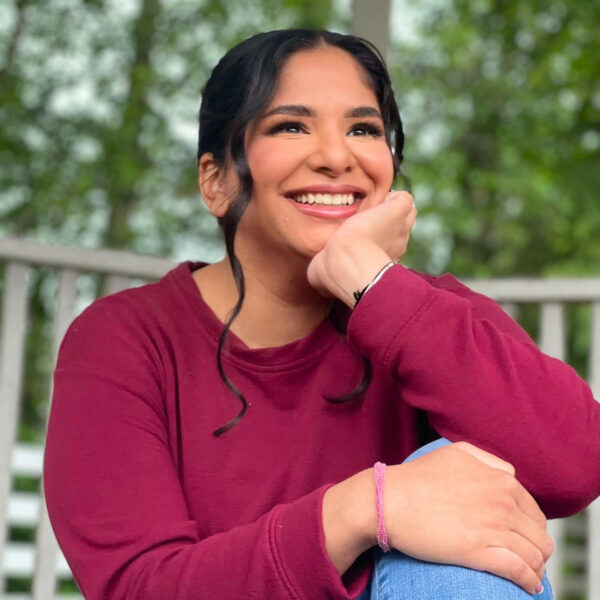
Harkirat Kaur grew up in a family full of medical professionals, including a sister who is now a psychologist.
When her best friend died by suicide in middle school, Kaur was devastated — but she also felt she had the support system to help her process the trauma in a healthy way. As she witnessed her peers grieve the loss, however, she realized that not everyone had a similar experience.
“I was able to get the support I needed, whereas some of my friends weren’t because of the mental health stigma that existed around them,” she said. “When something like this happens, it gets talked about and put in the news, but then it kind of slowly fades away. A lot of the youth out there, even if they want to get help, are faced with a system that is really hard to navigate.”
Kaur is currently a graduate student in the University of Washington Bothell’s Community Health & Social Justice master’s program, where she’s found a place to channel her passion for improving access to health care and addressing systemic gaps in mental health support.
Addressing health inequities
When she first began as an undergraduate at UW Bothell, Kaur planned to follow in her family’s footsteps and enter the medical field. She had a lot of experience providing community-based support through volunteer opportunities, such as raising money for UNICEF to help kids with malnutrition and volunteering in public schools and hospitals. She also worked with kids in an orphanage in Europe, where her family is from, and helped with medical camps that her family organized.
Given her experience working with communities and her passion for public health, her adviser suggested she might be interested in the Health Studies program.
“I found I had a passion for the social sciences and health studies, which taught me about some of the social determinants of health and to think critically about power, representation and the root cause of inequities,” Kaur said. “It made me want to pursue public health and learn about how marginalized voices are shut off and decentered — and how we can bring them to center to help navigate and address these inequities.”
Kaur completed bachelor’s degrees in Society, Ethics & Human Behavior and in Health Studies in 2022 before receiving her master’s degree in Education in 2024. But she didn’t stop there. Wanting to further explore how to tackle systemic health challenges, she decided to enroll in the CHSJ master’s program.
“I chose UW Bothell because of how much one-on-one interaction you get to have with your professors,” she said. “One thing that fascinated me is how much your professors, mentors and advisers really try to understand your goals and ambitions and to help guide you to them. The fact that you can get that kind of support is what’s really kept me here.”
“UW Bothell has given me a language and a framework to really understand that storytelling isn’t just about personal experiences. It’s about methods for shifting narratives at an institutional level.”
Harkirat Kaur, graduate student, Community Health & Social Justice
Sharing lived experiences
Kaur has learned in her CHSJ courses how powerful a tool in public health storytelling can be. She’s witnessed it firsthand by sharing her own lived experiences through her writing.
As part of the curriculum in one of her classes, taught by Dr. Jody Early, professor in the School of Nursing & Health Studies, Kaur wrote a personal essay about losing her friend to suicide. Her article, “Building a Resilient Future: Youth Mental Health and Suicide Prevention,” was published by the National Alliance on Mental Illness. The piece details her experience, but it’s also a call to action advocating for systemic and policy changes to prevent youth suicide.
“I hope it helps whoever reads it — whether it’s a parent or a policymaker or maybe even a youth — to know how to get help but also what they can do and what actions can be taken both as individuals and as part of a larger system,” Kaur said. “UW Bothell has given me a language and a framework to really understand that storytelling isn’t just about personal experiences. It’s about methods for shifting narratives at an institutional level.”
For her capstone project, Kaur is working with King County to build an advisory board for public health messaging. She is engaging directly with the Latinx community and youth to understand their health communications preferences.
While data is helpful in this work, she finds that individual experiences are especially informative. “I come to this work with a deep commitment to equality and lifting community voices,” she said. “Narratives are really important to me because they help fill the gaps and show the lived realities behind the statistics. Paired with narratives, data becomes more compelling, contextual and actionable.
“Stories with data really illustrate how policies show up in real people’s lives and make inequities harder to ignore.”
Working side by side
Kaur will be graduating in June and plans to pursue a career in public health as a community health or program director, where she can lead equitable, community-driven initiatives and foster inclusive public health systems.
“Working side by side with communities is important to me,” she said. “Collaborating with communities is central to my public health philosophy. I’ve learned that effective engagement begins with listening — many communities already hold the insights needed for sustainable solutions.”
Her ultimate goal is to co-design public health systems that amplify community strengths, address structural inequities and elevate local voices in decision-making. “I want to use storytelling as a bridge between the communities and the decision makers and leverage individual voices for collective change.”