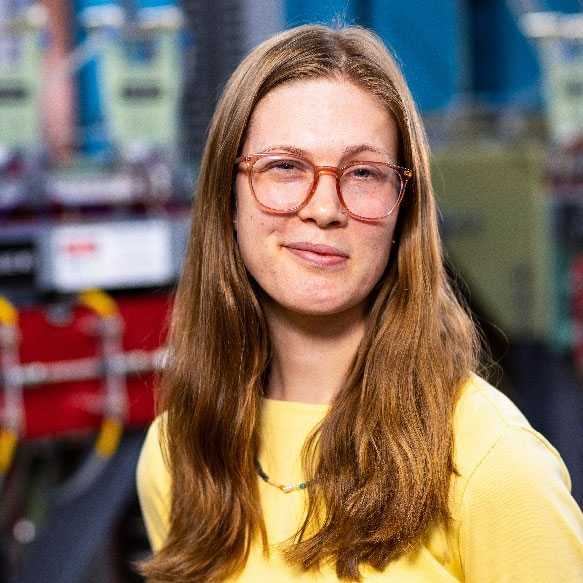
Eirene Fudenna had never been to Washington state until she moved to Seattle just six weeks before starting college. In 2020, near the end of her undergraduate studies, she began experiencing constant nausea and pain. Having spent her formative years overseas in Southeast Asia, she was unsure of how to go about getting care in the U.S. and so put it off.
When worsening symptoms and a little convincing from her friends finally brought her to seek care, the source of her symptoms was at last revealed: a brain tumor.
“It changed the course of my life and my family’s,” she said.
The experience, and the long period of recovery that followed, sparked an interest in public health that soon grew into a passion — one that led her to become a graduate student in the University of Washington Bothell’s Community Health & Social Justice master’s program.
Beyond the medicine
Fudenna underwent her first surgery within 36 hours of receiving her diagnosis.
After nearly two decades overseas, her family moved back to the U.S. to support her through her recovery. She thought a lot during that time about what she wanted to do next. What had first drawn her to Washington was Seattle Pacific University’s Global Development Studies program.
“The program looked at questions around nation-state building and why people get stuck in cycles of poverty,” Fudenna said. “I knew that I wanted to work with people and that there’s a big need to support communities all over the world in a variety of ways, so that’s really been my driver.”
She wanted to weave her newfound passion for public health into that same desire to help people, but she knew she didn’t want to go into the medical field. As she researched alternatives, she came across UW Bothell’s CHSJ master’s program.
“I saw that the program actually emphasized working with the community partners that are doing the critical work, and supporting them and the people who are being impacted the most by certain policy decisions,” she said. “The opportunity to work alongside those in need was really attractive to me.”
A channel for personal stories
Fudenna’s first courses focused on the fundamental aspects of public and community health, such as social determinants. Now, she said, she feels she’s really getting to the meat of the program in classes about policy and communication, and about exploring how to advocate for change effectively.
In a health communication course taught by Dr. Jody Early, professor in the School of Nursing & Health Studies, Fudenna learned how to channel her own health story into personal essays and expose the larger context. As part of the course, Early invited the editor of “Narrative Matters” to speak to the class over Zoom. An essay column in the peer-reviewed journal “Health Affairs,” “Narrative Matters” aims to amplify personal stories that carry a policy message and bring new voices into health policy debates.
Early encouraged her students to send their stories to the journal, and Fudenna submitted her essay, “Learning The Limits Of Health Care Sharing Plans.” It was accepted and later published in January 2026.
In the piece, she shares the terrifying discovery of her tumor, and the symptoms and uncertainty around seeking care that preceded it. As she wrote, “Although my diagnosis was frightening, the resulting price tag was, in some ways, even worse.”
“I saw that the program emphasized working with the community partners that are doing the critical work, and supporting them and the people who are being impacted the most by certain policy decisions.”
Eirene Fudenna, graduate student, Community Health & Social Justice
A motivation to share
Because her father’s employer had switched from insurance to a cost-sharing plan, which isn’t subject to the same Affordable Care Act regulations, the brain tumor was considered a preexisting condition. In other words, it wasn’t covered.
Fudenna and her family were left holding the bill — a half-a-million-dollar bill.
“It is clear that health care in the U.S. has to be stripped down to its bones and rebuilt with well-being for all in mind,” she wrote. “And it needs to happen for the next young woman with a brain tumor — preexisting or not — so that she can focus not on financial fear or bureaucratic health care struggles but on treatment and recovery.”
At first, Fudenna was nervous about publicly sharing her story because of how politicized health care issues can become and the potential for attracting online hate. Ultimately, she decided the pros outweighed the cons.
“This thing that happened to me and my family is a big part of why I ended up in this program and why I’m so passionate about reform for the system,” she said. “So if I can’t be authentic about what got me here, I’m kind of shooting myself in the foot for later. In the end, I’m very grateful that I shared my story.”
From vulnerability to trust
Fudenna has been pleased by the response to her article. She’s also been touched by her classmates’ responses, and in turn, has been moved by the stories her peers have shared as well.
“Not everyone has stories exactly like mine, but no one just stumbled into this program,” she said. “We’ve all chosen it for a very specific reason, and more often than not, there are personal stories that tie them to what we’re studying and why we’re studying it.
“I’ve been so grateful to hear their stories, and to receive their trust and their willingness to be vulnerable — in and out of the classroom.”
Fudenna said she wants to use what she’s learned in the program to support South Asian and Indigenous populations. In a study abroad program last summer, she gained experience working in tandem with local nurses in India to create health intervention programs.
“It was amazing to exercise the muscles that I built up in school and be able to see what it looks like on the ground,” she said. “It was a privilege to participate in the trip, and I’m really excited about continuing to create interventions for people who need assistance and care.”