Humans have fought over resources since the dawn of time. From land and water to gas and minerals, natural resources continue to be common drivers in global conflict and commerce.
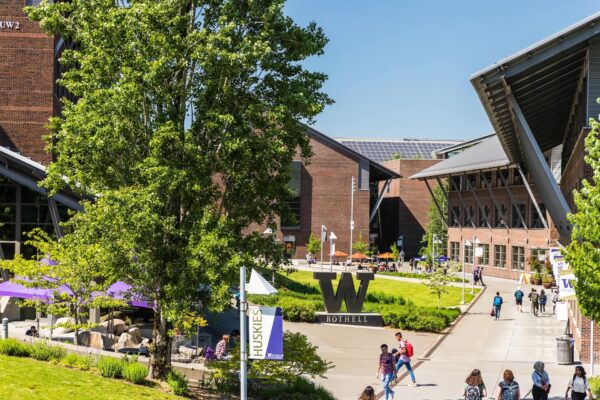
Now, in the era of globalized digital platforms, information and communication technologies such as artificial intelligence and social media have joined the fray, said Dr. Min Tang, associate teaching professor in the University of Washington Bothell’s School of Interdisciplinary Arts & Sciences.
“When the internet and information communication technologies became integral to our society and everyday life,” she said, “they also kind of became these invisible resources for people to fight over.
“It’s become an important issue in global internet governance — and even international relations.”
Digital dissemination of information
Originally from China, Tang completed her undergraduate degree in broadcasting and television journalism. She then spent her early career as a journalist. As the media landscape evolved, she became increasingly interested in how structural issues in the digital industry shape the dissemination of information.
She moved to the U.S. to explore the issue from an academic perspective. Tang completed a master’s degree in global communication from the University of Southern California and a doctorate in communication from the University of Illinois at Urbana-Champaign.
Now, in her role at UW Bothell, she teaches media communication studies and global studies — often through the lens of science, technology and society. Her research as a critical political economy scholar of media and communications focuses on the geopolitics of information.
“I look at how information communication technologies, as sites of capitalist reproduction, power policy negotiation debates and geopolitical rivalries,” Tang said. “I’ve paid a lot of attention to the news between the U.S. and China and taken an interest in the fight over the internet industry that has taken place in recent years.”
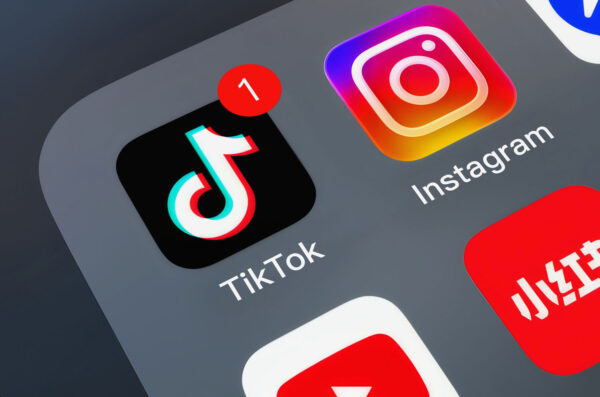
Her recent research paper, “Whose head servant? TikTok’s conundrum between digital capitalism and states,” examines TikTok as the latest chapter in this ongoing struggle.

A heated rivalry across the globe
Tang chronicled the history of TikTok and its U.S. presence, from when the app first entered the scene in 2016 in China and then internationally a year later through the platform gaining popularity in the U.S. in 2018 for its short video content format.
In 2020, it became the most downloaded app in the world — overtaking Meta platforms Facebook and WhatsApp, which had both held the spot in previous years.
And this is when, she noted, the U.S. first took a special interest in TikTok. President Donald Trump signed an executive order in August 2020 to effectively ban the platform. The parent company ByteDance later sued and won a partial preliminary injunction.
The attempt to ban TikTok was purportedly driven by the company’s alleged ties to the Chinese government and national security concerns about data collection, Tang said, she believes there is another layer to the equation.
“Traditionally, we know that the U.S. tech companies are the definite leader globally in this industry,” she said. “To some extent, the U.S.-based social media might feel threatened by the rise of TikTok.”
Throughout the legal and political saga of the attempted and partial bans of TikTok, one question keeps cropping up is: “Is TikTok really a Chinese company?”
The identity crisis of a corporation
ByteDance, one of the highest valued private companies in the world, is based in Beijing, and TikTok CEO Shou Zi Chew said in a U.S. congressional hearing that the company is “global,” with TikTok headquarters in both Los Angeles and Singapore.
Tang’s research found that this distinction made little difference. As she wrote in her paper, “Despite ByteDance’s attempts to downplay Chinese state connections and align with U.S. market and political practices, TikTok’s identity remains contested due to its failure to integrate fully into the U.S. military-digital complex.”
She also revealed that in its efforts to “Americanize,” TikTok has increased its investments in lobbying and public relations over the years, following the “Silicon Valley model” for how U.S. tech companies operate.
Although TikTok spent $1.9 million on lobbying efforts in 2024, Tang noted that this still falls remarkably short of Facebook’s $17 million in 2019. “When it comes to these state-capital interactions,” she said, “TikTok has no power to compete.
“These U.S. tech companies like Meta, Google and Microsoft put a lot of money into lobbying and have really close connections and collaborations with the U.S. government,” Tang said. “When you compare how much TikTok puts into lobbying, it is dwarfed by those companies.
“We always think of our system as a kind of capitalist neoliberal free market, but deep down these companies have a lot of contracts with the Department of Defense and other government agencies.”
“We always think of our system as a kind of capitalist neoliberal free market, but deep down these companies have a lot of contracts with the Department of Defense and other government agencies.”
Dr. Min Tang, associate teaching professor, School of Interdisciplinary Arts & Sciences
The latest but not the last
In late January 2026, ByteDance finalized a deal to hand U.S. operations over to an American investor group — with majority stakeholders including Oracle, Silver Lake and MGX — to avoid a federal ban.
“It’s not the first time the U.S. government has used its state power to challenge companies from other countries for its own political and economic interests,” Tang said. “The U.S.-led tech war on China reflects its longstanding aim to dominate the lucrative and strategic tech sector.
“This TikTok case really highlights and reminds us of the still very important role and the power of the state, in this case the U.S. government, which is a really powerful player in our global digital industry,” she said. “And we’re seeing that growing entanglements between capital and the state are reshaping platform globalization.”