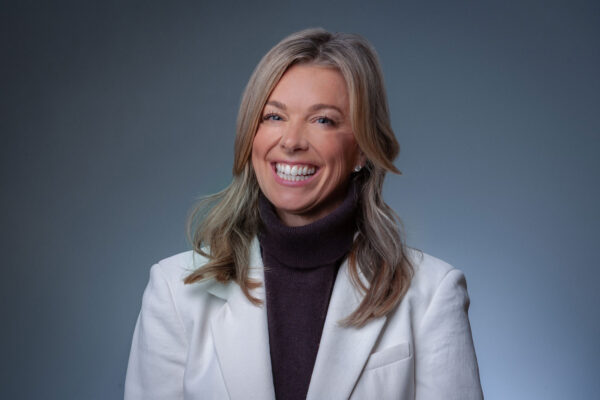
Taking over as director of the Goodlad Institute for Educational Renewal, mathematics professor Dr. Allison Hintz knew she stood on big shoulders.
Her first order of business: return to the work of Dr. John Goodlad, the renowned educational researcher for whom the institute is named.
In doing so, Hintz came to more deeply appreciate — and take fresh inspiration from — his profound influence on the field of education.
“Through many large-scale research projects and influential books, Dr. Goodlad strengthened the democratic purposes of schooling, deepening the understandings of how schools work and how they could improve,” Hintz said. “He created centers for educational research, arguing that scholarship must be connected to real classrooms.”
She stepped into the Goodlad Institute directorship in August 2025, after 15 years as one of its community of scholars. She is only the institute’s third director since its 2008 founding, following in the footsteps of Drs. Carrie Tzou and Tom Bellamy.
Community engaged to inspire change
Hintz is especially keen to continue the momentum of the institute’s many projects advancing justice-centered education.
“We are deepening commitment to community-engaged scholarship,” she said. “Educational renewal requires deep partnership among schools, universities and communities working together. The Goodlad Institute exists to support collaborations that advance community-engaged scholarship through action.”
She is a principal investigator in one such effort, the LEADER Initiative. This multi-year collaboration brings together 14 partners in a shared effort to increase and sustain the racial, ethnic and linguistic representation of the educator workforce. “Children in schools may not see themselves in their teachers,” Hintz said.
While teaching staffs in Washington are primarily white, she added, the student population of K-12 schools is much richer in diversity.
To address this imbalance, the LEADER Initiative includes community partners such as local tribes, area school districts and two professional teacher training programs. Collectively, their reach extends to teachers, community-based organizations in the region — and across the state.
The potential impact of this group’s work also has national implications, Hintz said. “You can make local change, and you can inspire broader change.”
“We are deepening commitment to community-engaged scholarship. Educational renewal requires deep partnership among schools, universities and communities working together.”
Dr. Allison Hintz, professor, School of educational studies
Support for teachers and diverse learners
The LEADER initiative extends around the globe to include teachers from multilingual and immigrant backgrounds.
This summer, Dr. Yue Bian, associate professor in SES and a Goodlad scholar, will embark on a project examining the learn-to-teach journeys of 10 transnational teachers. These teachers gained their credentials in the United States and now teach in K-12 classrooms around the country.
“Transnational teachers must navigate geographical, political, social, cultural, linguistic and ideological boundaries within a new academic and professional context,” said Bian. “This project will examine how they construct and negotiate their professional identities in this process.”
Meanwhile, Goodlad scholar Dr. Maxine Alloway, director of teacher education in SES, is partnering with local elementary schools and school districts to design and facilitate internships for UW Bothell students on the path to becoming teachers.
“Being a part of Dr. Hintz’s Goodlad Scholars professional learning community has helped me connect with school districts through participants’ established partnerships and has offered personal support as I navigate a new professional context,” said Alloway, who joined the SES in September.
Yet other Goodlad scholars are actively finding new ways to meet K-12 students’ diverse needs.
Dr. Sarita Shukla, associate teaching professor in SES, collaborated with her students in her “Teaching and Learning in a Multicultural Society” course to create the Toolkit for Student Success. Aimed at area teachers, administrators and families in the Puget Sound region, this resource evaluates the effectiveness of nonprofit organizations that advocate for young people with intersecting identities.
A focus on students in STEM education
The Goodlad Institute also boasts a robust STEM education team that has a focus on justice-centered learning, too.
One of its projects is led by Dr. Veronica Cassone McGowan, who is a Goodlad scholar and faculty director of the Collaborative for Socio-Ecological Engagement, and Tzou, who remains a principal investigator for the institute. Their project aims to reimagine STEM pre- and in-service teacher preparation.
Along with other faculty colleagues from UW Bothell, they are co-designing two project-based, interdisciplinary science content sequences for K-5 pre-service teachers that center racial justice and gender equity. These offerings serve as science foundation courses for students seeking certification through UW Bothell education pathways.
Hintz herself remains active in grade school classrooms, working alongside local math teachers as both a researcher and an author.
The second edition of her book, “Intentional Talk and Listening: How to Structure and Lead Productive Mathematical Discussions,” was published in December 2025. Co-authored with Dr. Elham Kazemi, professor at the UW’s College of Education in Seattle, it is a natural extension of their research into the ways students and teachers listen to each other and themselves during discussions.
“Our learning about classroom discussions is inspired by community teachers and students,” Hintz said. “Together, we’re creating classroom communities where children are seen, heard and valued as sense-makers.”
An active network of scholars and partners
Hintz and all her institute colleagues are creating an essential bridge between research and hands-on classroom practice — just as John Goodlad envisioned.
In the midst of myriad roles and responsibilities, the Goodlad Institute provides a space for UW Bothell faculty to dream, design and create the work that inspires both them and their community partners.
“I’m excited for the role the institute plays in building a space where people can be curious together, where we can develop our thinking, and where we’re serious about learning with each other in an intellectual community,” said Hintz.
“Continuing to build this community together is exciting for me and for us.”