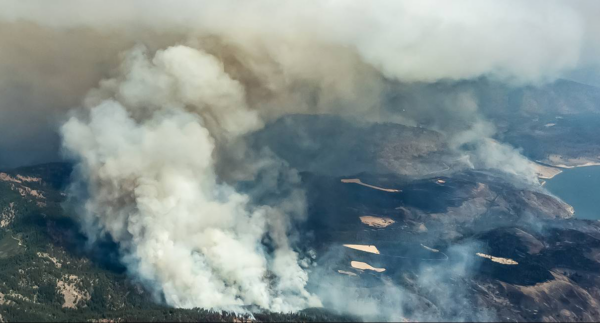
In a warming world, natural disasters are increasing in both frequency and severity, making disaster preparedness more important than ever. During this time of year, those in the Pacific Northwest brace for one hazard in particular: wildfires.
The 2026 summer outlook also includes above average temperatures and below average precipitation, according to the National Oceanic and Atmospheric Administration’s Climate Prediction Center. That, paired with lower-than-normal snowpack this winter — and Washington has all the makings for significant wildland fire potential.
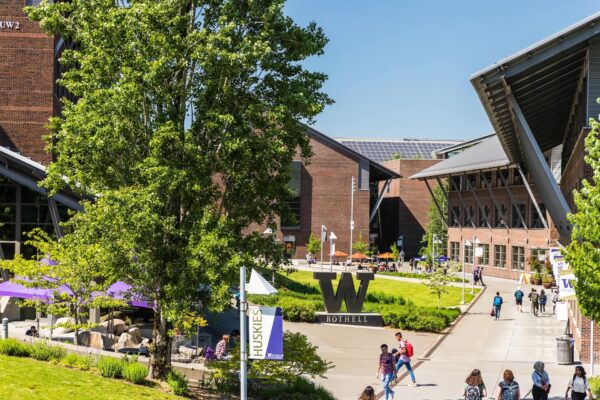
As the season typically picks up in early July, there’s no better time than the present for Washingtonians to do what they can to prepare, said Dr. Dan Jaffe, professor in the University of Washington Bothell’s School of STEM.
Jaffe will share his expertise on the subject in the Science Pub Talk at McMenamins Anderson School in downtown Bothell on June 9.
Air quality research
Jaffe has taught and studied environmental chemistry and air pollution for nearly 30 years. His work has investigated pollutants — from ozone and mercury to aerosols and particulate matter — and their sources, such as fossil fuels and, of course, wildfires.

He expanded his work during the 2018 wildfire season to include indoor air pollution when he discovered that the air quality indoors was often as bad, or even worse, than outside. He became interested in how best to improve and protect air quality at home and in other indoor environments.
“In the last 10 years, the amount of smoke that the Pacific Northwest has received has gone up dramatically,” he said. “In the beginning, we could all say ‘I was caught by surprise. Who knew we could have such horrible smoke?’ But we can’t say that anymore.
“I wish the climate wasn’t changing as fast as it is, but there are greater forces at play here. It’s a global issue, and we can expect it to get worse so it really behooves everyone to think about wildfire preparedness.”
Impacts to health
Much of his research has focused on the environmental impacts of air pollution, but Jaffe has recently begun examining where human health fits into the picture, too. His latest paper looks at both the health and regulatory impacts of particulate matter from wildfires.
With funding support from both NOAA and NASA, Jaffe and his research team used surface observations to identify the smokiest regions in the United States. They then compared that data with emergency department visits to estimate how many daily visits for asthma were due to smoke.
People most often associate wildfires with the Western region of the U.S., but the impacts from smoke are widespread and have the potential to affect all corners of the country. The team found that while rural areas in the West have the highest concentrations of smoke, larger metropolitan areas saw more smoke-related emergency department visits in absolute numbers.
This research emphasizes that everyone can benefit from taking precautions ahead of wildfire season, Jaffe said, adding, “If you wait until we get a bad smoke event, you’ll be out of luck when you try to buy an air filter. So, plan ahead now to prepare for wildfire smoke.”
Home air purification
When it comes to preparedness, Jaffe noted that home air filters are the most important tool — and a more accessible option than one might think.
“In the past several years, we’ve done a lot of research on indoor air and studying how effective different filtration methods are,” he said. “One thing we found is that a decent air filter might cost $200, but you can also make one yourself for $40 that’s almost as good. Cost shouldn’t be a deterrent.”
Jaffe details how to make a low-cost air purifier using a box fan and a MERV 13 filter on his website. Not only is this option cheaper, but it also eliminates the need to choose between staying cool or having clean air on hot summer nights. He noted that unlike other air purifiers, a box fan purifier can sit in the window to help bring in cool, filtered air. Because of the lower cost, it is also possible to have multiple filtration units, which is needed to protect everyone in different rooms in a home. Heat pumps are also a great long-term solution that many people are opting for, he noted.
Being prepared also requires staying informed. For real-time data, Jaffe recommends people visit the AirNow Fire and Smoke Map, developed by the UW, the Environmental Protection Agency and the U.S. Forest Service. And for the latest forecasts on where there will be smoke tomorrow, he advises people visit NOAA’s High-Resolution Rapid Refresh Model.
“Fuel that normally wouldn’t start drying out until mid-summer is already dry now — giving us a two-month head start on our fire season.”
Dr. Dan Jaffe, professor, School of STEM
The need to prepare now
“I can’t promise it’s going to be a good or a bad fire season, but right now the dice are really loaded for a bad season,” Jaffe said. “We’re going into a very strong El Niño and we had a record low snowpack, which means that fuel that normally wouldn’t start drying out until mid-summer is already dry now — giving us a two-month head start on our fire season.
“The time to get prepared for wildfire smoke is now.”
At his pub talk on June 9, titled “Smoke Season and Washington Wildfires,” Jaffe will dive deeper into his recent research and talk about what smoke is, how it affects human health and how people can protect themselves and their homes. Additional information and a link to buy tickets can be found in the UW Bothell events calendar. To learn more about Jaffe’s research and his recommendations for the upcoming wildfire season, visit the Jaffe Group website.