Liliana Flores was always drawn to math and science. Growing up just north of Seattle, she knew while taking a middle school science class with one of her favorite teachers that she might someday want to teach in the field, too.
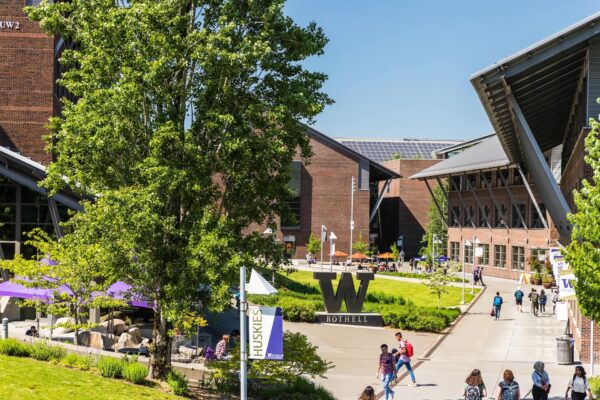
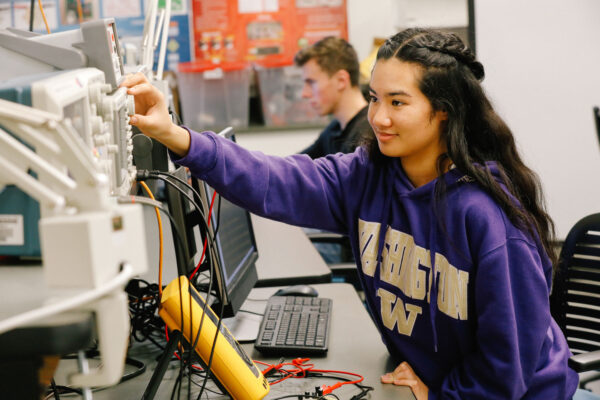
When it came time to apply to colleges, Flores hoped to find a small campus community with opportunities for further STEM exploration, which she did at the University of Washington Bothell. She then planned to major in Mechanical Engineering — that was, until her sophomore year when she got her first taste of astrophysics.
“On a whim, I took an Intro to Astronomy course, and from then on, I was hooked,” she said. “Astrophysics is so broad. Literally, the expanse of the universe is your limit. There’s so much to explore and so many unanswered questions and ways to expand on what we know, and that really excited me.”
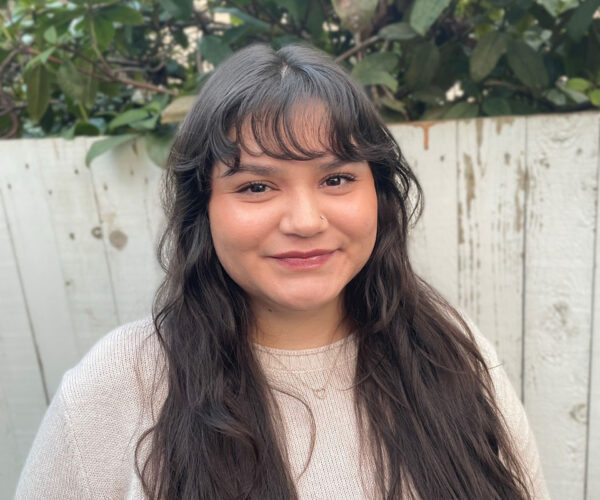
Flores graduated with a bachelor’s in Physics in 2025. Today, she continues to support the research of Dr. Paola Rodríguez Hidalgo, associate professor in the School of STEM, while setting her sights on her own future as an educator in physics.
A shining enthusiasm for astrophysics
Rodríguez Hidalgo first met Flores in the Introduction to Astronomy course she taught in 2023. She admired Flores’ interest both in science and in sharing science knowledge with others. This was especially apparent during Astronomy Day that year, when students presented on various topics to a public audience at a library in the city of Bothell.
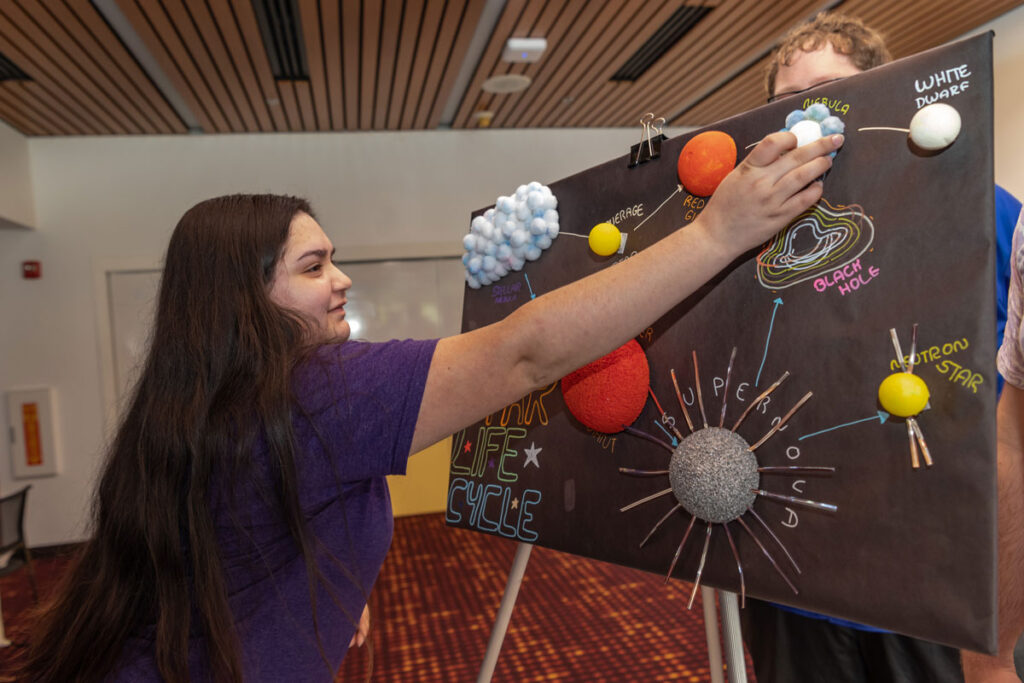
“I noticed Liliana’s spark, her curiosity, every time we discussed a new topic about the universe,” Rodríguez Hidalgo said. “She was outstanding at communicating science to the public at the Bothell library. She was relatable, engaging and able to explain difficult concepts without dumbing them down for the audience.”
Her enthusiasm and her brilliance, Rodríguez Hidalgo added, led her to invite Flores to join her research group at the end of that quarter.
According to Flores, this all made a great impact on her. “Professor Rodríguez Hidalgo’s mentorship was everything to me,” she said. “That first astronomy course I took and the research it led to changed the entire trajectory of my education. What’s great about her mentorship is that she sees what you’re capable of, and she pushes you to attain that.
“I would also say that being able to see someone who looks like me, a Hispanic woman, in science academia flourishing and leading students was really cool for me.”
An out-of-this-world experience
Another thing that makes Rodríguez Hidalgo an invaluable mentor, Flores said, is the way she helps connect students to scholarships, grants and opportunities to learn more outside the classroom.
The most exciting opportunity that Rodríguez Hidalgo encouraged her to go after, she recalled, was the James Webb Space Telescope workshop at the Space Telescope Science Institute, a premier space observatory.
“It was a big deal to me, and I was really excited,” she said. “At first, I definitely had some imposter syndrome. It was a bit intimidating, especially talking to people in various stages of their careers. But after spending time with them in the workshop and in the dorm-style environment, I became more comfortable and was able to build friendships within the program and connect with people from all over the world.”
Over the two-week summer program, Flores learned about the capabilities of the JWST and the background of various transient phenomena, such as supernovae and black hole mergers.
“I was very proud to have been able to go, and it really changed my outlook on what I wanted to do and strengthened my confidence in myself and my abilities,” Flores said. “It was a great experience to learn about all these topics and then come back to the research group and share what I had learned.”
One new skill that proved to be especially valuable was how to write research proposals for using the telescope. After she returned from the summer workshop, Flores and Rodríguez Hidalgo worked on a proposal of their own.
A journey into the unknown
Rodríguez Hidalgo’s research group study quasars, a phenomenon where gas and dust from extremely luminous galactic cores fall into a supermassive black hole, which can sometimes produce winds known as outflows. These extreme and powerful outflows, Rodríguez Hidalgo noted, might be a key missing piece of the puzzle of how galaxies form and evolve.
The JWST proposal she and her team submitted aims to improve understanding of this phenomenon. Flores served as a co-principal investigator on the proposal, using what she learned in the JWST workshop to lead the technical component and to contribute to deciding on their scientific goals.
Submitting a scientific proposal is no small feat, Rodríguez Hidalgo said, and Flores’ workshop experience was crucial to the project.
“Professor Rodríguez Hidalgo’s mentorship was everything to me. That first astronomy course I took and the research it led to changed the entire trajectory of my education.”
Liliana Flores, Physics ’25
In her role now as a research technologist on the team, Flores leverages her student experiences to onboard new undergraduates. Recently, she joined Rodríguez Hidalgo in Edinburgh, Scotland, where they presented their work as part of a collaboration with the Sloan Digital Sky Survey. She is also working on her own first-authorship paper.
“To me, truly, students like Liliana make our work worthwhile,” Rodríguez Hidalgo said. “UW Bothell’s mission to expand access to education for communities across Washington state that might not otherwise have that opportunity is deeply important to me.
“It is personal: I decided to become an astronomer the first time I had access to a research experience as an undergraduate, so I love bringing that experience to other students. And sometimes, such as in the case of Liliana, it helps them find their passion as well.”
When the stars are the limit
While the research team waits to hear back on its proposal, Flores is looking ahead to what lies next for her. She has applied to several post-graduate physics and astronomy programs so she can continue her education in the fall.
Her ultimate goal is still to teach.
“I love learning and teaching and exploring the best ways to learn,” Flores said. “When I tell people I do astrophysics research, I often hear, ‘Oh, I could never do that, that’s so hard.’ But I’ve found that it depends on how you’re learning and how it’s taught to you.
“I want to make physics and astronomy more accessible because I don’t think it’s out of reach for anyone,” she said. “I’m really passionate about being able to break down the idea that it’s too hard. It takes a bit of work to grasp initially, but it is possible — and it’s worth it.”