When Parker Ford graduated from Western Washington University with a bachelor’s degree in computer science in 2021, he struggled to find a job. So he set an ultimatum for himself: If he didn’t find something that year, he would go back to school.
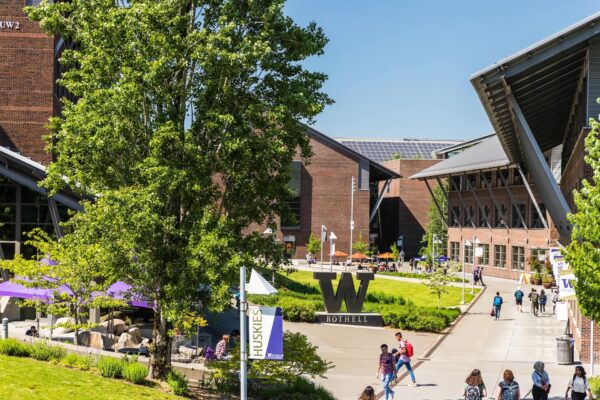
In 2022, he enrolled in the Computer Science & Software Engineering master’s program at the University of Washington Bothell.
“The whole time I had been doing a traditional job-search approach of just sending out a ton of applications online and searching on LinkedIn, with very few opportunities,” Ford said. “It wasn’t until I opened myself up to something different that I saw the biggest return for myself.”
Shortly after completing his graduate studies, Ford accepted a dream position as a software engineer. His path to getting the job, he said, involved a passion for computer graphics, a bit of cloud watching, a trip to Brazil — and a stroke of serendipity.
Technical meets creative
Ford grew up just 15 minutes away from UW Bothell in Maltby, Washington. When researching possible graduate programs to attend, the proximity was definitely a perk. But even more of a draw, he noted, were the computer graphics courses taught by Dr. Kelvin Sung, a professor in the School of STEM.
“My senior year at Western, I had taken a graphics course that ignited a spark in me,” Ford said. “It was the perfect intersection of a creative outlet and the technical side that really interested me. I had that in the back of my mind that this was what I wanted to pursue in the future.
“Seeing that UW Bothell had a professor who specialized in graphics was a huge plus for me.”
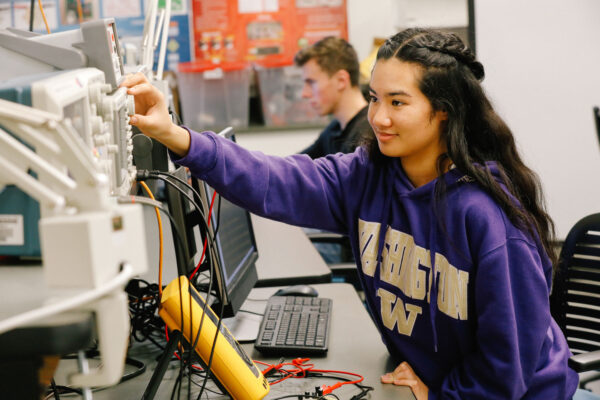
The cherry on top, he added, was the teaching assistantship he was offered. Not only did it cover tuition, but it also helped him improve some of his non-technical skills.
Ford said he enjoyed Sung’s teaching style and his focus on hands-on project work. His enthusiasm for the subject was palpable.
“In my classes, Parker was always seen in the front, participating and just very pleasant in class in general,” Sung said. “He did really well, and in most of the projects he would do extra credit. It was obvious that he has a strong interest in this area.”



Inspiration in the clouds
After completing a course on rendering, Ford asked Sung to be his capstone adviser. The idea of rendering was still fresh in his mind one day while he was cloud watching — and he wondered how he could digitally render realistic clouds.
“The cool thing about having Kelvin as an adviser is that he lets you make it your own,” Ford said. “You get to come up with your own idea and really take the lead. He’s just there to guide you along that path. The idea for cloud rendering really sprouted this rabbit hole that became my thesis presentation.”
For Sung, the idea of cloud rendering was also exciting, as it was something he had never done before either.
“I knew very little about this area so I was very happy that he chose it, and we were actually able to learn together,” he said. “That’s why it’s so much fun working with grad students. Every student who comes in with an interest in a specific topic, for me, it’s a learning opportunity.
“I give them guidance and directions on what they should know to do the work,” he said, “and then they find out the specifics and share that knowledge with me.”
Accurately rendering clouds is both a difficult and important part of creating believable virtual worlds. Clouds present several unique challenges — including the lack of a solid shape, which means you have to define how other objects should interact with it, as well as the complex way the clouds interact with light.
Ford and Sung published the details of their solution to the problem in their paper, “Real-Time Atmospheric Cloud Rendering System,” which they also submitted to present at a conference in Manaus, Brazil.
“The cool thing about having Kelvin as an adviser is that he lets you make it your own. You get to come up with your own idea and really take the lead. He’s just there to guide you along that path.”
Parker Ford, Computer Science & Software Engineering ’24
A skillset in demand
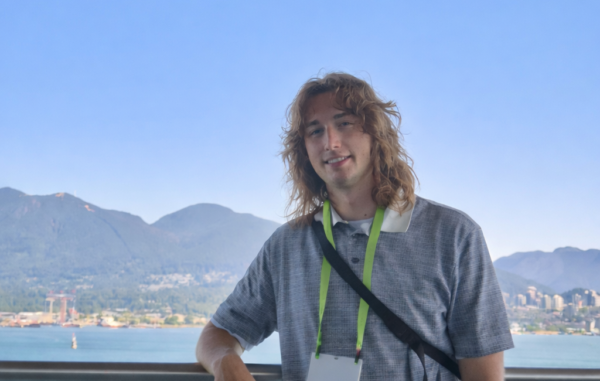
Sung had been reviewing papers for the Brazilian Conference on Graphics, Patterns and Images for more than a decade and always wanted to attend. After the paper on cloud rendering was accepted, Sung realized that unfortunately his dream of going would have to wait, due to a scheduling conflict. He asked Ford if he could go in his place.
“I was excited but also intimidated by the idea of flying across the globe and giving a presentation in a foreign country,” Ford said. “I had a fear of public speaking, but working as a TA and teaching a lab once a week was kind of like exposure therapy.
“By the time I was there, I wasn’t really nervous about giving the presentation at all.”
That talk went well, he said, with questions and interest from the audience. Afterward, two people approached him and introduced themselves as employees at LeapThought, a software company based in Singapore, with offices spanning the globe — including one in Bellevue, Washington. They mentioned that the company was always looking for people with his unique skillset and that they should keep in touch.
A few months later, Ford was interviewing for a job at the company. He now works there as a software engineer. Serving as a generalist, he even does work in graphics.
“It all kind of worked out for me, because it’s exactly what I wanted to do for my first job,” he said.
Open to the possibilities
Sung said he is impressed by Ford’s academic journey, from his struggles to his eventual success finding a job. After he graduated in 2024, Sung invited him to speak to his undergraduate computer graphics class about his experiences.
“I would really like to impart to students that you need to open yourself up to new situations — and that, when you put yourself out there, it seems like the opportunities will find you,” Ford said. “If I had never agreed to publish my thesis and go to Brazil, who knows, I might still be looking for a job.”
Sung also appreciates how down to earth and honest Ford was about his journey. Although the job market can be challenging to navigate, Sung said, students, like Ford, can arm themselves with the knowledge, skills and experience they need to succeed by staying open to the possibilities.