One alumna’s path to a human rights career
When Hannah Ravani, Global Studies ’16, reflects on her work today, she doesn’t start with titles or credentials. She starts with impact.
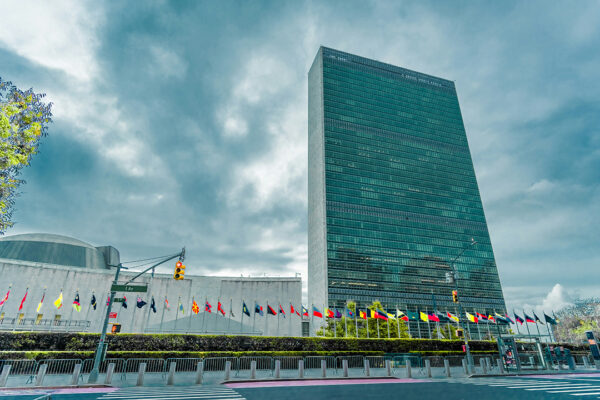
She is a manager of governance and anti-corruption at the United Nations Global Compact, operating at the intersection of business, policy and human rights — and helping companies align with global standards on labor, ethics, the environment and anti-corruption.
But her path there didn’t begin with a clear plan about how she might make a positive difference in the world.
“I always wanted to do something meaningful,” she said, “but I didn’t know what that could look like in practice.”
That clarity came later — and it started at the University of Washington Bothell.
Exploring new ideas
When Ravani arrived at UW Bothell, she was open to possibilities. She explored a range of subjects, paying attention to what held her interest, what stayed with her after classes and what conversations carried into her daily life.
That curiosity led her to political science and global studies courses in the School of Interdisciplinary Arts & Sciences, where she was introduced to the foundations of human rights, migration and global policy.
Just as important were the relationships she built along the way. “At UW Bothell, it was small enough that you could really engage with professors,” Ravani said. “You could develop your interests and get a sense of what work in that space actually looks like.”
Courses with faculty such as Dr. Karam Dana and Dr. Camille Walsh became turning points. Through their teaching and investments of time and advice in their students, Ravani began to see new pathways for her own future.
“Professor Dana was the first person who even mentioned law school to me,” she said. “I hadn’t thought about that on my own. Having someone invested in your learning and your future really opened my worldview.”
Making education possible
Like many UW Bothell students, Ravani approached her education with both ambition and practicality.
She lived at home during her undergraduate years, worked while in school and kept costs manageable. With family support, she graduated from UW Bothell debt-free. Graduate school required taking out loans, but she made the decision to borrow with careful planning, balancing cost with long-term opportunity.
“I thought about it holistically,” Ravani said. “What does this choice cost, and what does it open up for me?”
This combination of support and strategy made it possible for her to pursue opportunities that might otherwise have felt out of reach, including possibilities beyond the campus.
Learning beyond class
Through a study abroad seminar in Greece, Ravani examined the integration of the Roma community while witnessing the early stages of the Syrian refugee crisis. The on-the-ground experience made abstract concepts tangible, offering a firsthand look at the realities of migration and displacement.
“It opened my eyes to the pressures and hardships people face,” she said.
UW Bothell’s Washington, D.C., Human Rights Seminar added another dimension, giving her insight into working with policymakers and advocates toward systems-level change.
Together, she said, these experiences helped her connect her interests with global challenges — and imagine a role for herself finding solutions.
Building her path
After graduating, Ravani continued pursuing a career in policy and law, even as her path ahead remained uncertain.
She studied law at the University of San Diego, viewing legal training as a versatile foundation for advancing justice and human rights. Later, she returned to Washington to complete a Master of Laws focused on sustainable international development at the UW’s School of Law, where she was introduced to the work of the United Nations Global Compact.
Along the way, she sought hands-on experiences by supporting regional and international advocacy efforts, working with survivors of trafficking and contributing to human rights cases. Each step added to her clarity and reinforced her focus on making a systemic impact.
“I tried to think strategically about each decision — what it would cost, what it would add to my experience and how it would move me forward,” she said.
Following through
That mindset shaped one of the biggest decisions in her journey.
While completing her graduate studies, Ravani connected with alumni working at the UN Global Compact and stayed in touch, even when their responses were sporadic and opportunities didn’t immediately materialize.
She eventually secured an internship at the company’s headquarters in New York, one that required a sudden move across the country.
“It was a big leap,” she said. “I didn’t know anyone there, and there was a lot of uncertainty. But I felt like it was worth the investment.”
Her confidence paid off. By demonstrating her commitment and continuing to build relationships, she earned an offer to move from intern to a full-time role.
Creating impact at scale
Today, Ravani focuses on helping businesses play a meaningful role in advancing global goals.
Through the UN Global Compact, she collaborates with companies, policymakers and organizations to develop tools, guidance and partnerships that support ethical business practices. Her efforts center on governance and anti-corruption, areas that are critical to building sustainable, equitable systems.
For Ravani, the most rewarding part is seeing progress, even in complex and uncertain times.
“Companies are still stepping up,” she said. “People across sectors are still working together to move these goals forward.”
That sense of continuity — steady, collective effort — is what keeps her motivated.
Advice for students: start where you are
For students who feel uncertain about their path, Ravani offered a simple perspective — you don’t need to have everything figured out.
Instead, start with curiosity.
Lean into the subjects that interest you. Build relationships with faculty, ask questions and reach out to people whose work you admire.
“People want to help,” she said. “You don’t have to have it all figured out. Sometimes it’s just about trying.”