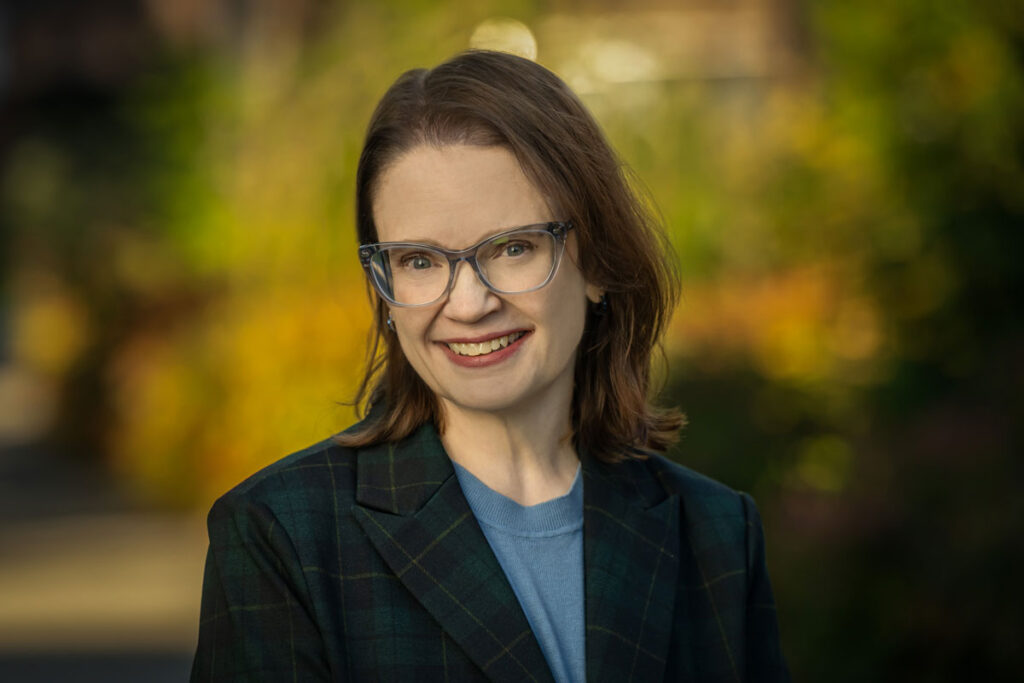
For Dr. Elizabeth Follmer, the word “misfit” took on new meaning while completing her doctorate at the University of Iowa. Her degree was in Business Administration, with an emphasis on Organizational Behavior & Human Resources, and her dissertation centered around the match — or mismatch — between the characteristics of a person compared to an environment.
Her adviser passed on to her some previously collected data on people who identified as not fitting into their organization. In other words, misfits.
Although her adviser had extensively researched person-environment fit, she didn’t fall into the category of misfits herself, Follmer remarked. “I looked at the data and immediately recognized patterns in their efforts to fit in at work, I recognized the experience of being a misfit.”
The topic stayed with her as she began to carve out her own research niche. In 2020, she realized there was another word for misfit: neurodivergent.
“I hadn’t thought about neurodiversity at all, but what I was reading about it started to look really interesting and familiar,” she said. “A light bulb went off and I realized, ‘Misfits researchers and neurodiversity researchers were describing some of the same experiences … We’re totally studying the same thing. We’re just not using the same language.”
The ROI of neuro-inclusion
Now a lecturer at the University of Washington Bothell’s School of Business, Follmer specializes in research about neuro-inclusion in the workplace. She is most interested in studying topics that leaders and organizations care about, such as return on investment.
“Especially in the era where DEI (diversity, equity and inclusion) is not getting the investment that it used to,” she said, “I think research on the ROI of neuro-inclusion is important because at this point leaders are not going to pay attention to any of this unless they can make money off it.”
Luckily, there’s a lot about making workplaces neuro-inclusive that does contribute to the bottom line, she added. “My research makes the evidence available to people in leadership to say, ‘This is worth doing — whether or not you’re doing it for altruistic or DEI-centric reasons.’”
In her latest paper, “Creating inclusive work environments for autistic employees and leaders: The importance of psychological safety,” Follmer collaborated with Dr. Jennifer Spoor, research director in the Olga Tennison Autism Research Centre and an associate professor at La Trobe University in Melbourne, Australia. Together, the pair wrote the paper as a bridge between academic practitioners and industry leaders — focusing on how autism influences psychological safety in leader-follower relationships.
Barriers in work environments
In the paper, Follmer and Spoor give an overview of the landscape of autism in the workplace and some of the barriers that people with autism often face in that setting. One such barrier is the neurotypical norms and expectations in the workplace, particularly the physical sensory environment. As people with autism often struggle with sensory overwhelm — things that a neurotypical person might be unbothered by or able to block out such as bright lights, noise levels and smells — can be completely disabling.
“For that reason, a lot of folks with autism really thrived during lockdown because they had to work from home, which is exactly what they had always needed,” Follmer said. “They no longer had the sensory nightmare of commuting where they were exhausted before the workday even started or having coworkers popping their heads in. They had comfort, environmentally, for the first time.”
She speculates that this also accounts for part of the difficulty in getting people to return to the office, as neurodivergent people make up a not insignificant portion of the population — about one in five people, according to the British Medical Bulletin.
“A lot of these people had the best time of their careers during that time and refused to go back to office for that reason,” Follmer said. “That segment of the population realized how good their work could be if they had what they needed.”
A matter of real need
Follmer said the remedy is not just about providing accommodations but also questioning the assumption that one size fits all and asking employees how they work best.
“It’s important to understand that some people have different needs, and it’s not a matter of being intentionally difficult or entitled,” Follmer said. “It’s a matter of, ‘I can work this way, and I can’t work this way. Please allow me to work.’”
Another barrier Follmer and Spoor cover in their research is the stigma around autism and the harmful stereotypes often reinforced by the media and society. The solution they offer is greater awareness of autism and breadth of autistic experiences through training and education.
This can also help create a space in which individuals with autism no longer feel they have to “mask” or hide their autistic characteristics.
Awareness in the classroom
Follmer has seen the benefits of this in her own classroom. When she introduces herself at the start of each quarter, she shares a little about her research on neurodiversity. There’s a palpable sigh of relief in the room when she does this, she said.
“You can see about 20 percent of the room go, ‘Oh, okay, she’s not going to fight me about accommodations, or if I tell her something about my ADHD she’s going to be cool with it,’” Follmer said. “Talking about that from the beginning makes those folks feel much more comfortable in the room.”
She added that in her own way, she’s also learned to “unmask” in her teaching — noting that her teaching style a decade ago was much more “buttoned up” and formal.
“Now, I tend to approach things in a pretty casual, authentic voice,” she said. “The more authentic my expression becomes, the better it seems to go with students.”
“It’s important to understand that some people have different needs, and it’s not a matter of being intentionally difficult or entitled.”
Dr. Elizabeth Follmer, lecturer, School of Business
A growing population
As Follmer and Spoor wrote, “Our proposed remedies are often simple and inexpensive (and even free in many cases) to implement, but they are likely to have a profound impact on the well-being and productivity of autistic employees and leaders.”
The value of neuro-inclusion far outweighs any cost, Follmer said, especially when looking toward the future: While about 20% of all adults today identify as neurodivergent, a survey from ZenBusiness found that 53% of Generation Z workers identify as “definitely or somewhat” neurodiverse.
“That means, people in industry need to pay attention to this, especially if they have an eye on developing access to talent via early career pipelines” she said.
Critics of this figure may label Gen Z as entitled, Follmer continued, and that assumption will cost them. “The more people who understand this stuff,” she said, “the less human effort across all populations will be wasted simply because people who are the gatekeepers don’t know how to recognize neurodivergent strengths and support this section of the general population.
“And maybe the next generation can help — maybe, they can do work that you never imagined could be done.”