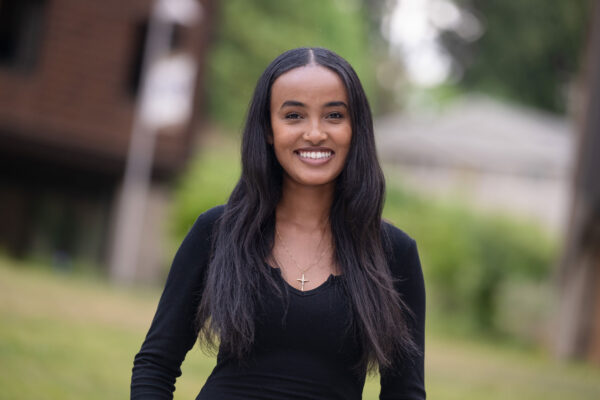
Koket Gebiremichael knows what it’s like to be the new girl in school.
Born in Ethiopia, she came to the U.S. at age six. Her American classmates weren’t always kind, sometimes mocking her mispronunciations of English words.
Because her family was new to the American education system, Gebiremichael navigated the next 15 years with little guidance. Yet she is the first in her family to attend college in the states, and funded her dual degrees at the University of Washington Bothell in Health Studies and in Law, Economics & Public Policy.
Gebiremichael faced challenges on every front during her four years on campus: financial, social and personal. Each time, she turned adversity into opportunities to connect, serve and uplift others.
The legacy of an immigrant family
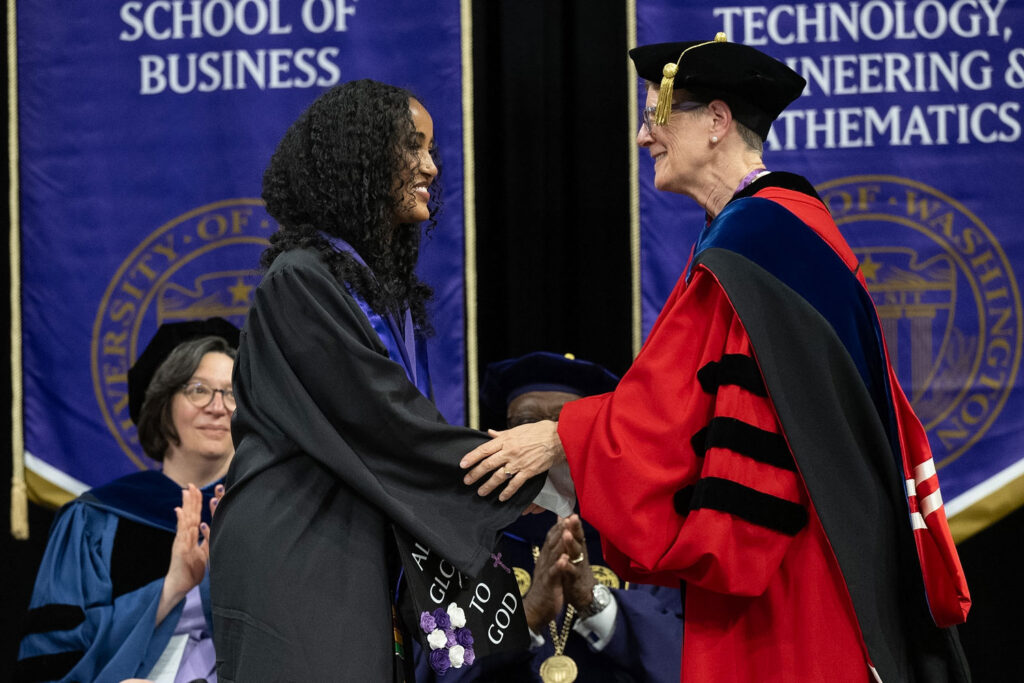
Known for her relationship-building abilities and optimistic attitude, Gebiremichael was presented with the 2026 Chancellor’s Medal at Commencement on June 14. At first, she was inclined to downplay the significance of this accomplishment. Wasn’t she simply doing what needed to be done? Handling the things that were expected of her?
That’s the legacy of an immigrant family, she said.
But then, a realization: “I can take a deep breath. This award shows me that I’ve made an impact, and I hope that impact is something that moves forward with other students.”
In the fall, this Chancellor’s Medalist will continue her studies in nursing.
Creating a space for community
Gebiremichael said she was very shy when she arrived at UW Bothell, unsure of what to expect. But she kept her eyes open. When she noticed an uptick in the number of East African students on campus, a light bulb went off: Probably a lot of her peers were navigating the same issues she faced.
There was no club for this growing demographic, no organized way for students to meet and support each other.
So Gebiremichael decided to take action. With friends Yabsera Legesse and Eskndr Tadesse, she created BunaTalk (CoffeeTalk), a club for the Habesha community.
The kickoff event in January 2025 attracted more than 100 students. Gebiremichael and her fellow organizers were expecting 20 or 30. “It was genuinely so shocking,” she said.
In May 2025, just five months after its inception, the club was recognized for its impact on campus life with the Club Council’s Rising Star Award.
Calling on hard-won skills
While at UW Bothell, Gebiremichael juggled a full courseload, family responsibilities and multiple jobs. She started working at 16, she said, committed to paying for her own college education. Among her many roles: nursing assistant, lab assistant, children’s tutor and residential hall adviser.
It was the latter that called on Gebiremichael’s hard-won skills in navigating unfamiliar situations and creating inclusive spaces. She was hired for the role midway through her sophomore year. By then, the other apartment advisers had worked together for months and had established their own groove.
“It was a hard transition for me,” said Gebiremichael. “Imagine 26 staff members who all know each other, have been hanging out together, and you’re the new one. It was back to being a kid.”
The new job also wreaked temporary havoc with her financial aid, adding unexpected pressure to pay tuition out of pocket.
Rising to the challenge
Katherine Higgins, Horizon Hall resident director who nominated Gebiremichael for the Chancellor’s Medal, admired how she tackled these obstacles. “She had to quickly find her place, build trust and learn expectations all at once,” said Higgins in her nomination letter. “Through this stressful experience, the thing that stood out to me about Koket was her optimistic mindset.
“Faced with what others might describe as impossible, she dug deeper, met with Financial Aid, put in more hours to meet people and build relationships, and left nothing to chance.”
Gebiremichael went on to become a treasured member of the apartment adviser team. “Her natural relationship-building abilities and joyfully optimistic spirit pull others in and somehow make them feel a sense of belonging in the residence halls,” Higgins said.
She also noticed how Gebiremichael was quick to remember details about people and to check in when someone needed extra support.
“Sometimes,” said Gebiremichael, “that’s all you really need — to sit down with someone who can say, ‘I’ve been there, I came through it and so can you.’”
Opening up with confidence
Something else changed for Gebiremichael during her time at UW Bothell. In the early days, she said, she didn’t speak much in class. “I would just take notes and listen.”
When Dr. Stephanie Iverson Cabral, associate teaching professor in the School of Nursing & Health Studies, posed questions in her “Introduction to Epidemiology” class, Gebiremichael’s hand was often half-up, half-down. She hesitated to speak up.
But Iverson Cabral called on her nonetheless.
“She was very encouraging, whether I got the answer right or wrong,” Gebiremichael said. “It opened me up and made me more comfortable. I stopped second-guessing myself.”
“Her natural relationship-building abilities and joyfully optimistic spirit pull others in and somehow make them feel a sense of belonging in the residence halls.”
Katherine Higgins, resident director, Horizon Hall
Expanding your horizons
Gebiremichael encourages others, especially first-generation students like herself, to adopt a similar attitude.
“Take every opportunity you get,” she said. “I was so shy, but I expanded my horizons and tried new things.”
And ever the optimist, she added, “It might work out! No matter what happens, you’re gaining experience.”