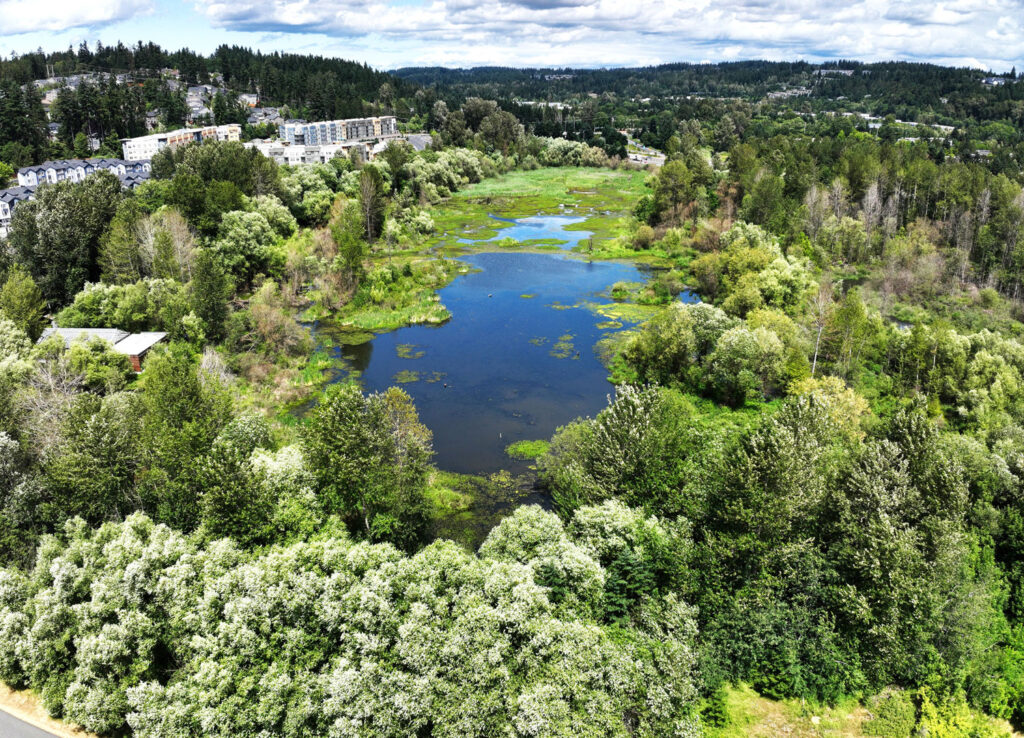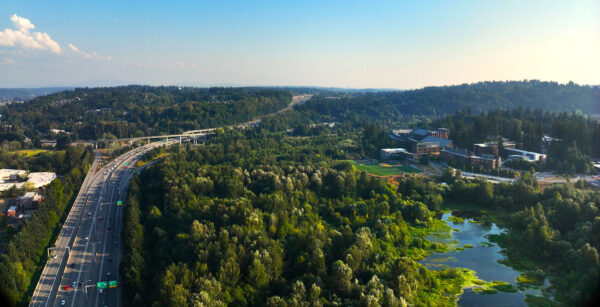
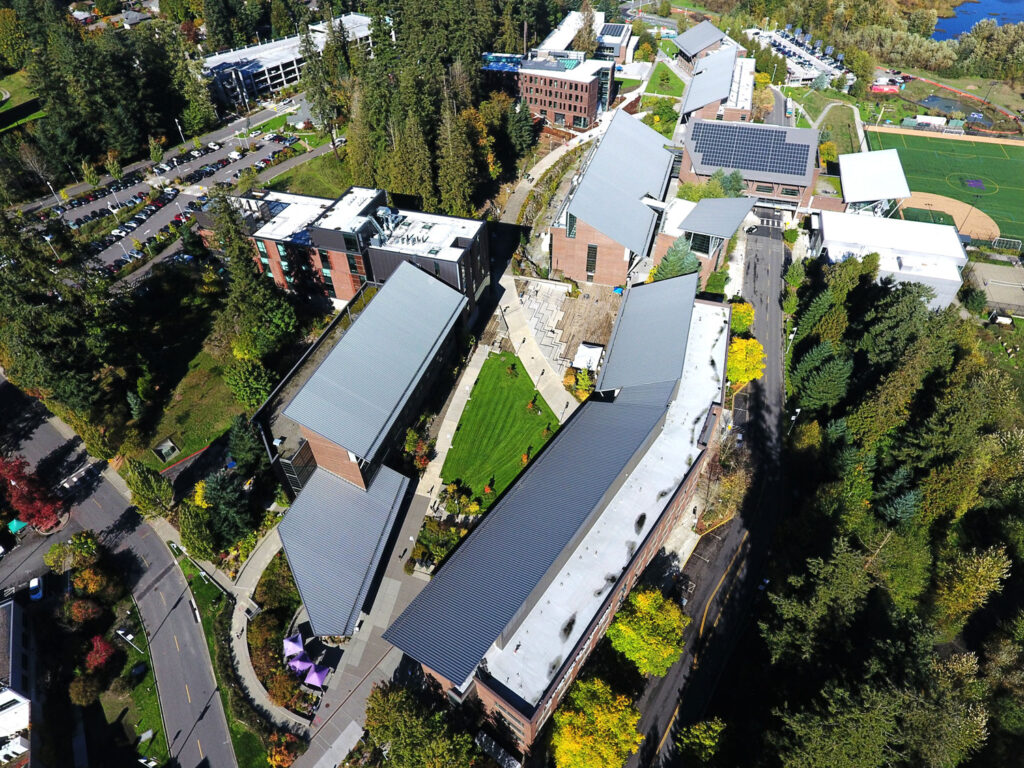
The University of Washington Bothell is home to one of the largest and most complex floodplain restorations in Washington state.
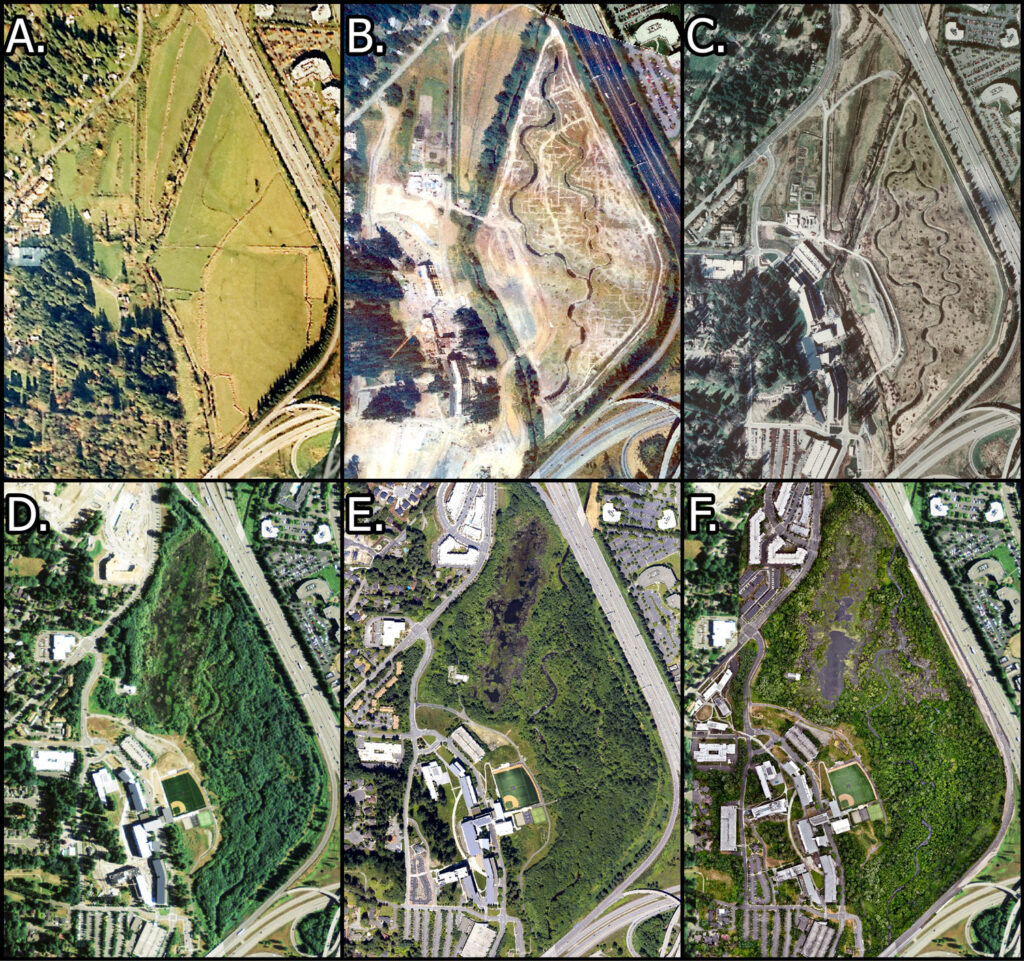
With the arrival of European-American settler farmers in the 1870s, the wetland forest on the land that now houses the campus became degraded by cattle ranching throughout the late 19th and mid-20th centuries. In 1997, when construction on the UW Bothell/Cascadia College campus began, so, too, did restoration to return the area to be a wetland habitat.
Today, the North Creek wetland is again home to a diverse array of native flora and fauna. It also serves as a living laboratory for the study of wetland ecosystems and ecological restoration.
“Faculty, students, staff and administrators take great pride in our campus, and its sustainability story is told often,” said Dr. Santiago Lopez, professor in the School of Interdisciplinary Arts & Sciences. “One feature of that story, however, had not been fully explored: the restored wetland’s role in mitigating the urban heat island effect.”
This past year, Lopez and his co-researchers set out to study this aspect of the wetland and answer some important questions: How much cooling does it provide — and how far does that benefit extend?
An open-air laboratory
Also working on this research was Dr. Jin-Kyu Jung, professor in the School of IAS, and Dr. Bo Ae Chun, professor at the Catholic Kwandong University in Gangneung, South Korea. Through an earlier collaboration, the team had acquired drone-based remote sensing equipment that could measure surface-level thermal radiation.
“We realized the campus could serve as an open-air laboratory for testing how wetlands function as thermal regulators,” Lopez said. “It’s a project that would contribute both to the scientific understanding of urban wetland ecosystems and to the campus community’s appreciation of the landscape it works so hard to restore and protect.”
While much of the literature around urban heat islands focuses on parks, street trees and green roofs, the heat mitigation benefits of restored wetlands is less documented, Lopez said. And in the Pacific Northwest, warming summers and more frequent heat waves due to climate change make urban heat a growing concern.
“If we could demonstrate a measurable cooling effect, the campus restoration would stand not only as an ecological success story but also as evidence that wetland restoration is a viable climate adaptation strategy for urbanizing regions,” he said.
The research team also saw the project as an opportunity to prove the value of drone-based thermal remote sensing as a teaching and research tool, allowing students to gain experience collecting and analyzing fine-resolution thermal imagery in a familiar landscape. Serving in this role on the project was one of Lopez’ former students, Haoye Zhang (Data Visualization ’25).
A natural tool for learning
Zhang had experience working with similar data while interning with the National Supercomputing Center in his home city of Shenzhen, China, where he analyzed the relationship between land use and precipitation. He then returned to Seattle, where he had previously completed an associate degree in Computer Science at North Seattle College, and started studying at UW Bothell.
“It had always been a dream of mine to be a Husky,” he said. “I believe a university should be more than a place to learn, and UW’s commitment to using research, innovation and knowledge to create impact in society stood out as an ideal place for me to follow my dreams.”
He developed a strong interest in remote sensing in Lopez’ classes. Lopez then invited him to join the research project, working on image processing and data analysis.
“I’ve been able to connect the knowledge and the skills I’ve learned and apply them to real-world issues. It makes me feel good to contribute to raising awareness about rising temperatures.”
Haoye Zhang, Data Visualization ’25
“I was drawn to the wetland research project because it was similar to the work I did in China,” Zhang said. “I really like the environmental field and how I’ve been able to connect the knowledge and the skills I’ve learned and apply them to real-world issues. It makes me feel good to contribute to raising awareness about rising temperatures.”
Zhang plans to begin a master’s program in Data Science at the UW in Seattle in fall 2026.
Underestimated means for environmental justice
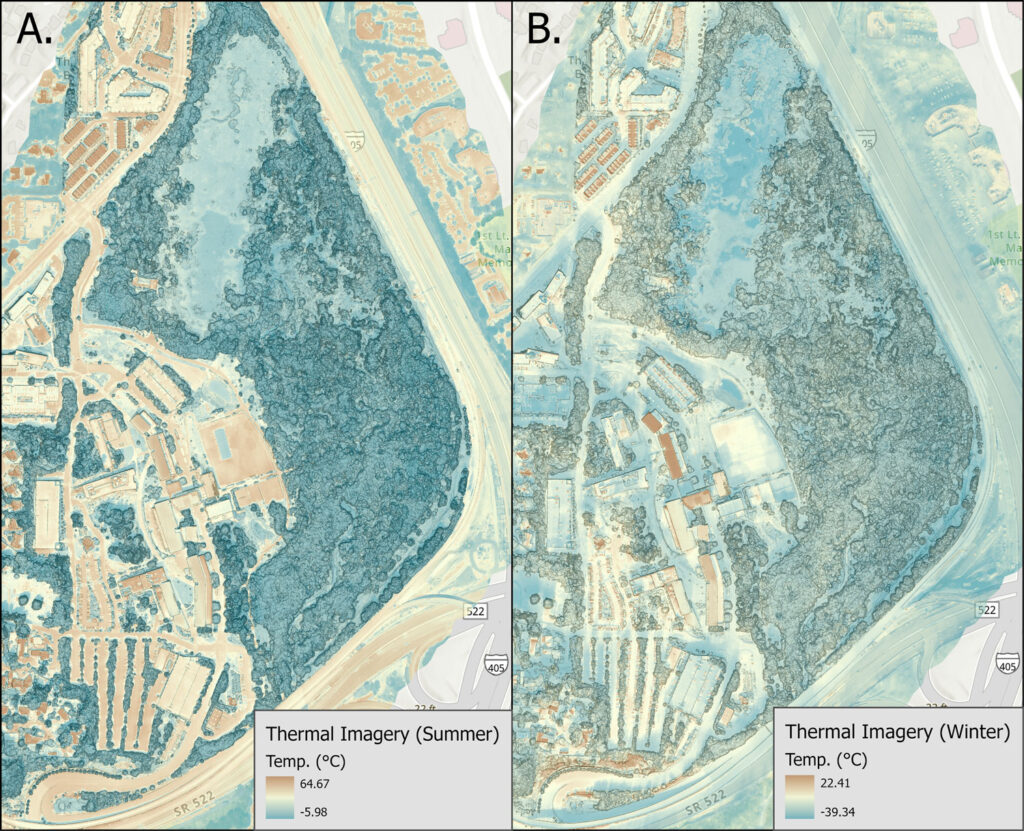
Starting in summer 2025, team members measured the thermal contrast between the wetland environment and the built portions of campus across different seasonal conditions. They also identified the spatial gradient of cooling — or where the wetland’s influence begins and ends, and how it diminishes across distance.
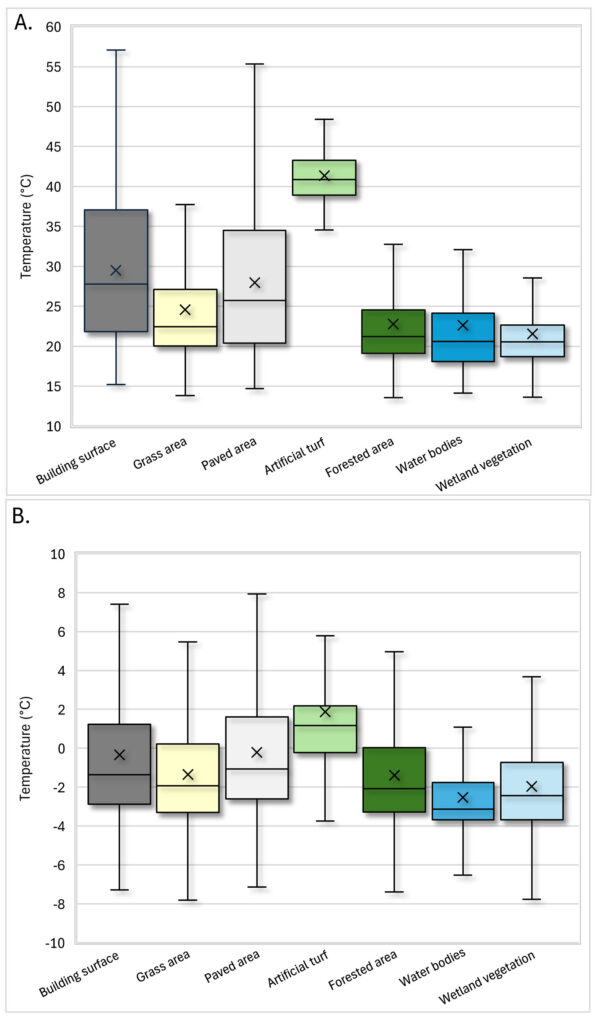
What they found is that wetland restoration is indeed an effective tool in combating the intensified urban heat island effect. Not only did the restored wetland appear to significantly lower land surface temperatures, but the cooling effect was also most pronounced during the warmer daytime conditions when heat mitigation matters most, Lopez said.
Most surprising, he said, was how their detailed, high-resolution thermal data compared with previously used satellite data.
“We had assumptions from working with Landsat thermal data, where a single pixel can swallow an entire section of campus and average away everything interesting,” Lopez said. “At the drone’s higher spatial resolution, patterns emerged that simply are not visible from a satellite’s orbit. It made me reconsider how much of the urban heat island literature may be underestimating the contribution of small green and blue patches — not because those patches don’t cool but because our instruments have not been able to see them.”
The ability to measure these more detailed differences at a neighborhood and community-level scale can also help to reveal areas that are more exposed to climate extremes — making it a valuable tool for informing place-based environmental justice efforts, he added.
“Being able to map that at fine resolution is what turns a general claim about inequity into an actionable, place-specific one.”
Value ‘beyond the habitat’
The team recently published an article on its findings in Urban Climate.
“What readers should take away from this research is that the value of wetlands extends well beyond the habitat and water-quality functions they’re usually credited with,” Lopez said. “A restored wetland is also a piece of climate-adaptation infrastructure.
“In an urbanizing watershed like ours, and in a region facing warmer summers, that thermal-regulation service is not incidental, it is a measurable public good,” he said. “Restoration is a cost-effective strategy for building cooler, more livable cities — one worth protecting, funding and replicating.”
Lopez is continuing to monitor these benefits. This past spring, UW Bothell students in his remote sensing course helped mount a series of sensors across campus to measure air temperature. This campus sensor network will provide denser and more relevant information than anything that was previously available.
“Stay tuned as we learn more about our campus and how its distinctive features can illuminate ongoing environmental change — in the Pacific Northwest and beyond,” Lopez said.