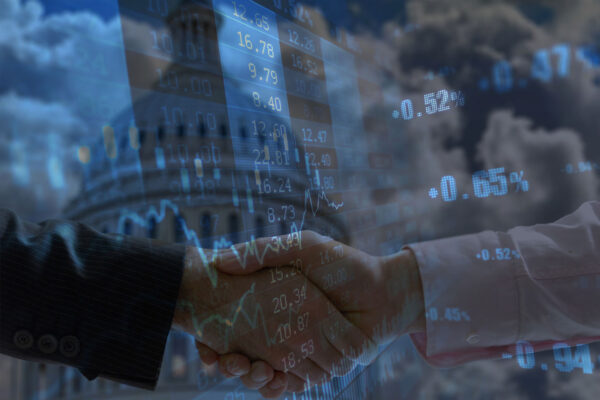
The U.S. Securities and Exchange Commission prosecutes about 50 cases of insider trading on average each year. As many scholars and regulators agree, however, these cases likely represent only a fraction of the illegal insider trading that happens each year.
According to a study from the University of Technology Sydney, the true number of incidents could be at least four times higher.
Illegal insider trading refers to the buying or selling of financial securities, such as stocks or bonds, using information that is not available to the public. Although insiders are required to report their transactions to the SEC, illegal trading is still difficult to catch and even harder to prove.
In her latest research, Dr. Solmaz Batebi, an assistant teaching professor in the University of Washington’s School of Business, looks to artificial intelligence as a potential tool for improving insider trading predictions.
Bridging two languages
Growing up in Iran, Batebi was always interested in money and fascinated by her uncle, who worked in the stock market. She saw him as a role model — a knowledgeable person who everyone trusted. “I wanted to be like him,” she said.
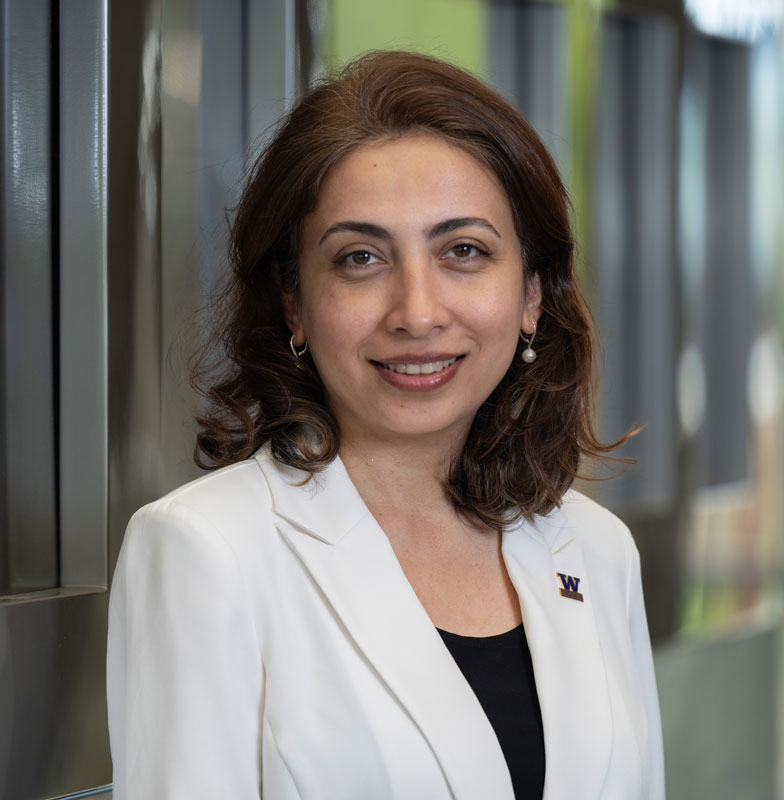
“What I like about finance,” she added, “is that it’s a dynamic world. Everything that happens in the world, you see the market reaction, and you see how people react to the news. You can learn a lot about sociology, psychology, math and more. That’s what I love about it.”
Batebi worked in market surveillance and regulatory development at the Tehran Stock Exchange, where she helped design and implement data-driven compliance tools and updated regulations addressing market manipulation and high-frequency trading. She became interested in algorithms and data science at play in surveilling the market.
At the time, it was uncommon for finance experts to also have computer science knowledge and skills, she said. “The software engineers didn’t have the business acumen, and we didn’t have the coding skills. There wasn’t a common language between us, so I became interested in bridging those two things.”
She began teaching herself coding skills and taking computer science courses. Then, she took her studies abroad to the U.S.
Connecting finance and computer science
Batebi received a doctorate in Business Administration with a concentration in Finance from the University of Texas Rio Grande Valley. Under the mentorship of Dr. Ahmed Elnahas, an associate professor at UTRGV, she continued exploring the intersection of finance and computer science.
She became increasingly interested in how artificial intelligence could be leveraged in the market — particularly for insider trading analysis. Batebi then devoted her dissertation to the topic, and recently published her findings in a paper, “Are machines better predictors of insider trading?”
“When you want to prove that someone has done something illegal, you need to be able to prove their intention,” she said. “Proving that is really hard, and often you don’t know if they saw a gain because they have certain information or because they just know the market well.
“I wanted to know: How can I answer those questions by using AI?”
While her mentor knew little about how AI intersected with finance, Batebi said Elnahas eagerly supported her in investigating the topic. After graduation, she had initially planned to again work in the stock market — but her passion for the research and encouragement from Elnahas inspired her to enter the world of academia.
Analyzing human decision making
Batebi’s research revealed that machine learning methods substantially outperformed traditional methods of predicting both the likelihood and the magnitude of insider sales. Because human decision making is complex, she noted that more linear models often fail to take all the variables into account. AI, for its part, excels at synthesizing and analyzing information and behavior patterns.
The biggest advantage in using AI, though, was speed. “Before AI, investigations on a single trade could take six months to a year to understand the intention,” Batebi said. “With AI, much of that same workload can happen in a couple minutes.”
In analyzing trading behaviors, Batebi also found a significant difference across genders. While male traders acted more based on incentive, female traders appeared to rely more heavily on information.
“Male insiders are more adventurous. They’re risk lovers. Instead of putting trust in the information they use, they are motivated by an incentive for increasing their salary,” she said. “But women are more risk averse. They put their trust in information to make a decision, and they don’t want to act without having enough knowledge. They’re more conservative in that sense.”
As a result of that general difference in behavior, Batebi saw more pronounced predictive gains among female insiders.
“I always tell my students that you need a superpower in the job market.”
Dr. Solmaz Batebi, assistant teaching professor, School of Business
Finding a superpower
In fall 2025, Batebi joined the faculty at UW Bothell, where she now teaches finance. She brings her computer science expertise into the classroom as well to help students develop analytical and technical skills relevant to both academia and industry — bridging theory with real-world financial applications.
“I always tell my students that you need a superpower in the job market,” she said. “Just getting a certificate or a degree is not enough. Having something beyond this, like coding and computer science skills, is a real plus, and it can be a superpower for you.”
Batebi also welcomes students into her research and said she is eager to help them on the journey to publishing their own work. Her next research paper will examine how AI can be applied in investment banking and wealth management.